5 Paint Sprayers That Cut Painting Job Time in Half
Graco’s Magnum X5 suits whole rooms and exteriors with its airless piston pump. Wagner’s FLEXiO 590 handles furniture and walls with two swappable nozzles, and the HomeRight Super Finish Max covers cabinets and small projects at low cost.
Graco’s Magnum X5 finishes whole rooms and exteriors fastest among these seven sprayers. Wagner’s FLEXiO 590 splits the difference for furniture and walls with two interchangeable nozzles. HomeRight’s Super Finish Max delivers a smooth cabinet finish at the lowest price here.
Airless, HVLP and handheld units solve genuinely different problems, and picking the wrong type means either endless masking or a job stretching across a whole weekend. Published coverage rates, nozzle systems, supported coatings and cleanup requirements all vary sharply between types. Owner reports about overspray and real-world thinning needs filled in the gaps that spec sheets leave out.
How to pick the right one
Airless, HVLP or Handheld: How Do You Choose? Airless sprayers force paint through a small tip at high pressure, covering huge areas fast and handling thick, unthinned latex at the cost of significant overspray. HVLP uses a high volume of low-pressure air to atomize paint gently, giving a finer finish with far less mist, which is why it dominates cabinet work. Handheld units combine pump and gun in one body for convenience on small jobs. Match the type to the job instead of buying the most powerful option available.
Do You Need to Thin Paint Before Spraying? Most HVLP sprayers need latex paint thinned and strained, and skipping either step causes spitting, orange peel and clogged nozzles. Airless units generally spray unthinned paint but still need the right tip size, with wider fan tips for walls and smaller tips for trim and cabinets. Straining through a mesh filter matters even when thinning is not needed, since one dried lump ruins a panel.
How Do You Mask and Ventilate Safely for Spraying? Spraying puts atomized paint into the air, so plan on masking every surface you don’t want coated, including floors, fixtures and anything downwind outdoors. A properly rated respirator beats a dust mask, and eye protection plus ventilation round out the setup. Airless sprayers run at pressures high enough to inject paint under skin, so never point the gun at anyone and always engage the trigger lock before servicing the tip.
How Long Does Cleaning a Paint Sprayer Take? The sprayer that gets used again is the one you’re willing to clean. Handheld HVLP units clean up in minutes with water for latex paint. Airless sprayers need the hose, pump and tip flushed through, which takes longer and uses more water or solvent. Never let paint sit inside a sprayer overnight, since dried material in the pump kills these tools faster than anything else.
The shortlist, ranked

Graco Magnum X5 Airless Paint Sprayer
A suction tube pulls paint straight from the can, skipping the cup refills that slow down other sprayer types. Most latex paint needs no thinning before spraying through this unit. Heavy overspray follows from the airless pump, so masking becomes mandatory rather than optional.
Pros
- Sprays unthinned latex straight from the can
- Covers large areas far faster than cup sprayers
- Reversible tip clears clogs without disassembly
Cons
- Heavy overspray demands thorough masking
- Cleanup takes longer than a handheld unit

Wagner FLEXiO 590 HVLP Paint Sprayer
Two nozzles ship in the box, one tuned for wide wall coverage and one for fine detail on furniture and trim. Adjustable airflow and material controls dial back overspray for interior work. Big walls go slower with this unit than with an airless sprayer.
Pros
- Two nozzles cover both walls and detail work
- Adjustable settings reduce overspray indoors
- No hose or separate compressor required
Cons
- Cup refills slow down larger jobs
- Thick latex often needs thinning first
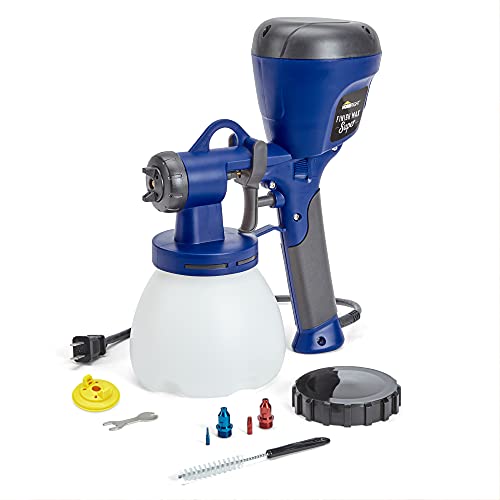
HomeRight Super Finish Max Paint Sprayer
Kitchen cabinets and furniture on a budget get a smooth finish from this small HVLP unit, given correct thinning and technique. Three spray patterns plus adjustable flow give control across edges and flat panels. Whole-house exteriors sit outside its comfort zone.
Pros
- Smooth cabinet finish for a low price
- Three spray patterns suit different surfaces
- Light enough to hold through a long session
Cons
- Thicker paints need thinning and straining first
- Small cup means frequent refills
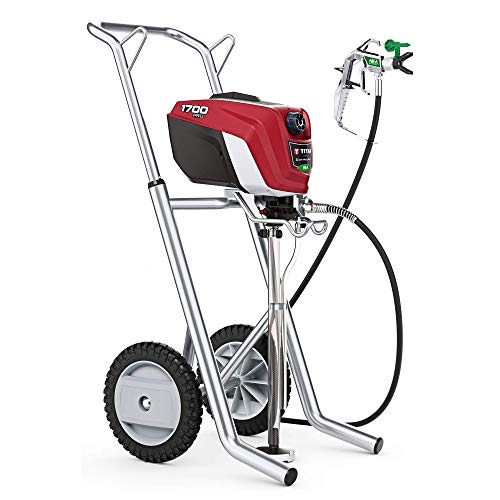
Titan ControlMax 1700 Pro Airless Paint Sprayer
A high-efficiency airless design runs at lower pressure than conventional airless units, cutting overspray while keeping coverage speed. Fences, siding and large exterior jobs benefit most from that combination. Cost sits above a homeowner-grade airless sprayer, aimed at people painting regularly.
Pros
- Noticeably less overspray than standard airless
- Fast coverage across siding and fences
- Long hose reduces repositioning the unit
Cons
- Costs more than homeowner-grade airless sprayers
- Still needs proper masking for detail work

Fuji Spray Semi-PRO 2 HVLP Spray System
A proper metal spray gun, rather than an all-in-one handheld body, gives this turbine HVLP system its edge in atomization and control. Cabinet doors, furniture and fine finishes come out closer to a professional spray shop’s results than any handheld here. Painting walls with it wastes its strengths.
Pros
- Finest atomization of anything in this group
- Metal gun offers fine spray adjustment
- Turbine keeps the weight out of your hand
Cons
- Expensive relative to homeowner sprayers
- Slow and inefficient across large wall areas

Graco TrueCoat 360 DS Handheld Paint Sprayer
Spraying at any angle, including upside down, makes this unit useful for ceilings, furniture undersides and awkward corners. Unthinned paint sprays without the mixing and straining step most handheld HVLP units require. A limited cup capacity keeps it to smaller jobs.
Pros
- Sprays upside down for ceilings and undersides
- Skips thinning for most latex paints
- Quick to grab for small jobs
Cons
- Small cup limits total job size
- More overspray than turbine HVLP units

Wagner Control Pro 130 Power Tank Paint Sprayer
A refillable tank replaces the suction tube, keeping the unit stable and removing the risk of tipping over a paint can. Lower pressure than conventional airless cuts overspray substantially, making it more usable indoors. Pouring and straining paint into the tank adds a step before spraying starts.
Pros
- Much less overspray than standard airless
- Stable tank avoids knocking over a paint can
- Comfortable gun with a flexible hose
Cons
- Paint must be poured and strained into the tank first
- Tank capacity means refills on bigger jobs
Side by side
| # | Model | Technology | Best for | Score | Price |
|---|---|---|---|---|---|
| 1 | Graco Magnum X5 Airless Paint Sprayer | Airless piston pump | Best overall | 9.4 | Check price |
| 2 | Wagner FLEXiO 590 HVLP Paint Sprayer | HVLP turbine, handheld | Best value | 9.2 | Check price |
| 3 | HomeRight Super Finish Max Paint Sprayer | HVLP handheld | Best budget | 9.0 | Check price |
| 4 | Titan ControlMax 1700 Pro Airless Paint Sprayer | High efficiency airless | Best for large exteriors | 8.8 | Check price |
| 5 | Fuji Spray Semi-PRO 2 HVLP Spray System | Turbine HVLP with separate gun | Best finish quality | 8.6 | Check price |
| 6 | Graco TrueCoat 360 DS Handheld Paint Sprayer | Handheld airless | Best handheld | 8.3 | Check price |
| 7 | Wagner Control Pro 130 Power Tank Paint Sprayer | High efficiency airless | Best for reduced overspray | 8.0 | Check price |
Good to know
Do I need to thin paint for a sprayer?
It depends on the type. Most airless sprayers handle unthinned latex straight from the can. Most handheld and turbine HVLP units need latex thinned and always strained, so check the manual before starting.
Which sprayer is best for kitchen cabinets?
A turbine HVLP system gives the finest atomization and smoothest result, with the Fuji Semi-PRO 2 at the top end and the HomeRight Super Finish Max as the budget route. Airless sprayers can do cabinets too, but need careful tip selection.
How much overspray should I expect from a paint sprayer?
Standard airless produces the most overspray, high-efficiency airless considerably less, and turbine HVLP the least. Mask floors, fixtures and adjacent surfaces regardless of type, since fine mist travels further indoors than expected.
Can you spray paint indoors safely?
Yes, with proper masking, ventilation and a rated respirator. HVLP and high-efficiency airless units suit indoor work better because of reduced mist. Cover light fittings and door hardware before starting.
Is a paint sprayer actually faster than a roller?
For large open areas, fences and exteriors, yes, substantially. For a single furnished room, masking time often cancels the speed advantage. Sprayers win clearly on repetitive detailed items like cabinet doors and railings.
How long does cleaning a paint sprayer take?
Handheld HVLP units take roughly ten to fifteen minutes with water for latex paint. Airless sprayers with a hose take twenty to thirty minutes, including flushing the pump and cleaning filters.
What tip size should I use on a paint sprayer?
Wider fan tips suit walls and ceilings, narrower ones suit trim and cabinets, and orifice size should match coating thickness. Check the manufacturer’s chart for your specific paint rather than guessing.
Can a paint sprayer handle stain and sealer as well as paint?
Most sprayers handle thin coatings like stains, sealers and lacquers well, often better than thick latex. Confirm the unit is rated for the coating, since some models are water-based only.
Airless vs HVLP, which sprayer is better for a first-time user?
HVLP units like the Wagner FLEXiO give more control and less overspray, making them easier to learn indoors. Airless units like the Graco Magnum X5 suit large exterior jobs where speed matters more than fine control.
How much paint does a sprayer waste compared to a roller?
Overspray from a sprayer wastes more paint than a roller, especially with standard airless units outdoors in wind. High-efficiency airless and HVLP designs cut that waste significantly through lower pressure and finer atomization.
Our pick
Graco’s Magnum X5 suits rooms, fences and exteriors where speed matters and masking is straightforward. Wagner’s FLEXiO 590 gives more control and far less mist for furniture, trim and mixed work around a furnished house. HomeRight’s Super Finish Max remains the affordable route to a genuinely smooth cabinet finish.
Jake Monroe
Jake worked as a residential contractor for over a decade before shifting to full-time writing. He evaluates power tools, hand tools and workshop gear through the lens of someone who has actually used them on job sites, not just read the box.