How to Choose Network Attached Storage for Home or Office
Synology DiskStation DS224+ is the best overall NAS for home and small office use, pairing mature DSM software with hardware transcoding. QNAP TS-464 suits media heavy libraries thanks to faster networking. Asustor Drivestor 4 Pro AS3304T is the value pick for four bays on a smaller outlay.
Backups, photos and Plex without a steep learning curve point straight to the Synology DiskStation DS224+. The QNAP TS-464 handles heavier media work, and the Asustor Drivestor 4 Pro AS3304T adds a fourth bay without stretching the budget.
Spec sheets hide the details that matter day to day: whether the processor can transcode, how far the RAM expands, and whether the apps you rely on are even supported. We compared published specifications, drive compatibility lists and long term owner reports on noise, heat and rebuild times to rank these seven.
The best picks, ranked

Synology DiskStation DS224+
A two bay chassis pairs with an Intel Celeron processor that handles hardware transcoding and container workloads. Owners report DSM remains the most approachable NAS operating system, with straightforward backup, photo and surveillance apps. Memory can be expanded, keeping it useful as a household adds users.
Pros
- DSM is the easiest software to learn for first time owners
- Hardware transcoding handles most home media libraries
- Two Ethernet ports allow link aggregation or failover
Cons
- Only two bays, so growth means replacing drives
- No 2.5 Gigabit networking at this tier
QNAP TS-464
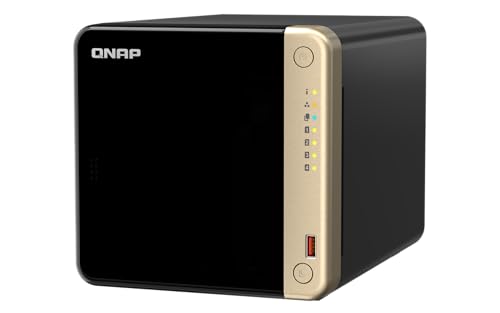
Four bays, dual 2.5 Gigabit ports and two M.2 slots for caching make this the more future proof pick for large video collections. Its Celeron N5105 supports hardware accelerated transcoding, and a PCIe slot leaves room for faster networking later. Owners note the QTS interface has a steeper learning curve than DSM.
Pros
- Dual 2.5 Gigabit ports move large files quickly
- Two M.2 slots allow SSD caching or storage tiers
- PCIe slot leaves room for future upgrades
Cons
- QTS interface feels busier than Synology DSM
- Fan noise is more noticeable in a quiet room

Asustor Drivestor 4 Pro AS3304T
Four bays and 2.5 Gigabit networking arrive at a tier where rivals often ship only two bays. The Realtek quad core processor handles file serving, backups and light container work well, though it is weaker for transcoding. Owners describe ADM as clean and quick to set up.
Pros
- Four bays and 2.5 Gigabit at an accessible tier
- ADM software is simple and responsive
- Compact chassis fits easily on a shelf
Cons
- ARM processor limits transcoding and heavy apps
- Memory is not user upgradeable

Synology DiskStation DS923+
Four bays, ECC memory support and an optional expansion unit target anyone who expects storage needs to keep climbing. Two M.2 slots serve as cache or a separate storage pool, and a 10 Gigabit upgrade card is available. Based on specifications it is aimed at small offices rather than casual media use.
Pros
- ECC memory support suits business style workloads
- Expansion unit adds bays without replacing the NAS
- Optional 10 Gigabit card for fast local transfers
Cons
- No integrated graphics, so transcoding is limited
- Drive compatibility rules are stricter than rivals

TerraMaster F4-424
An Intel N95 processor, dual 2.5 Gigabit ports and two M.2 slots are generous for this class. TOS 6 has improved considerably, and many owners still install a third party operating system to unlock more. Build quality is solid, though the fan runs harder than premium rivals under load.
Pros
- Strong processor and memory for the money
- Dual 2.5 Gigabit ports come as standard
- Two M.2 slots for cache or fast storage
Cons
- TOS app ecosystem trails Synology and QNAP
- Fan noise rises noticeably during rebuilds

WD My Cloud EX2 Ultra
This unit targets households that want mirrored backups and remote file access without much configuration. Setup is guided, and the mobile app covers photo and document sync well. Containers, virtual machines and heavy media transcoding sit outside its scope.
Pros
- One of the quickest setups for a first NAS
- Mobile app handles photo backup reliably
- Sold populated or as an empty enclosure
Cons
- Limited app catalogue compared with rivals
- Processor struggles beyond basic file serving

Synology DiskStation DS124
A single bay chassis brings DSM features without committing to a multi drive array. It suits a laptop backup destination or a small photo library, and it runs quietly on a desk. A single drive gives no redundancy, so a second backup copy is essential.
Pros
- Full DSM experience in a very small chassis
- Quiet enough for a bedroom or shared office
- Low power draw for always on use
Cons
- No drive redundancy with a single bay
- Not suitable for transcoding video
How to choose
How many drive bays does a home setup need Two bays mirrored give redundancy against one drive failing, which covers most households. Four bays allow a parity array where usable capacity grows without buying an entirely new unit later. Owners with several terabytes of photos and video often find four bays costs less over five years than replacing a two bay unit halfway through.
Which processor matches the jobs you plan to run File serving and backups run happily on an ARM chip. Transcoding video for Plex, running Docker containers or hosting a virtual machine needs an Intel or AMD processor, ideally with integrated graphics. Owners frequently say this single decision is what they would change about their first NAS purchase.
How network speed and memory headroom affect daily use Gigabit Ethernet caps transfers at roughly 110 megabytes per second, fine for streaming but slow for moving large project folders. A 2.5 Gigabit port removes that bottleneck if the router or switch supports it. Expandable memory matters too, since photo indexing and containers consume far more RAM than the base configuration provides.
Why a NAS is not a backup on its own RAID protects against a drive failing, not against deletion, ransomware or a flood. Every unit here supports scheduled copies to an external drive or cloud service, and setting that up on day one is the single most useful step available. Owners who have recovered from a failure almost always credit that second copy rather than the array itself.
Compared at a glance
| # | Model | Drive bays | Best for | Score | Price |
|---|---|---|---|---|---|
| 1 | Synology DiskStation DS224+ | 2 x 3.5 inch SATA | Best overall | 9.4 | Check price |
| 2 | QNAP TS-464 | 4 x 3.5 inch SATA | Best for media libraries | 9.2 | Check price |
| 3 | Asustor Drivestor 4 Pro AS3304T | 4 x 3.5 inch SATA | Best value | 9.0 | Check price |
| 4 | Synology DiskStation DS923+ | 4 x 3.5 inch SATA | Best for growing setups | 8.8 | Check price |
| 5 | TerraMaster F4-424 | 4 x 3.5 inch SATA | Best for four bays on a budget | 8.6 | Check price |
| 6 | WD My Cloud EX2 Ultra | 2 x 3.5 inch SATA | Best for simple backups | 8.3 | Check price |
| 7 | Synology DiskStation DS124 | 1 x 3.5 inch SATA | Best single bay starter | 8.0 | Check price |
Frequently asked questions
How many drive bays do I need for a home NAS?
Two bays cover most households once mirrored for redundancy. Large video libraries or several users call for four bays, which give room to grow and better usable capacity with parity.
Do NAS units come with hard drives included?
Most ship as empty enclosures, so drives are bought separately. A few models are offered pre populated. Check the listing carefully, since enclosure and populated versions often share very similar names.
Which drives should go in a NAS?
Use drives rated for continuous operation and vibration in multi bay chassis, such as NAS specific lines from major manufacturers. Desktop drives can work but generally carry shorter warranties and lack firmware features arrays rely on.
Can a NAS run Plex smoothly?
Direct play works on almost any unit. Transcoding is the demanding part, which needs a processor with integrated graphics such as the Intel chips in the DS224+, TS-464 or F4-424. ARM based units struggle once more than one stream needs converting.
Is RAID the same as a backup?
No. RAID keeps the array running when a drive fails, but it copies deletions and corruption instantly across every disk. A separate copy on an external drive or cloud service is still necessary.
How loud is a NAS in a living space?
The enclosure fan is usually modest, and the drives make most of the noise. Owners report that two bay units are easy to live with in a bedroom, while four bay units under load fit better in a cupboard or office.
How much power does a NAS use?
Small units typically draw somewhere between roughly ten and forty watts depending on drive count and activity, with disk hibernation reducing idle consumption. Four bay models with desktop class processors sit at the higher end of that range.
Can I access my NAS files away from home?
Yes. Every brand here offers a remote access service and mobile apps. Enable two factor authentication, keep the firmware current, and avoid exposing administration ports directly to the internet.
What is the difference between DSM, QTS and ADM?
DSM, QTS and ADM are the operating systems for Synology, QNAP and Asustor respectively. DSM is generally considered the most beginner friendly, QTS packs in more advanced features, and ADM keeps things simple on lower cost hardware.
Is a two bay or four bay NAS better for a small office?
A four bay unit like the QNAP TS-464 or Asustor Drivestor 4 Pro suits a small office better, since parity storage and room to grow matter more there than at home. A two bay unit still works for basic shared storage and backups.
The verdict
For most homes and small offices the Synology DiskStation DS224+ remains the easiest NAS to live with, combining capable hardware with software that does not demand a weekend of study. Choose the QNAP TS-464 when large media libraries and faster networking matter more, or the Asustor Drivestor 4 Pro AS3304T for four bays without the premium price.
Marcus Chen
Marcus covered consumer electronics for enthusiast tech publications for six years before joining ChoiceCrest. He specializes in translating manufacturer spec sheets into plain-language buying advice, with a focus on audio, computing accessories and smart-home gear.
You might also need
Setting Up Dual Monitors for a Home Office Desk

How to Choose a Smart Ceiling Fan for Any Room Size
Robot Vacuum Troubles and How to Fix Them at Home