Mini projectors for movie nights, travel and lit rooms
XGIMI MoGo 3 Pro is the best all-round mini projector, pairing a native 1080p panel with Google TV and hands-free image squaring. Anker Nebula Capsule 3 Laser is the one that travels. Epson EpiqVision Mini EF12 stays watchable with the lights on.
XGIMI MoGo 3 Pro fits most living rooms best, with a native 1920 by 1080 panel, Google TV on board and auto focus plus auto keystone that square the picture in seconds. Brightness still collapses in daylight, which is true of every compact model here. Projecting into a bright room? Jump to the Epson EF12 at 1000 lumens.
Brightness is where compact projectors get misrepresented most, because some brands quote light source lumens rather than ANSI figures measured off the screen. Resolution claims mislead in a second way, since supported input resolution is not panel resolution. We compared ANSI lumen ratings, native panels, light source type, built-in streaming platforms, battery runtime and the throw distance each model needs for a 100 inch image.
What we recommend

XGIMI MoGo 3 Pro Portable Projector
Native 1080p at roughly 450 ISO lumens, a sensible balance for a room with the curtains pulled. Google TV runs on the projector itself, so Netflix, YouTube and Disney Plus need no dongle hanging off the HDMI port. An integrated stand pivots through a wide arc, and auto keystone squares the frame without opening a menu.
Pros
- Streaming apps run natively with no stick needed
- Pivot stand replaces a separate tripod
- Auto setup squares the image in a few seconds
Cons
- No internal battery, so it needs mains power
- 450 lumens is too dim for a daylit room
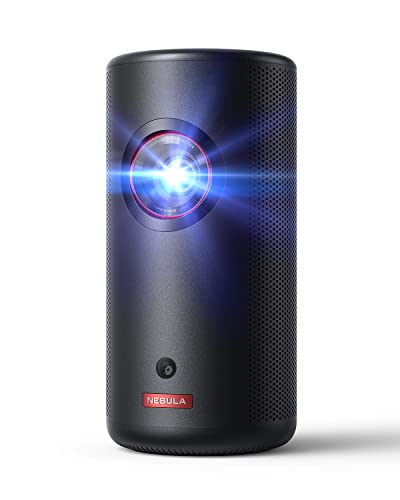
Anker Nebula Capsule 3 Laser
Shaped like a drinks can, yet it throws native 1080p from a laser engine rated near 300 ANSI lumens. Battery covers roughly two and a half hours of video, which clears a feature film in a hotel room. Google TV is licensed on board, so Netflix signs in properly instead of needing a side-loaded APK.
Pros
- Fits a bag pocket and still runs a real 1080p panel
- Laser source never needs a lamp replacement
- Runs off battery in hotels, tents and gardens
Cons
- One small speaker against bar-shaped rivals
- 300 lumens caps usable screen size near 80 inches

Samsung The Freestyle 2nd Gen
Its cradle swivels through close to 180 degrees, so the image lands on a wall, a ceiling or the floor without a stack of books underneath. Tizen brings the Samsung smart TV interface and its full app set. Auto levelling, focus and keystone re-square the picture every time the unit gets moved.
Pros
- Ceiling projection with no mount or improvised stand
- Tizen carries the mainstream streaming apps
- Runs from a compatible USB-C power bank
Cons
- Dimmer than similarly sized rivals
- Fan noise creeps in during quiet scenes

BenQ GS50 Portable Projector
Built for outside: an IPX2 splash-resistant shell and a chassis rated to survive a knee-height drop onto grass. Four speakers including a bass driver give it far more output than battery projectors usually manage, and open air swallows sound fast. Battery runs about two and a half hours at 500 ANSI lumens.
Pros
- Strongest built-in sound of any model here
- Shell handles dew, spills and garden knocks
- Battery runtime covers a full feature film
Cons
- Heavier and bulkier than the Nebula Capsule
- App platform is thinner than Google TV

Epson EpiqVision Mini EF12 Laser Projector
Brightest unit in this group at 1000 lumens, and its 3LCD engine produces equal white and colour brightness, so colours hold up instead of washing grey. Yamaha-tuned stereo speakers sit well above typical compact projector audio. Mains power only, which makes this a movable living room projector rather than a travel one.
Pros
- Copes with ambient light better than any rival here
- Equal white and colour brightness from 3LCD
- Laser engine rated for long life with no lamp swaps
Cons
- No battery, so it stays tethered to an outlet
- Largest and heaviest of the seven

ViewSonic M2e Portable LED Projector
Short throw ratio buys a big picture from a close wall, which solves bedrooms and small flats where nothing can back up ten feet. An LED engine drives the native 1080p panel, paired with Harman Kardon tuned speakers and auto focus. USB-C video input means a laptop or phone connects over one cable.
Pros
- Short throw fills a wall from a few feet away
- One USB-C cable carries video from a laptop
- Auto focus and auto keystone come standard
Cons
- Built-in app platform feels dated and slow
- LED output trails the laser and 3LCD models

AAXA P7 Mini HD Projector
No-frills battery projector that still puts out native 1080p from a body that sits in one hand. Smart apps are absent entirely, so plan on an HDMI streaming stick or a laptop. Battery lasts a little over an hour, enough for a presentation or an episode rather than a long film.
Pros
- Cheapest route to a native 1080p panel here
- Onboard media player reads video from microSD
- Slips into a laptop bag beside the charger
Cons
- No streaming apps of any kind on board
- Dimmest picture of the seven, so a dark room is essential
Before you buy
What to look for in a mini projector Three specs carry almost all the weight, and two of them get quoted dishonestly. ANSI lumens is the only brightness figure measured off the screen, across nine points, so ignore anything labelled light source lumens or LED lumens. Native resolution is the panel itself; a listing that advertises 4K support on a 720p chip is describing what it will accept and downscale. Every projector in this list uses a true 1080p panel. Light source comes third: laser and 3LCD engines hold colour and brightness longer than basic LED, and contrast ratio claims are unregulated enough to ignore.
How much brightness your room needs Match lumens to ambient light and screen size, not to the biggest number on the box. Around 300 ANSI lumens fills an 80 inch screen once a room is genuinely dark, which is the Nebula Capsule 3 territory. At 500, like the BenQ GS50, a dim room with a lamp on stays watchable. Only the Epson EF12 at 1000 lumens handles real ambient light. Pushing any of them to 120 inches spreads the same light over more area, and the picture goes flat. A grey ambient light rejecting screen lifts contrast more cheaply than upgrading the projector.
Best for travel: battery, weight and licensed apps Battery models trade brightness for freedom, and quoted runtimes assume moderate volume plus a reduced brightness mode. Anker Nebula Capsule 3 Laser and BenQ GS50 each clear roughly a feature film. AAXA P7 lands closer to an hour, which suits an episode. Neither XGIMI MoGo 3 Pro nor Epson EF12 carries a battery at all, so both need an outlet or an extension lead. Weight is the quiet dealbreaker, since anything over about three pounds stops feeling like carry-on. Check licensed apps too: Netflix only works natively where the manufacturer has paid for certification, as Anker and XGIMI have.
Placement, throw distance and backyard movie nights Throw ratio sets how far back the projector must sit for a given image width. Standard throw units need roughly eight to ten feet for a 100 inch picture, while the short throw ViewSonic M2e reaches that from far closer. Auto keystone fixes an angled image but crops pixels to do it, so aim square whenever the room allows. Samsung The Freestyle sidesteps the problem with a cradle that points at the ceiling. Outdoors, audio is the weak link, because no walls reflect sound back. BenQ GS50 answers that with four speakers and a splash-resistant shell; every other model here wants a Bluetooth speaker beside the screen.
How they stack up
| # | Model | Resolution | Best for | Score | Price |
|---|---|---|---|---|---|
| 1 | XGIMI MoGo 3 Pro Portable Projector | Native 1920 x 1080 | Best overall | 9.4 | Check price |
| 2 | Anker Nebula Capsule 3 Laser | Native 1920 x 1080 | Best for travel | 9.2 | Check price |
| 3 | Samsung The Freestyle 2nd Gen | Native 1920 x 1080 | Best for flexible placement | 9.0 | Check price |
| 4 | BenQ GS50 Portable Projector | Native 1920 x 1080 | Best for backyard movie nights | 8.8 | Check price |
| 5 | Epson EpiqVision Mini EF12 Laser Projector | Native 1920 x 1080 | Best for rooms with the lights on | 8.6 | Check price |
| 6 | ViewSonic M2e Portable LED Projector | Native 1920 x 1080 | Best value | 8.3 | Check price |
| 7 | AAXA P7 Mini HD Projector | Native 1920 x 1080 | Best budget | 8.0 | Check price |
Good to know
How many lumens does a mini projector need?
Roughly 300 ANSI lumens works at 80 inches in a fully dark room. Between 500 and 1000 covers a dim room or a larger image. Any room with daylight wants 1000 or more, which is why the Epson EF12 leads this group.
Are mini projectors bright enough for daytime use?
Not against an uncovered window, and no compact model here changes that. Drawing curtains or fitting a grey ambient light rejecting screen makes a bigger difference than a lumen upgrade. Evenings remain where these projectors do their best work.
Which mini projector is best for camping and travel?
Anker Nebula Capsule 3 Laser, since it is can-sized, runs about two and a half hours on battery and carries licensed Netflix. BenQ GS50 wins instead when sound and weather resistance outrank size. Both project a native 1080p image.
Do mini projectors have Netflix built in?
Only where the manufacturer has licensed it. Anker Nebula Capsule 3 Laser and XGIMI MoGo 3 Pro run Google TV with proper Netflix sign-in. Models without certification need a streaming stick in the HDMI port.
What screen size can a mini projector produce?
Most quote 100 inches or more, though brightness sets the real ceiling. At 300 ANSI lumens, about 80 inches keeps the picture punchy. Go wider and the same light spreads thinner, leaving washed-out shadows and grey blacks.
LED vs laser mini projector: which is better?
Laser engines, as in the Nebula Capsule 3 and Epson EF12, hold brightness and colour accuracy over thousands of hours and skip lamp changes. LED units cost less and run cooler, but land dimmer. Both outlast traditional bulb projectors by a wide margin.
Can I use a mini projector outside for a movie night?
Yes, once it is properly dark. Battery models remove the extension lead, and the BenQ GS50 adds splash resistance for dew on the grass. Budget for external sound unless the projector has multiple speakers, since open air eats audio.
How far from the wall should a mini projector sit?
Standard throw models want roughly eight to ten feet for a 100 inch image. Short throw designs such as the ViewSonic M2e hit that from a few feet. Measure your room depth against the throw ratio before ordering anything.
Is native 1080p worth it over a 720p mini projector?
Yes, mainly for text and menus, where a 720p panel smears subtitles and spreadsheet rows at 100 inches. Film and TV suffer less, since motion hides softness. Watch the wording carefully, because supported 4K input on a 720p chip is not a 4K projector.
XGIMI MoGo 3 Pro vs Anker Nebula Capsule 3: which should I pick?
Take the MoGo 3 Pro for home use, where the pivot stand, brighter output and mains power suit a fixed spot. Take the Capsule 3 Laser if it lives in a bag, since the battery and can-shaped body travel better. Both run Google TV on a native 1080p panel.
Final word
XGIMI MoGo 3 Pro is the default recommendation, because native 1080p, Google TV and hands-free squaring cover what most people want from a projector they carry between rooms. Rooms that never go properly dark need the Epson EpiqVision Mini EF12 instead, since 1000 lumens of 3LCD light is the only honest answer to ambient light here. Anyone packing a bag for hotels or campsites should take the Anker Nebula Capsule 3 Laser and accept the smaller picture.
Dana Whitfield
Dana spent eight years buying and merchandising for a regional kitchenware retailer before moving into editorial work. She has handled thousands of SKUs across cookware, small appliances and kitchen organization, and focuses on the practical differences that matter once a product is actually in daily use.


