Projector Screens for Dark Rooms, Lounges and Lawns
Silver Ticket STR Series leads for a room you can darken, pairing a tensioned 1.1 gain surface with a velvet-wrapped aluminium frame. Elite Screens Spectrum Electric retracts when the wall has other jobs. For backyard film nights, Elite Screens Yard Master 2 stakes down and stays put.
Silver Ticket STR Series is the pick for a dedicated viewing room: a tensioned matte white surface at 1.1 gain, a 160 degree viewing angle, and black velvet on the frame to swallow overshoot. It claims that wall permanently, which rules it out of a shared living space. Need the wall back after the credits roll? Elite Screens Spectrum Electric gives up very little optically.
Gain, ambient light and aspect ratio all interact with the projector rather than standing alone, which is why screen advice feels contradictory. We compared listed surface specifications, frame construction, mounting requirements and viewing angle. Owner reports about sag, creasing and hot spotting after months on a wall settled the close calls.
Our top picks

Silver Ticket STR Series Fixed Frame Projector Screen
Springs pull the matte white surface taut across an aluminium frame, so geometry and focus hold steady right into the corners. Black velvet wrapping absorbs projector overshoot instead of bouncing it back at the audience. Gain sits at 1.1 with a 160 degree viewing angle, keeping side seats bright, and assembly happens on the floor before the panel hangs on two brackets.
Pros
- Tensioning leaves no waves or ripples at any size
- Velvet border sharpens the image edge
- Handles 4K and active 3D sources without artefacts
Cons
- Occupies the wall permanently
- Assembly needs two people and clear floor space

Elite Screens Spectrum Electric Motorised Projector Screen
A tubular motor lowers the MaxWhite surface on command and rolls it back into a painted steel housing afterwards. Gain of 1.1 and a 180 degree viewing angle suit wide sofa arrangements better than most fixed panels. Three control routes exist: IR remote, wall switch, or a 12 volt trigger that drops the screen the moment the projector powers on.
Pros
- Wall returns to normal use between films
- Trigger input syncs the drop with the projector
- Steel housing hides the roller and fabric completely
Cons
- Needs mains power at the mounting point
- Untensioned surface shows slight waves at first

Elite Screens Manual B Series Pull Down Projector Screen
Slow retract gearing stops the violent snap-back that shortens the life of cheap pull-down screens. Optically it matches the motorised model: MaxWhite B fabric at 1.1 gain with a 180 degree viewing angle. Two screws and a stud are the entire installation, since no outlet is involved, and black backing blocks light bleeding through from behind.
Pros
- Mounts anywhere without wiring or a nearby socket
- Slow retract protects the fabric over years of use
- Black backing keeps rear light off the image
Cons
- Someone has to reach up for every screening
- Fabric takes days to flatten after unboxing

Elite Screens Yard Master 2 Outdoor Projector Screen
Snap-together aluminium poles build a free-standing frame in roughly fifteen minutes, then the surface hooks on under tension. Both faces of the material work, so the projector can sit behind the screen and keep cables away from the audience. Ground stakes and guy ropes come in the box, which decides whether the picture survives a breeze across open lawn.
Pros
- Breaks down into a carry bag between film nights
- Rear projection hides the projector and its shadows
- Staked frame holds steady in light wind
Cons
- Setup realistically takes two people
- Material creases if it gets packed away damp

VIVO 100-Inch Portable Projector Screen with Tripod Stand
An integrated tripod lifts the 100 inch surface to presentation height with no wall involved, which is why classrooms and meeting rooms lean on this format. Height steps through several stops, and the case folds out to become the base. Matte white fabric with black backing keeps slide text legible under office ceiling lights.
Pros
- One person carries and sets it up in a single trip
- No drilling or wall fixings required
- Height adjusts for seated or standing audiences
Cons
- Tripod legs eat floor space in front of the screen
- Fabric shows storage creases along the fold lines
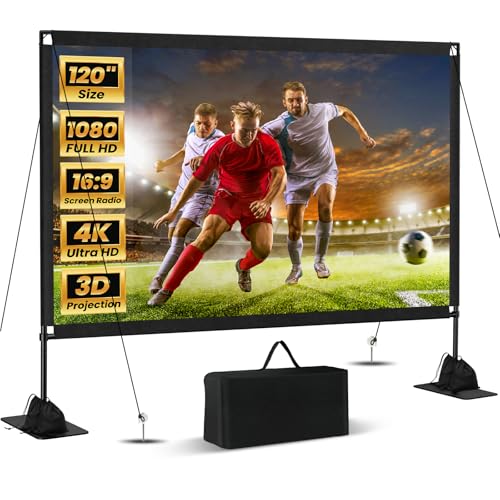
VANKYO StayTrue Projector Screen
Polyester fabric folds down small and shrugs off the hard creasing that ruins plastic sheets. Reinforced grommets run the full border, so it hangs from hooks, rope, a fence or a curtain rail. Owners report it settles flat within a day or two of hanging, which works fine for a screen that only comes out for parties.
Pros
- Lives in a drawer between uses
- Hangs indoors or outdoors from almost any anchor
- Fabric washes clean after a night in the garden
Cons
- Never reaches the flatness of a tensioned frame
- Ripples unless every corner is pulled taut

Mdbebbron 120-Inch Projection Screen
Strip away the frame and housing and this is what remains: a 16:9 polyester sheet with grommets around the edge. At 120 inches diagonal it fills a living room wall or a garden fence for the least outlay of anything here. Plan on steaming or ironing it on low first, because it arrives folded in a small box.
Pros
- Cheapest route to a genuinely large picture
- Works indoors and outdoors with no hardware
- Rolls up small enough for a shelf
Cons
- Creases need steaming before the first screening
- Thin material can show a bright spot from a strong projector
Before you buy
What to look for in a projector screen Gain measures how much light a surface reflects back against a reference white board, and 1.0 to 1.2 covers most rooms. Push higher and the centre brightens while the sweet spot narrows, producing hot spotting across wide seating. Viewing angle tells you how far off-axis a seat can sit before brightness drops, so 160 to 180 degrees handles a normal sofa layout. Match aspect ratio to the projector, which for home cinema means 16:9 almost every time. Check for black backing last, since light passing through thin fabric washes contrast straight out of the image.
Fixed frame vs pull down: which type suits your room Flatness is the whole argument for a fixed frame, and flatness is what holds focus and geometry consistent across a large image. Silver Ticket’s tensioned panel sets the reference here. Permanence is the cost, because that wall belongs to the screen during dinner parties too. Roll-down and motorised screens hand the wall back, trading a stretched surface for a hanging one. Elite Screens Spectrum Electric is the compromise most living rooms should make, and the Manual B does the same job without needing an outlet nearby.
What size projector screen fits your seating distance Diagonal roughly half the seating distance in inches is the usual starting point for films. Sit ten feet back and that lands between 100 and 120 inches, matching the VIVO and Mdbebbron picks. Text-heavy work like spreadsheets or slides wants a smaller image or a closer row. Measure throw distance before size, since every projector has a range where it can fill a given width in focus. Ceiling height also caps you in practice, because the bottom edge should sit above seated head level.
Ambient light, outdoor nights and occasional setups Matte white assumes you control the light, which most living rooms cannot during the day. Lamps behind the seating strip contrast faster than sunlight through a curtain does. Grey and ambient light rejecting surfaces target this, though they narrow viewing angles down to about one row. Paint the wall behind the screen a dark matte shade before spending on a specialist surface, since a pale wall reflects more light back than people expect. Outdoors, wind decides everything: a staked frame like Yard Master 2 holds where hanging fabric flaps, and anyone screening two films a year should just hang a VANKYO StayTrue and put it away.
The lineup, side by side
| # | Model | Type | Best for | Score | Price |
|---|---|---|---|---|---|
| 1 | Silver Ticket STR Series Fixed Frame Projector Screen | Fixed frame | Best overall | 9.4 | Check price |
| 2 | Elite Screens Spectrum Electric Motorised Projector Screen | Motorised roll-down | Best motorised | 9.2 | Check price |
| 3 | Elite Screens Manual B Series Pull Down Projector Screen | Manual pull-down | Best manual pull-down | 9.0 | Check price |
| 4 | Elite Screens Yard Master 2 Outdoor Projector Screen | Free-standing outdoor frame | Best for outdoor nights | 8.8 | Check price |
| 5 | VIVO 100-Inch Portable Projector Screen with Tripod Stand | Tripod portable | Best portable | 8.6 | Check price |
| 6 | VANKYO StayTrue Projector Screen | Foldable hanging screen | Best for occasional use | 8.3 | Check price |
| 7 | Mdbebbron 120-Inch Projection Screen | 120 in | Best budget | 8.0 | Check price |
Common questions
What projector screen gain is best for a home cinema?
Between 1.0 and 1.2 for most rooms, which is where the Silver Ticket and Elite Screens picks sit. Higher gain brightens the middle of the picture but causes hot spotting for anyone seated off to the side.
Fixed frame vs motorised screen: which should I buy?
Fixed frame for a dedicated room, because a tensioned surface stays perfectly flat for years. Motorised when the wall doubles as living space, since Elite Screens Spectrum Electric rolls back into its housing after use.
Can I just project onto a white wall?
You can, though texture scatters light and wall paint rarely reflects evenly across a large area. Proper screen material with black backing lifts contrast noticeably. Treat wall projection as a stopgap rather than the finished setup.
What size projector screen do I need?
Take your seating distance in feet, then aim for a diagonal roughly half that figure in inches for film viewing. Ten feet back suggests 100 to 120 inches. Confirm your projector’s throw range covers that width first.
How do you get wrinkles out of a projector screen?
Hang it taut and leave it a few days, which clears most creasing on polyester. A garment steamer or a low iron behind a cloth speeds things up considerably. Tensioned fixed frame screens never develop the problem.
Is a grey screen better than a white one?
Grey deepens black levels where ambient light exists, giving up overall brightness and viewing angle in exchange. Darken the room properly and white at around 1.1 gain outperforms it. Room control beats surface choice most of the time.
Which projector screen works outdoors?
Elite Screens Yard Master 2 is purpose-built for it, with snap-together poles, ground stakes and guy ropes. Hanging fabric like the Mdbebbron sheet is fine on a still night but ripples in any breeze.
Does screen aspect ratio have to match the projector?
Yes, otherwise you pay for surface area that never gets used. Most home projectors output 16:9, matching the Mdbebbron and Elite Screens models here. Ultra-wide 2.35:1 screens only make sense alongside an anamorphic lens or a zoom memory setup.
Do I need a screen for a 4K projector?
Resolution itself does not demand a special surface, but flatness does. A wave in hanging fabric softens fine detail exactly where 4K should show it. Silver Ticket’s tensioned panel is the safer pairing for a high resolution projector.
How high should a projector screen be mounted?
Keep the bottom edge above seated eye level, commonly around two to three feet off the floor in a living room. Centre the image on the seated viewing line rather than the wall. Motorised drops let you fine-tune that height during installation.
Final word
Anyone with a room they can darken should buy the Silver Ticket STR Series, since a tensioned surface fixes flatness problems no amount of projector tuning can touch. Living rooms that serve other purposes are better off with the Elite Screens Spectrum Electric, which gives up little optically and hands the wall back afterwards. Project a handful of times a year? Skip both, hang a VANKYO StayTrue, and spend the difference on a brighter projector instead.
Dana Whitfield
Dana spent eight years buying and merchandising for a regional kitchenware retailer before moving into editorial work. She has handled thousands of SKUs across cookware, small appliances and kitchen organization, and focuses on the practical differences that matter once a product is actually in daily use.
You might also need

Vollum 8 Liter Insulated Beverage Dispenser Review: Does the Spigot Design Deliver?

JH JIEMEI HOME Ramen Bowl Set Review: Real Donburi Bowls or Just Pretty Glaze?

Breaking Bad Los Pollos Hermanos Apron Review: Fun Fan Gear, But How Functional?