Marionettes Built for Smooth, Lifelike Movement
For a first string puppet, the Melissa and Doug Puppy Marionette wins with a simple wooden crossbar young children can tilt without coordinating separate strings. The Dragon Marionette suits older kids chasing dramatic wing and tail movement. The Folkmanis Dragon Hand Puppet skips strings entirely for younger siblings.
A first marionette succeeds or fails based on one thing: can a child move it without help. The Melissa and Doug Puppy Marionette answers that with a simple crossbar, the Dragon Marionette adds drama for kids ready for more strings, and the Folkmanis Dragon Hand Puppet removes strings altogether for a younger sibling.
Too many strings turn a gift into a tangled mess within minutes, and a frustrated child rarely tries twice. Age labels on packaging cover safety, not dexterity, so they only help so much. We compared control-bar design, string count, joint construction, and what parents report about how long each puppet holds a child’s attention before it lands in a toy box.
The top picks, ranked

Melissa and Doug Puppy Marionette
A wooden crossbar with few strings responds to a simple tilt, so legs and head move without coordinated pulls. That gives a young child a working puppet in the first minute. Fabric covering over the wooden body survives the drops that come with this age group.
Pros
- Tilt motion needs no string coordination
- Fewer strings mean fewer tangles
- Sturdy build handles daily drops
Cons
- Limited range of expressive poses
- Fabric collects dust over months of use

Melissa and Doug Dragon Marionette
Wings and a long tail sweep dramatically here, adding articulation beyond the puppy’s simple design. Extra movement comes with a couple more strings to manage, which suits a child who already handles a simpler puppet. Parents report it becomes the centerpiece of home puppet shows more than the animal designs.
Pros
- Wings and tail add dramatic movement
- Encourages story-led, imaginative play
- Bright finish resists fading
Cons
- Extra strings need more untangling
- Wings can snag on nearby furniture

Melissa and Doug Cinderella Marionette
A familiar fairy-tale character does the imaginative heavy lifting, so a child slots straight into a story they already know. Arms swing freely on this wooden frame without demanding precise control. Delicate fabric detailing suits gentler play rather than rough handling.
Pros
- Familiar character prompts instant play
- Free-swinging arms animate with ease
- Attractive enough to display between uses
Cons
- Dress fabric shows wear quickly
- Least durable design in this lineup
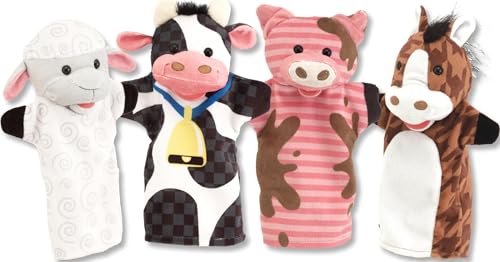
Melissa and Doug Horse Marionette
Four-legged puppets are harder to animate than upright characters, yet jointed legs here fall into a walking rhythm once a child finds the right rocking motion. That makes it a natural second marionette after mastering a simpler one. More legs mean more strings, so early sessions benefit from supervision.
Pros
- Convincing four-leg walking motion
- Solid wooden joint construction
- Rewards a child seeking more challenge
Cons
- Four leg strings tangle more easily
- Steeper learning curve than simpler puppets
Melissa and Doug Cow Marionette
A chunkier, lower profile keeps this puppet stable even when a small child lifts the control unevenly. Farm-themed play extends its life well past puppet shows alone. Simpler painted detail than the dragon or Cinderella is part of why it survives rough handling.
Pros
- Low, stable stance forgives clumsy lifting
- Fits into wider farm-themed play
- Painted finish wipes clean easily
Cons
- Less expressive than character puppets
- Shorter strings limit dramatic movement
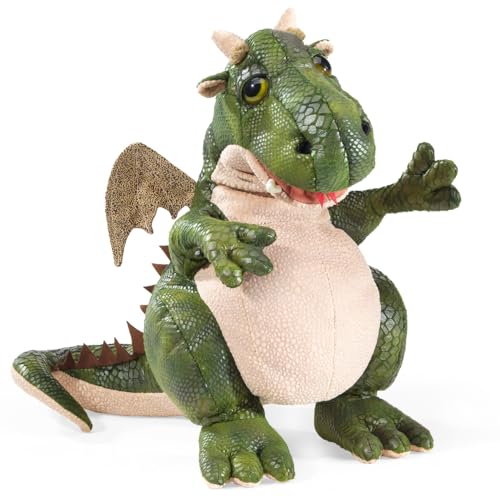
Folkmanis Dragon Hand Puppet
No strings exist here at all, which is the point. A toddler who cannot manage a control bar can still perform with this movable-mouth hand puppet. Older children keep using it too, since posable features hold up beyond toddler play.
Pros
- No strings means nothing to tangle
- Works for children too young for marionettes
- Movable mouth and posable features hold up well
Cons
- Not a marionette, so no string skill practiced
- Sized for an adult hand more than a small one

Melissa and Doug Deluxe Puppet Theater
A stage turns a puppet from a toy into a planned activity, hiding the control bar and giving a child a reason to invent a show. This wooden theater includes a curtain, a chalkboard sign, and an opening sized for a standing child. Assembly is required, so treat it as a family project rather than a stocking filler.
Pros
- Turns puppets into a real performance
- Sturdy wooden construction
- Works with marionettes and hand puppets alike
Cons
- Takes up significant floor space
- Assembly takes real time
Before you buy
How many strings should a first marionette have? Buying the most articulated puppet available backfires with a first-time user. A marionette with many strings tangles the moment it is set down carelessly, and a child who cannot fix it stops asking for it. A simple crossbar with few strings delivers an immediate result, and that early success is what keeps a child coming back. Save complex puppets for a child who already handles a simple one.
What age is right for a marionette? Age labels on packaging cover choking hazards, not dexterity. A three-year-old can work a simple animal puppet with a gentle rocking motion but struggles to coordinate separate leg pulls. Most children manage a four-legged puppet deliberately around five or six. A younger sibling who wants in is better served by a hand puppet than a smaller marionette.
How do you check build quality before buying? Wooden bodies with fabric covering survive drops far better than molded plastic. Joints are the usual failure point, so look at how limbs attach and whether strings run through a fixed point rather than a glued spot, since glue comes loose over time. A simple design is also easier to restring years later with fishing line and patience.
What is the best way to store a marionette so it doesn’t tangle? Nearly every marionette that stops getting played with is one that got tangled in a toy box. A hook on the back of a bedroom door solves that permanently, keeping strings straight and fabric from creasing. A puppet theater with a rail underneath does the same job while making the puppets part of the room.
Side by side
| # | Model | Material | Best for | Score | Price |
|---|---|---|---|---|---|
| 1 | Melissa and Doug Puppy Marionette | Wood with fabric covering | Best overall | 9.4 | Check price |
| 2 | Melissa and Doug Dragon Marionette | Wood with fabric wings and tail | Best value | 9.2 | Check price |
| 3 | Melissa and Doug Cinderella Marionette | Wood with fabric dress | Best for storytelling | 9.0 | Check price |
| 4 | Melissa and Doug Horse Marionette | Wood with fabric mane and tail | Best for four legged movement | 8.8 | Check price |
| 5 | Melissa and Doug Cow Marionette | Wood with painted finish | Best for younger beginners | 8.6 | Check price |
| 6 | Folkmanis Dragon Hand Puppet | Hand and arm puppet, no strings | Best no strings alternative | 8.3 | Check price |
| 7 | Melissa and Doug Deluxe Puppet Theater | Wooden puppet stage | Best companion purchase | 8.0 | Check price |
Good to know
What age can a child start using a marionette?
Around three works for a simple animal puppet, since the movement comes from tilting the control rather than pulling individual strings. More articulated puppets suit five and up, once a child coordinates separate movements deliberately.
How do you untangle marionette strings?
Hang the control bar so the puppet dangles freely, then work knots loose starting from the puppet end. Most tangles fall out on their own once the puppet hangs straight for a minute.
Are marionettes safe for toddlers?
Strings are the main concern, so marionettes are not suited to unsupervised play under age three. Store them hanging out of a toddler’s reach, and supervise the first few sessions with any new puppet.
What is the difference between a marionette and a hand puppet?
A marionette hangs from strings on a control bar and is animated from above. A hand puppet is worn on the hand and animated from inside, which makes it far easier for a young child to manage.
Can a marionette with broken strings be repaired?
Yes. Most marionettes can be restrung with strong braided fishing line tied through the original attachment points. Photograph the puppet before starting so the new strings match the original lengths.
Do you need a puppet theater to enjoy marionettes?
No, but it changes how a child plays. A stage gives them somewhere to hide and a structure for a show, and parents report longer play sessions once one is in the room. A tension rod and a sheet in a doorway achieve much the same effect.
Which type of marionette holds a child’s interest the longest?
Character and creature puppets already familiar from stories, like a dragon or a fairy-tale figure, get used more than generic designs. The puppet is only the prop; the story is what sustains the play.
How should marionettes be cleaned?
Spot clean fabric with a barely damp cloth and let it air dry, keeping water away from wooden joints and knots. Never machine wash a string puppet, since the strings will tangle beyond recovery.
Marionette versus hand puppet, which is better for a toddler?
A hand puppet is the easier choice for a toddler, since it needs no string coordination at all. Save a marionette for around age three or four, once a child can manage a simple crossbar.
Final word
Start with the Melissa and Doug Puppy Marionette, since its simple crossbar gives a young child a moving puppet within seconds instead of a knot of strings. Move up to the Dragon Marionette once dramatic movement is wanted, and add the Folkmanis Dragon Hand Puppet for a younger sibling who needs nothing to tangle.
Rachel Simmons
Rachel previously worked in child-product retail and brings a practical, detail-first eye to gear reviews, focusing on safety standards, ease of use and the fine print that matters most for new caregivers.