Kids Binoculars Built Tough Enough for Little Hands
Occer 12×25 Compact Binoculars top the list because the barrels close narrow enough for a child’s face. Kidwinz Original 8×21 is the shock-resistant value pick, and Educational Insights GeoSafari Jr. Kidnoculars suit toddlers who cannot yet manage a focus wheel.
Occer 12×25 Compact Binoculars fit most children over about seven comfortably. Kidwinz Original 8×21 suits younger explorers who will drop them, and Educational Insights GeoSafari Jr. Kidnoculars work best for a three or four year old who cannot manage a focus wheel yet.
Magnification gets most of the attention, yet it matters least once a child actually picks up a pair. High magnification amplifies hand shake, so the image wobbles and interest fades within a minute. Fit and focus decide whether binoculars get used at all. We compared magnification, objective size, interpupillary range, focus systems, weight and rubber armouring, then weighed owner reports on durability after real drops.
Before you buy
What to look for in kids binoculars Fit and focus matter more than the magnification number on the box. Barrels need to close far enough for a small face, and the focus wheel needs to turn easily under young fingers. Rubber armouring and a real neck strap decide whether a pair survives the first month. Everything else, including lens coatings, is secondary to those three things.
Why lower magnification usually wins Every hand tremor gets multiplied by the magnification figure, so a 12x view shakes twice as hard as a 6x view. Under sevens do best with 6x to 8x, which produces an image they can actually hold still. Save 10x and above for older children with steadier hands. A steady 8x view shows more real detail than a wobbling 12x one.
Best kids binoculars for toddlers versus older children A three or four year old needs a fixed focus pair with oversized eyepieces, since a focus wheel just causes frustration at that age. By six or seven, most children can manage a centre wheel and benefit from 8x to 10x magnification. Teenagers and older kids who want real reach can step up toward adult-spec pairs like the Bushnell Falcon.
Durability and daily use Kids binoculars get dropped, sat on and left out in the rain. Thick rubber armouring, a strap that actually gets used, and a case the child will carry matter more than optical extras. Never let a child point binoculars at the sun, and check that the strap is short enough not to snag while climbing.
The best picks, ranked
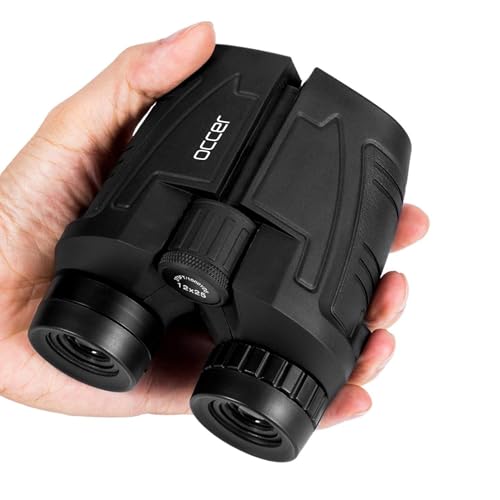
Occer 12×25 Compact Binoculars
Barrels close narrow enough for a child’s eye spacing, the single most common reason kids binoculars go unused. A large centre focus wheel turns easily under small fingers. BAK4 prisms with multi coated lenses brighten the image beyond typical toy grade glass, and owners report adults use the same pair comfortably.
Pros
- Barrels fold narrow enough for small faces
- BAK4 prisms brighten the image
- Light enough to hold steady
Cons
- 12x magnification amplifies hand shake
- Not rated fully waterproof

Kidwinz Original 8×21 Kids Binoculars
Thick rubber armouring and a shock absorbing body are built to survive a drop on a path. Eight times magnification keeps the image steady, unlike higher powered pairs aimed at adults. Based on specifications, the narrow minimum barrel spacing suits children from roughly four years upward.
Pros
- Genuinely tough rubber armoured body
- 8x magnification keeps images steady
- Narrow barrel spacing fits young children
Cons
- Small objectives struggle in low light
- Included neck strap is short

Educational Insights GeoSafari Jr. Kidnoculars
No focus wheel exists to fumble with. Oversized eyepieces let a small child line up a view without adult help, and magnification stays deliberately low so the image never wobbles. This is less a serious optical instrument than a way to get a three year old looking at birds and bugs.
Pros
- Huge eyepieces are easy for toddlers to align
- No focus adjustment to get wrong
- Very durable chunky construction
Cons
- Low magnification limits real observation
- Outgrown by around age six
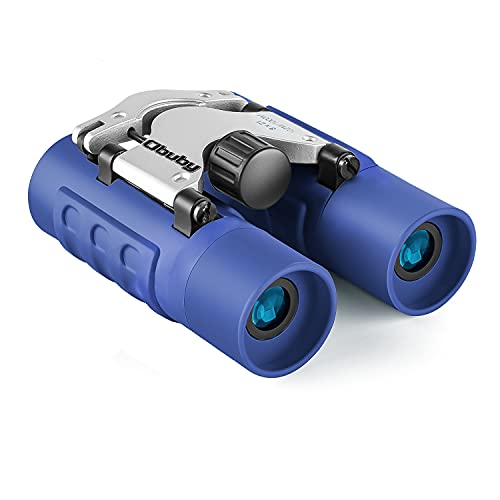
Obuby Real Binoculars for Kids
Heavy rubber coating wraps a compact folding body with non slip grips sized for smaller hands. Eight times magnification paired with 21mm objectives suits daytime nature watching without overwhelming a young user. Owners report these survive treatment that ends cheaper models, which is the main reason to pick them over prettier options.
Pros
- Robust enough for real outdoor use
- Non slip grips suit small hands
- Complete kit with case and cloth
Cons
- Optical quality is modest
- Slightly heavy for the youngest users

SkyGenius 8×21 Compact Binoculars
Under half a pound, this pair stays comfortable held up for several minutes at a time, which matters more than it sounds for small arms. A folding roof prism design slips into a coat pocket. Based on specifications, it suits travel, zoos and sports days rather than serious wildlife watching.
Pros
- Extremely light for small arms
- Folds into a pocket easily
- Steady 8x image
Cons
- Thin body offers little drop protection
- Small exit pupil dims quickly at dusk
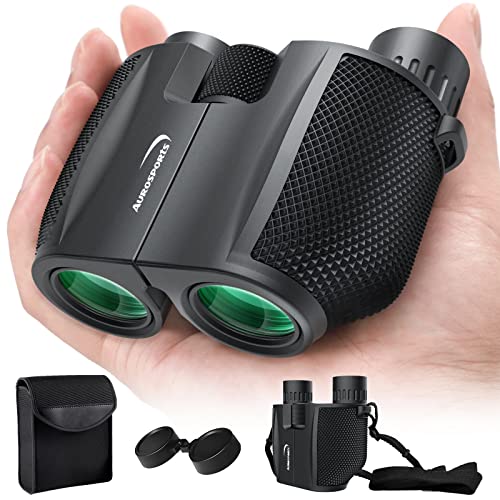
Aurosports 10×25 Folding Binoculars
Higher magnification and larger objectives suit a child who has outgrown a starter pair and wants more distant detail. The folding design still closes narrow enough for younger teenagers. This is the sensible bridge between a toy and an adult pair, useful at sports events as well as in the garden.
Pros
- More reach than typical kids models
- Brighter view from larger objectives
- Folds compact for a bag or pocket
Cons
- 10x needs steadier hands than 8x
- Barrels do not close as narrow as toddler models
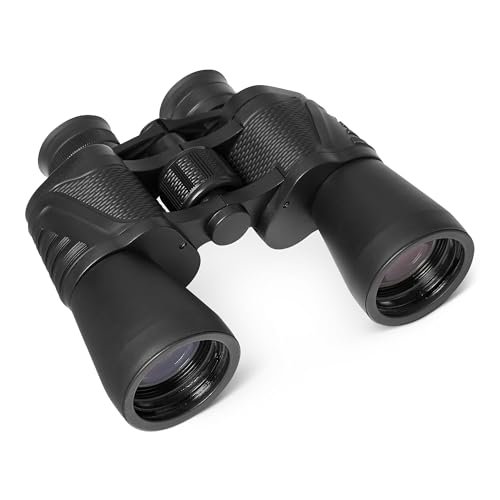
Bushnell Falcon 7×35 Binoculars
Not marketed as a children’s product, yet the low 7x magnification and large 35mm objectives give a bright, forgiving image that suits a child learning proper binoculars. A porro prism body adds bulk compared with folding compacts. Choose this pair when a child is genuinely interested in birds and will use it for years.
Pros
- Brightest, steadiest image here
- Instafocus lever is quick to use
- Will remain useful into adulthood
Cons
- Heavy for younger children to hold up
- Barrels may not close narrow enough for small faces
How they stack up
| # | Model | Magnification | Best for | Score | Price |
|---|---|---|---|---|---|
| 1 | Occer 12×25 Compact Binoculars | 12x with 25mm objectives | Best overall | 9.4 | Check price |
| 2 | Kidwinz Original 8×21 Kids Binoculars | 8x with 21mm objectives | Best value | 9.2 | Check price |
| 3 | Educational Insights GeoSafari Jr. Kidnoculars | 2x with oversized eyepieces | Best for toddlers | 9.0 | Check price |
| 4 | Obuby Real Binoculars for Kids | 8x with 21mm objectives | Best for durability | 8.8 | Check price |
| 5 | SkyGenius 8×21 Compact Binoculars | 8x with 21mm objectives | Best lightweight pair | 8.6 | Check price |
| 6 | Aurosports 10×25 Folding Binoculars | 10x with 25mm objectives | Best for older children | 8.3 | Check price |
| 7 | Bushnell Falcon 7×35 Binoculars | 7x with 35mm objectives | Best optical quality | 8.0 | Check price |
Common questions
What magnification is best for kids binoculars?
For younger children, 6x to 8x works best. It produces a steady image with a wide field of view, which makes finding a bird or animal much easier. Higher magnification amplifies hand shake and narrows the view, frustrating beginners.
At what age can a child use binoculars?
Around three years old for fixed focus models like the GeoSafari Jr. Kidnoculars, and around five or six for a pair with a focus wheel. Hand steadiness and eye spacing are the limiting factors, not age alone.
Why does my child only see two circles instead of one?
The barrels sit too far apart for their eye spacing. Push the two halves together until the circles merge. If they will not close far enough, that pair is too large for the child and a compact folding model is needed instead.
Are kids binoculars waterproof?
Most are water resistant rather than fully waterproof, so light rain is fine but submersion is not. Rubber armouring helps with splashes and drops but does not seal the internals. Dry them thoroughly if they get wet, especially around the focus wheel.
What do the two numbers on binoculars mean?
The first number is magnification and the second is the front lens diameter in millimetres. So 8×21 means objects look eight times closer through 21mm objectives. Larger objectives gather more light, which helps at dawn, dusk and under tree cover.
Can children who wear glasses use kids binoculars?
Yes, provided the pair has enough eye relief and fold down eyecups. Roll the eyecups down so glasses sit closer to the lenses. Without that adjustment, a child sees a narrow tunnel view instead of the full field.
How should I clean binocular lenses?
Blow off loose dust first, then use the supplied microfibre cloth with a small amount of lens cleaner if needed. Never wipe dry grit across coated glass, and avoid tissue or a shirt, since both can scratch the coating.
Do kids binoculars come with a case?
Most do, including the Kidwinz and Obuby models here. A case genuinely extends binocular life, since loose pairs in a rucksack pick up scratches and knocked focus. A short neck strap matters just as much, since it prevents drops in the first place.
Toddler binoculars vs a real starter pair, which should I buy first?
Start with a fixed focus toddler pair like the GeoSafari Jr. under age five, since a focus wheel just frustrates that age group. Once a child manages a wheel confidently, a real 8x pair like the Kidwinz or Occer shows far more detail.
Our pick
Occer 12×25 Compact Binoculars are the pair worth buying for most children, since they fold narrow enough for a young face and outshine toy grade competition. Choose Kidwinz Original 8×21 for a younger child who will drop them, and Educational Insights GeoSafari Jr. Kidnoculars for a toddler’s first look.
Rachel Simmons
Rachel previously worked in child-product retail and brings a practical, detail-first eye to gear reviews, focusing on safety standards, ease of use and the fine print that matters most for new caregivers.


