Bulk Marble Run Sets Ranked by Connector Type and Pieces
Hape’s Quadrilla Vertigo Marble Run wins overall, praised for wood dowel joints that resist wear other plastic sets lose within months. Classrooms building multiple towers should choose the 150-piece Marble Genius Super Set. Families with a Duplo bin already at home get instant expansion from the Hubelino 200-Piece Starter Set.
Hape’s Quadrilla Vertigo Marble Run earns the top spot for families who rebuild towers often, since its wood dowel joints stay tight for years. Marbles roll almost silently across its sanded tracks, a detail no plastic set here matches. Its higher cost per piece and larger shelf footprint rule it out for tight budgets or small storage spaces.
Connector type separates these sets more sharply than piece count does, and a stud-based Hubelino brick will never click into Quercetti’s twist-lock system. We compared piece counts, listed materials, connector designs and stated compatibility with brick or magnetic tile collections already in a home or classroom. Owner reports of joint wear, missing pieces and repeated-rebuild durability shaped the final order.
What we recommend

Hape Quadrilla Vertigo Marble Run
Beechwood dowels click into place across this 70-piece spiral tower, no glue or magnets required. Sanded wood tracks send marbles down with far less noise than a plastic run produces. Because pieces share Hape’s Quadrilla system, a family can add towers from other sets over several birthdays.
Pros
- Dowel joints stay tight without tools or glue
- Sanded wood keeps marble noise low
- Expands with other Quadrilla and Hape wooden lines
Cons
- Priced higher per piece than plastic bulk sets
- Needs more shelf space than a folding plastic bin

Marble Genius Marble Run Super Set
150 color coded pieces give this set enough length for two or three towers running side by side. A picture instruction booklet walks a classroom aide through several layouts without reading dense text. Plastic connectors, though, loosen faster than wood joints once daily rebuilding starts.
Pros
- 150 pieces support full classroom-table layouts
- Picture guide lets kids build with minimal adult help
- Expands with other Marble Genius sets
Cons
- Connectors loosen under heavy repeated use
- Does not connect to Duplo or other brick systems

Ravensburger GraviTrax Starter Set
Instead of a freestanding tower, GraviTrax uses a pegboard grid where gravity, magnetism and free-fall pieces steer a steel marble through a planned path. Reading the grid and predicting height changes asks more of a builder than stacking plastic tubes. One included base plate covers a modest footprint until a buyer adds more.
Pros
- Grid layout teaches gravity and height planning directly
- Large expansion catalog across Trax, Blocks and PowerTrax lines
- Base plate folds flat for storage
Cons
- Recommended age starts higher than most sets here
- Single starter plate limits build size without extras

Hubelino 200-Piece Marble Run Starter Set
Large-brick studs on every Hubelino piece snap onto standard Duplo bricks, so this 200-piece set doubles as a marble run and a brick expansion. A household with Duplo already on a shelf gains instant extra parts instead of a separate toy system. Push-fit track sections go together fast, though a hard knock can pop a run apart mid-play.
Pros
- Studs connect directly to Duplo and similar large-brick sets
- 200 pieces cover full-table group layouts
- Push-fit assembly needs no tools
Cons
- Sections separate if bumped during active play
- Printed instructions cover only a handful of layouts

Quercetti Migoga Marble Run Building Set
Twist-lock connectors on this Quercetti set go together faster than stud-based bricks, making it a reasonable first bulk set for a new builder. Sixty pieces build one or two towers rather than a full-table course. Two boxes combined is the practical path to a classroom-sized layout.
Pros
- Twist-lock pieces assemble quickly for younger builders
- Compact box stores easily between sessions
- Lower piece count keeps setup fast for short play
Cons
- One box limits builds to small towers
- Connectors show wear sooner than thicker-walled sets

PicassoTiles Marble Run Magnetic Tile Expansion Set
PicassoTiles turns a flat magnetic tile wall build into a moving marble course by adding channel tiles to an existing collection. Magnets stay sealed inside each tile per the manufacturer listing, worth checking for households with toddlers. It works only as an add-on, so a base magnetic tile set has to already be on hand.
Pros
- Extends an existing magnetic tile set into marble play
- Vertical builds work on walls or windows
- Magnets sealed inside tiles per listing
Cons
- Needs a separate base tile set to function
- Channels drop marbles more easily than dedicated track pieces
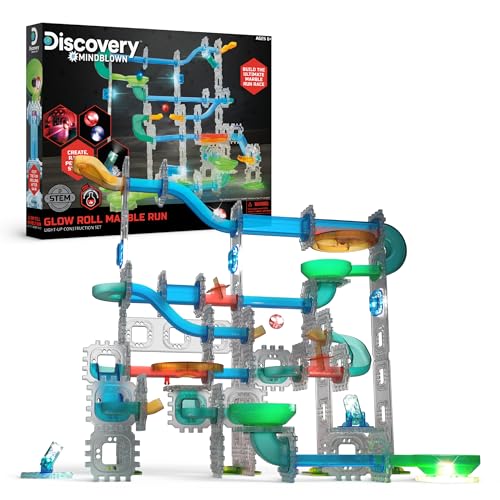
Discovery Kids Glow in the Dark Marble Run
Glow-in-the-dark rods and marbles let this Discovery Kids tower keep running once the lights go out. Freestanding construction skips a brick base entirely, unlike Hubelino’s stud system. Connectors favor stability over quick teardown, so it suits a shelf display better than a set rebuilt every day.
Pros
- Glow rods and marbles work after dark
- 130 pieces build multi-level freestanding towers
- No base plate or brick set required
Cons
- Takes more effort to disassemble than snap-together tracks
- Not compatible with Duplo or magnetic tile systems
How to choose
What to check before buying a bulk marble run Piece count sets the ceiling on layout size, and anything under 100 pieces usually builds just one modest tower. Sets at 150 pieces or more support a full-table course for several kids at once. Connector type matters as much as count, since stud bricks, twist-lock pieces and magnetic tiles rarely mix between brands. Recommended age also varies more than people expect, since a grid system like GraviTrax demands more planning skill than a simple freestanding tower.
Wood versus plastic: which lasts through daily rebuilding? Wood dowel joints, like the ones in Hape’s Quadrilla line, resist wobble for years and run marbles more quietly than plastic tubing. Plastic connectors cost less per piece and come in brighter colors, but they loosen after months of snapping apart and back together. A home shelf display wears a plastic set far slower than a classroom rebuilding towers every single day. Cost upfront, not fragility, is the real trade between the two materials.
Best setup for a classroom or several kids at once Group builds need enough parts for two or three towers running in parallel, which puts 150-plus piece sets ahead of a 60-piece starter box. Picture instructions carry more weight in a classroom, where an aide supervising several children leans on a preset layout instead of trial and error. Large-brick systems such as Hubelino also let a school fold marble run pieces into an existing Duplo bin rather than buying a second toy line. Two or three smaller boxes combined still cover a group activity in a pinch.
Does a marble run need to match bricks or tiles already owned? Sometimes, and it changes what a set is worth to a specific household. A family with a deep Duplo collection gets more mileage from Hubelino’s stud-compatible pieces than from a stand-alone system like Quercetti’s. Magnetic tile owners face the same calculation, since PicassoTiles and similar packs only function as an add-on to tiles bought earlier. A freestanding option like the Discovery Kids glow set sidesteps the whole question, at the cost of never linking to another toy line.
The lineup, side by side
| # | Model | Piece count | Best for | Score | Price |
|---|---|---|---|---|---|
| 1 | Hape Quadrilla Vertigo Marble Run | 70 wooden pieces | Best overall | 9.4 | Check price |
| 2 | Marble Genius Marble Run Super Set | 150 pieces | Best for classroom or group STEM use | 9.2 | Check price |
| 3 | Ravensburger GraviTrax Starter Set | 122 pieces | Best for STEM and magnetic engineering | 9.0 | Check price |
| 4 | Hubelino 200-Piece Marble Run Starter Set | 200 pieces | Best for Duplo compatibility | 8.7 | Check price |
| 5 | Quercetti Migoga Marble Run Building Set | 60 pieces | Best budget | 8.4 | Check price |
| 6 | PicassoTiles Marble Run Magnetic Tile Expansion Set | 40 pieces | Best for combining with magnetic tile sets | 8.2 | Check price |
| 7 | Discovery Kids Glow in the Dark Marble Run | 130 pieces | Best for after-dark play | 8.0 | Check price |
Good to know
How many pieces make a good size marble run?
Plan on at least 100 pieces for one tall tower, and 150 or more when two or three kids build separate towers at once. A 60-piece box like Quercetti’s Migoga works best as a starter or paired with a second box for a bigger course.
What age range fits a marble run set?
Most freestanding sets, including Hape Quadrilla, Hubelino and Marble Genius, list an age range starting at 3 or 4. Grid-based GraviTrax asks more of a builder and lists an age range starting at 8, since layouts require planning height and drop points.
Does Hubelino connect to Duplo bricks?
Yes. Hubelino uses the same large-stud sizing as Duplo, so pieces from either brand snap together without an adapter. A family with an existing Duplo bin can add a Hubelino starter set and build with the combined collection right away.
GraviTrax or Marble Genius, which is better for a beginner?
Marble Genius suits a younger or first-time builder, since its picture instructions and lower age listing make setup simple. GraviTrax fits an older child already comfortable building, because its grid relies on planning height and gravity rather than stacking pieces.
Can a marble run attach to magnetic tiles?
Yes, add-on packs like the PicassoTiles Marble Run Magnetic Tile Expansion Set snap onto standard magnetic tiles, adding channels for a marble to travel through. These kits need a base tile set first, since they are not a stand-alone marble run.
Is wood or plastic better for a marble run?
Wood, as in Hape’s Quadrilla dowel joints, holds tight through years of rebuilding and runs quieter than plastic. Plastic costs less per piece and comes in brighter colors, though connectors loosen faster under daily classroom use. The choice comes down to upfront budget against long-term joint durability.
Which marble run works best for a classroom?
The 150-piece Marble Genius Marble Run Super Set fits classroom use well, since its piece count supports several towers at once and its picture guide needs little adult supervision. Hubelino’s 200-piece starter set is a strong alternative for schools that already stock Duplo bricks.
Do glow in the dark marble runs actually glow?
Yes. The Discovery Kids Glow in the Dark Marble Run uses rods and marbles molded with glow plastic that needs a few minutes under bright light or sunlight to charge. The glow fades gradually rather than lasting all night, so it works best right after charging for a single play session.
Is a bulk marble run worth it over a small starter box?
For repeat play or more than one child, yes, since a small box like Quercetti’s 60-piece set runs out of parts fast. A bulk set spreads the per-piece cost lower and supports bigger layouts without buying a second box right away.
Our pick
Hape’s Quadrilla Vertigo Marble Run is the pick for anyone rebuilding towers for years, since wood dowel joints outlast plastic connectors by a wide margin. Classrooms or homes running two or three towers at once should choose the 150-piece Marble Genius Super Set instead, since its picture guide needs little supervision. Families with a Duplo bin already on a shelf get the most value from the Hubelino 200-Piece Starter Set, and budget-first buyers should start with Quercetti’s Migoga set rather than a pricier bulk box.
Rachel Simmons
Rachel previously worked in child-product retail and brings a practical, detail-first eye to gear reviews, focusing on safety standards, ease of use and the fine print that matters most for new caregivers.

