Macro Extension Tubes That Keep Autofocus Working
Kenko’s Auto Extension Tube Set DG leads. Rings of 12mm, 20mm and 36mm stack to 68mm while autofocus and electronic aperture keep working. Canon EF shooters after a cheaper three ring set can take the Vello EXT-CE. Sony E mount bodies pair with the Viltrox DG-NEX.
Kenko’s Auto Extension Tube Set DG fits Canon EF and Nikon F shooters best. Three rings deliver 12mm through 68mm of extension, and every contact stays connected, so autofocus, metering and electronic aperture survive. Bulk is the tradeoff, since three metal rings add real weight to a bag.
Choosing is harder than the simple design suggests. No glass sits inside a tube, so sharpness still comes from your lens. Get the mount wrong, or buy a set with no contacts, and a modern lens locks wide open. We compared published tube lengths, contact wiring, mount material and reported play between rings. Owner feedback about aperture errors and loose flanges after months of swapping settled the order.
What we recommend

Kenko Auto Extension Tube Set DG
Rings of 12mm, 20mm and 36mm run from a modest close focus boost to near life size on a 50mm prime. Kenko wires every contact through, keeping autofocus, metering and electronic aperture alive on Canon EF and Nikon F bodies. Any combination stacks, up to 68mm total.
Pros
- Three lengths cover most magnification targets
- Camera keeps command of the aperture
- Rings lock with no detectable play
Cons
- Heavier than a two ring mirrorless pair
- Joints carry no weather sealing

Vello EXT-CE Auto Extension Tube Set
Contacts run through all three rings, so Canon EF and EF-S glass keeps autofocus and electronic aperture. Lengths of 13mm, 21mm and 31mm stack to 65mm. Build sits a step under Kenko, which argues for supporting a heavy telephoto by the lens rather than the body.
Pros
- Full three ring spread at mid tier cost
- Electronic aperture control stays intact
- Rear caps ship with every ring
Cons
- Mount tolerance varies between samples
- Canon mounts only, no Nikon or Sony option

Meike MK-EF-AF3A Macro Extension Tube Set
Two rings of 10mm and 16mm total 26mm, enough to push a 50mm prime well inside its native close focus. Metal mounts front and rear resist the wear plastic flanges collect from repeated swaps. Contacts stay wired, so an EF or EF-S lens still focuses on its own.
Pros
- Metal flanges survive frequent lens swaps
- Pair adds little bulk to a camera bag
- Autofocus holds up on most EF primes
Cons
- Extension tops out at 26mm
- Autofocus hunts badly on zoom lenses

Viltrox DG-NEX Auto Focus Macro Extension Tube Set
Built specifically for Sony E and FE glass, this pair offers 10mm and 16mm rings that stack to 26mm. Contacts carry autofocus, aperture and stabilisation data through to the body. Short flange distance on mirrorless makes even 10mm shift framing noticeably, which suits flowers and jewellery.
Pros
- Full electronic support on Sony bodies
- Light enough for gimbal or handheld work
- Covers APS-C and full frame E mount
Cons
- Sony A mount lenses will not fit
- Gain shrinks fast on longer focal lengths

Movo MT-N68 AF Macro Extension Tube Set
Nikon F bodies get the same 12mm, 20mm and 36mm spread found on premium sets, with contacts wired for autofocus and metering. All three stack for 68mm of extension. Construction runs lighter than Kenko, which saves bag weight but calls for support under a long lens.
Pros
- Full three ring spread on the Nikon F mount
- Lighter than all metal alternatives
- Handles both DX and FX lenses
Cons
- Lighter body flexes under heavy glass
- Screwdriver era lenses lose autofocus

Fotodiox Macro Extension Tube Set
Dropping the contact block is how Fotodiox keeps this set simple. Rings of 12mm, 20mm and 36mm stack exactly like wired versions, but the camera loses aperture control. You need a lens with an aperture ring, or a body that holds a set value, and focusing goes manual.
Pros
- Least costly route to a full 68mm of extension
- Nothing electronic inside to fail
- Sold for several different mount types
Cons
- Aperture sits wide open on most modern lenses
- No autofocus and no exif data
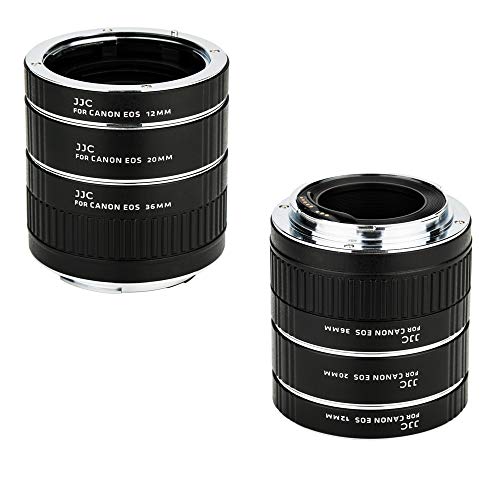
JJC AET-MFT Auto Extension Tube Set
Olympus, OM System and Panasonic bodies get a matched 10mm and 16mm pair with contacts wired for autofocus and aperture. Crop factor works in your favour, since a smaller sensor fills with a tighter slice of the subject. Put the camera on a tripod, because depth of field shrinks to millimetres at this magnification.
Pros
- Purpose built for the Micro Four Thirds mount
- Barely registers in a jacket pocket
- Crop sensor enlarges the effective subject size
Cons
- Smallest extension range in this group
- A few older Panasonic lenses throw errors
Compared at a glance
| # | Model | Tube lengths | Best for | Score | Price |
|---|---|---|---|---|---|
| 1 | Kenko Auto Extension Tube Set DG | 12mm, 20mm, 36mm | Best overall | 9.4 | Check price |
| 2 | Vello EXT-CE Auto Extension Tube Set | 13mm, 21mm, 31mm | Best value | 9.2 | Check price |
| 3 | Meike MK-EF-AF3A Macro Extension Tube Set | 10mm, 16mm | Best for Canon EF autofocus | 9.0 | Check price |
| 4 | Viltrox DG-NEX Auto Focus Macro Extension Tube Set | 10mm, 16mm | Best for Sony E mount | 8.7 | Check price |
| 5 | Movo MT-N68 AF Macro Extension Tube Set | 12mm, 20mm, 36mm | Best for Nikon F DSLRs | 8.5 | Check price |
| 6 | Fotodiox Macro Extension Tube Set | 12mm, 20mm, 36mm | Best budget | 8.3 | Check price |
| 7 | JJC AET-MFT Auto Extension Tube Set | 10mm, 16mm | Best for Micro Four Thirds | 8.0 | Check price |
What matters most
What an extension tube does to your lens A tube is a hollow spacer that sits between lens and body. Push the lens further from the sensor and its minimum focus distance shrinks, so a small subject fills more of the frame. Nothing optical sits inside, which leaves image quality entirely to your lens. Two costs follow. You lose roughly one to two stops of light at typical extensions, and infinity focus disappears until the tube comes off.
Contacts, autofocus and the aperture problem Wired tubes pass signals through, so the body still sets aperture and can attempt autofocus. Bare tubes cost less and leave modern lenses stuck wide open, because an electronic aperture defaults to fully open with no signal. Macro work usually wants f8 or smaller for usable depth of field. That makes a wired set the safe default unless your lens carries a physical aperture ring.
Matching tube length to focal length Magnification roughly equals extension divided by focal length. Fit 36mm to a 50mm prime and you add about 0.7x on top of the lens’s own figure. Fit the same ring to a 200mm telephoto and the gain barely shows. Short primes react hardest to short tubes, which is why 10mm feels dramatic on a 25mm lens and almost invisible on a 135mm.
Shooting insects and flowers in the field Working distance collapses as extension grows. A 36mm ring on a short prime can put the front element a few centimetres from a bee, which ends most insect shots early. Longer lenses with moderate extension keep you back far enough to stay unnoticed. Pack a flash or a bright LED panel, since light loss plus a small aperture drags shutter speeds down. A focus rail beats twisting the focus ring once magnification climbs.
Questions worth asking
What is a macro extension tube?
It is a hollow ring that mounts between camera and lens, adding physical distance so the lens focuses closer than its design allows. No optical elements sit inside, which is why the tube adds no distortion of its own.
Do extension tubes reduce image quality?
Not directly, since there is no glass to degrade the image. Light loss is real, and pushing a lens far past its designed focus range can soften the corners. Stopping down to f8 or f11 usually brings sharpness back to a usable level.
Which extension tubes work with autofocus?
Wired sets carry contacts through: the Kenko DG, Vello EXT-CE, Meike MK-EF-AF3A, Viltrox DG-NEX and JJC AET-MFT all qualify. Autofocus slows and hunts at high magnification, so many photographers switch to manual focus anyway.
Can you stack extension tubes together?
Yes, rings in a set are designed to stack. All three from a 12mm, 20mm and 36mm set give 68mm of extension. Expect depth of field measured in millimetres and a working distance of only a few centimetres.
Extension tube vs close up filter, which is better?
A tube keeps image quality intact but costs you light and infinity focus. A screw on close up filter adds glass in front, keeps the light, and packs smaller, yet softens the edges. Tubes win on quality, filters win on convenience.
How much magnification does a 36mm tube add?
Divide extension by focal length. On a 50mm lens, 36mm adds roughly 0.7x. On a 100mm lens, the same ring adds about 0.36x. Short focal lengths gain the most from any given tube.
Is a macro extension tube worth it instead of a macro lens?
For occasional close up work, yes, because a tube set uses glass you already own. Shoot macro weekly and a dedicated macro lens wins on working distance, autofocus speed and flat field sharpness.
Do extension tubes fit any lens?
Any lens sharing the mount will attach, but results vary widely. A wide angle can end up focusing inside its own barrel, which is unusable. Primes between 35mm and 100mm give the most practical results.
Which extension tube is best for Sony E mount?
Viltrox builds the DG-NEX pair for exactly that mount, wiring autofocus, aperture and stabilisation through both rings. Lengths of 10mm and 16mm stack to 26mm, enough for flowers, coins and small products on an E mount body.
Do extension tubes work with weather sealed lenses?
Your lens keeps its own sealing, but the tube joints add none of their own. Dust and moisture can travel through an unsealed ring toward the sensor. Swap tubes indoors where possible, and cap both ends before they return to the bag.
Our pick
Canon EF and Nikon F owners should start with the Kenko Auto Extension Tube Set DG, because three stackable rings and full contact wiring keep the aperture under camera control. Sony E mount shooters get the same electronics in a lighter pair from the Viltrox DG-NEX. Leave the manual Fotodiox set alone unless your lens has a physical aperture ring, since an electronic lens will simply sit wide open.
Marcus Chen
Marcus covered consumer electronics for enthusiast tech publications for six years before joining ChoiceCrest. He specializes in translating manufacturer spec sheets into plain-language buying advice, with a focus on audio, computing accessories and smart-home gear.