Longboards Shaped for How You Actually Ride
The Sector 9 Lookout leads this comparison as a cruiser shaped for comfortable commuting and casual riding. The Loaded Tan Tien suits riders focused on dancing and footwork tricks, while the Quest Super Cruiser fits beginners who want a forgiving first board.
The Sector 9 Lookout stands out because its drop-through mounting and directional shape make it easy to push and cruise over real distances without feeling twitchy. Its main limitation is specialization, since it is not built for the footwork dancing or carving performance dedicated boards offer.
We compared published deck shape, flex rating, construction material and intended riding style across each board rather than running our own ride tests.
The best picks, ranked

Sector 9 Lookout
A drop-through mounting style lowers the deck’s center of gravity, improving stability while pushing at commuting speeds. A directional shape favors riding one way, which suits steady cruising over switch-stance tricks. Maple ply construction balances flex with enough stiffness for stable rolling.
Pros
- Drop-through mounting improves stability while cruising
- Directional shape suits steady commuting over tricks
- Maple ply construction balances flex and stability
Cons
- Directional shape performs less evenly switch than a true twin deck
- Not built for dancing footwork like the Loaded Tan Tien
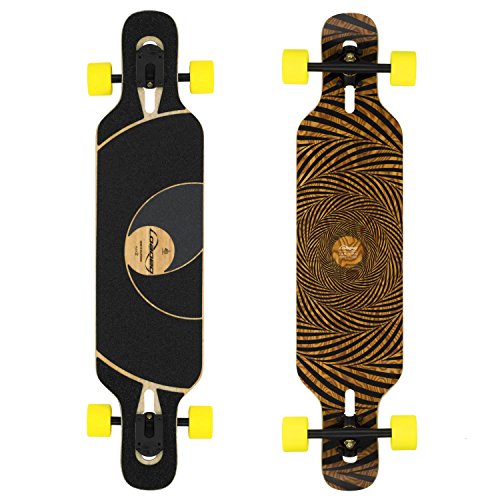
Loaded Tan Tien
A symmetrical, flexible deck shape gives riders room to walk the board and cross-step, central to dancing longboard style. Bamboo and fiberglass construction flexes predictably under footwork without feeling unstable. Its length and shape prioritize dance and freestyle tricks over high-speed carving.
Pros
- Symmetrical shape and length support cross-stepping and dance tricks
- Bamboo and fiberglass flex predictably under footwork
- Suits freestyle riders better than cruising-only boards
Cons
- Less suited to high-speed carving or downhill riding
- Longer deck is less maneuverable in tight spaces than shorter cruisers

Landyachtz Drop Carve
A dropped deck platform lowers the rider’s stance, improving stability during aggressive carving turns. Drop-through trucks mount lower to the ground, reducing the leverage needed to initiate a turn. A directional shape with kicktail adds some control for tighter carving lines.
Pros
- Dropped platform improves stability during aggressive carving
- Drop-through trucks reduce leverage needed to initiate turns
- Kicktail adds control for tighter carving lines
Cons
- Lower deck clearance risks wheel bite on sharp turns
- Less suited to dancing footwork than a flat-deck design
Loaded Vanguard
A stiffer flex pattern maintains stability at the higher speeds downhill and freeride riding demands. A symmetrical shape allows sliding and riding switch, important for freeride slides and stance changes. Reinforced construction resists the stress of hard carving and controlled slides better than a flexible dancing deck.
Pros
- Stiffer flex maintains stability at higher downhill speeds
- Symmetrical shape supports sliding and switch riding
- Reinforced construction holds up to hard carving and slides
Cons
- Stiff flex feels less forgiving for casual cruising
- Higher price point among the boards compared here

Arbor Pilsner
A directional cruiser shape keeps the board stable at walking and light pushing speeds through a commute. Moderate flex absorbs small cracks and bumps in pavement better than a stiff deck. A compact length makes it easier to carry or store than longer dancing or freeride boards.
Pros
- Moderate flex absorbs small pavement cracks and bumps
- Compact length is easier to carry and store
- Directional cruiser shape suits steady commuting
Cons
- Less stable at higher speeds than stiffer downhill boards
- Not built for dancing or aggressive carving performance

Globe Pioneer
A directional cruiser shape keeps the price accessible while still offering stable, predictable riding. Maple construction holds up reasonably well to regular use without the cost of premium composite decks. It suits casual riders more than those chasing dancing or downhill-specific performance.
Pros
- Lower price than premium dancing or freeride longboards
- Maple construction holds up to regular casual use
- Stable, predictable ride for everyday cruising
Cons
- Fewer performance features than premium carving or freeride boards
- Less suited to dedicated dancing or downhill riding

Quest Super Cruiser
A wide, flexible deck forgives small balance mistakes better than a stiff, narrow performance board. Soft, large wheels absorb bumps and cracks that would unsettle a beginner on harder wheels. Its simple directional shape keeps the learning curve straightforward for a first longboard.
Pros
- Wide, flexible deck forgives beginner balance mistakes
- Soft, large wheels absorb bumps better than harder wheels
- Simple shape keeps the learning curve manageable
Cons
- Flex and wheel softness limit performance at higher speeds
- Not built for dancing, carving or downhill riding
What to look for
What to look for in a longboard Deck shape decides riding style more than any other factor, with directional shapes suited to cruising and symmetrical shapes suited to dancing or freeride riding. Flex affects both comfort and stability, with softer flex absorbing bumps and stiffer flex holding up better at speed. Construction material and mounting style, like drop-through trucks, influence stability and how low the deck sits to the ground.
Directional versus symmetrical shapes Directional boards, like the Sector 9 Lookout and Arbor Pilsner, ride best in one direction and suit steady cruising or commuting. Symmetrical boards, like the Loaded Tan Tien and Loaded Vanguard, ride the same both ways, which matters for dancing footwork and freeride sliding where switching stance happens constantly. Riders focused purely on commuting rarely need the switch-riding ability a symmetrical deck provides.
Flex for dancing versus stiffness for downhill Dancing boards like the Loaded Tan Tien use predictable flex that supports footwork without feeling unstable underfoot. Downhill and freeride boards like the Loaded Vanguard use a stiffer flex pattern to stay stable at speeds where excess flex could cause instability. Beginners generally benefit from a softer, more forgiving flex like the Quest Super Cruiser until their balance and speed control improve.
Matching a longboard to riding style Carving enthusiasts should prioritize a dropped deck and drop-through trucks like the Landyachtz Drop Carve for stability during aggressive turns. Dancers need length and a flexible, symmetrical deck like the Loaded Tan Tien rather than a short, stiff cruiser. New riders should start with a wide, forgiving board like the Quest Super Cruiser before moving toward a specialized carving, dancing or downhill deck.
How they stack up
| # | Model | Mounting | Best for | Score | Price |
|---|---|---|---|---|---|
| 1 | Sector 9 Lookout | Drop-through | Best Overall Cruising | 8.8 | Check price |
| 2 | Loaded Tan Tien | Symmetrical, dance-oriented | Best for Dancing and Freestyle | 9.0 | Check price |
| 3 | Landyachtz Drop Carve | Dropped deck, drop-through | Best for Carving | 8.9 | Check price |
| 4 | Loaded Vanguard | Symmetrical, freeride-oriented | Best for Downhill and Freeride | 9.1 | Check price |
| 5 | Arbor Pilsner | Directional cruiser | Best for Commuting | 8.6 | Check price |
| 6 | Globe Pioneer | Directional cruiser | Best Budget Value | 8.0 | Check price |
| 7 | Quest Super Cruiser | Wide directional cruiser | Best for Beginners | 8.1 | Check price |
Questions worth asking
What longboard shape is best for beginners?
A wide, forgiving directional shape like the Quest Super Cruiser helps new riders balance more easily than a narrow performance deck.
What is the difference between a directional and symmetrical longboard?
Directional boards like the Sector 9 Lookout ride best one way, while symmetrical boards like the Loaded Tan Tien ride the same in both directions.
What longboard is best for dancing?
The Loaded Tan Tien uses a flexible, symmetrical bamboo and fiberglass deck built specifically for cross-stepping and freestyle footwork.
Is a stiffer longboard better for downhill riding?
Yes. The Loaded Vanguard uses a stiffer flex pattern that stays more stable at the higher speeds downhill riding involves.
What makes a longboard good for carving?
A dropped deck and drop-through trucks, used on the Landyachtz Drop Carve, lower the stance and reduce the leverage needed to turn.
What longboard is best for a daily commute?
The Sector 9 Lookout and Arbor Pilsner both use directional cruiser shapes built for stable, steady pushing over real distances.
Does deck material affect how a longboard rides?
Yes. Bamboo and fiberglass decks like the Loaded Tan Tien flex more predictably than solid maple decks like the Sector 9 Lookout.
What is the most affordable longboard option?
The Globe Pioneer offers a directional cruiser shape and maple construction at a lower price than premium composite decks.
Can one longboard handle both cruising and carving?
A directional board like the Sector 9 Lookout handles light carving reasonably well, though a dedicated carving deck performs better at speed.
Our pick
Most riders get the best overall value from the Sector 9 Lookout, which cruises comfortably without specializing too narrowly. Riders focused on dance and footwork tricks should choose the Loaded Tan Tien instead, since its flexible symmetrical deck is built for that style. Beginners should skip performance-focused decks entirely and start with the Quest Super Cruiser.
Sierra Daniels
Sierra's background is in landscape design and nursery retail. She focuses on lawn and garden equipment, outdoor furniture and gear durability, weighing published specs against how materials actually hold up outside.