Which Snowboard Boots Are Actually Light on Your Feet?
The Burton Ruler BOA fits most riders wanting a balanced, lightweight all mountain boot. Freestyle riders get more from the K2 Vandal, since its soft flex suits jibbing and buttering. Beginners on a budget do well with the Salomon Launch, whose light, forgiving build eases the learning curve without added cost.
Riders who want one boot for the whole mountain do best with the Burton Ruler BOA, since its single dial lacing tightens evenly without piling on weight. Its medium flex means dedicated park riders may still want something softer. Freestyle skiers reach for the K2 Vandal instead, drawn to its soft, playful flex, and beginners on a budget do well with the Salomon Launch, whose light, forgiving build eases the learning curve.
Flex rating and lacing type affect perceived weight almost as much as actual boot mass, since a stiff boot fights your leg all day even at a lighter spec. We compared listed boot weight, flex index and owner reports on pack out, comfort and how well the liner holds shape after a season of riding.
The top picks, ranked

Burton Ruler BOA Snowboard Boots
One BOA dial tightens the whole boot evenly, which cuts down on lace fatigue during a full day out. Medium flex, rated around 5 out of 10, works for groomers and moderate park laps alike. Multi season owners say the liner packs out slowly instead of going flat after a few months.
Pros
- Single dial lacing tightens evenly in seconds
- Medium flex handles groomers and moderate park terrain
- Liner keeps its shape across multiple seasons
Cons
- Not soft enough for dedicated park and jib riding
- BOA dial eventually needs replacement after years of use

K2 Vandal Snowboard Boots
Soft flex, close to 3 out of 10, gives instant response for jibbing and buttering that stiffer boots resist. Zone lock lacing lets riders tighten the ankle and foot separately instead of one uniform pull. Park riders say the light overall weight keeps legs fresher through repeated laps.
Pros
- Soft flex responds fast to jib and butter tricks
- Zone lacing tightens ankle and foot independently
- Light build reduces fatigue over repeated park laps
Cons
- Too soft for aggressive carving at higher speeds
- Traditional lacing takes longer to tighten than a BOA dial

Salomon Launch Snowboard Boots
Soft, forgiving flex absorbs early turning mistakes instead of fighting back on every edge change. Traditional laces keep the price below most BOA equipped boots in this class. New riders in their first seasons say the lighter build makes linking turns less tiring.
Pros
- Forgiving flex softens the impact of beginner mistakes
- Costs less than comparable BOA equipped boots
- Light weight eases fatigue during early learning sessions
Cons
- Lacks the precision intermediate riders eventually want
- Liner wears faster under frequent, heavy use
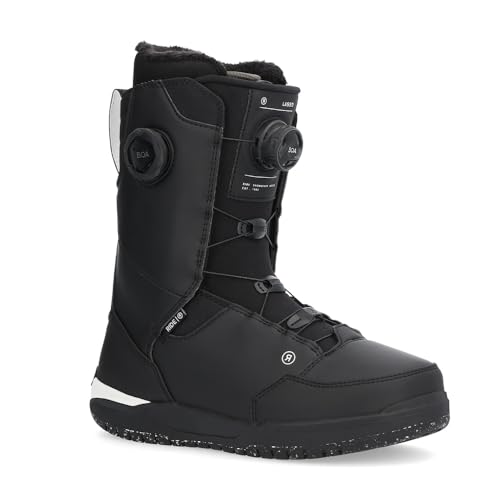
Ride Lasso Snowboard Boots
Two independent BOA dials adjust the cuff and the foot separately, so riders can loosen the top for the lift and keep the bottom snug. Medium flex, around 6 out of 10, sits between soft park boots and stiffer freeride models. Owners say the dual dial setup adjusts faster mid run than laces or a single dial.
Pros
- Dual dials adjust cuff and foot independently
- Loosens and retightens in seconds between runs
- Medium flex covers most all mountain terrain
Cons
- Second dial adds a bit more weight than single BOA
- Costs more than traditional lace up boots

ThirtyTwo Lashed Snowboard Boots
A reinforced outsole and upper resist the abrasion that rails and boxes put on a boot faster than groomed runs do. Traditional lacing keeps the build simple, so a snapped lace is easy to replace on the mountain. Frequent riders report this boot outlasting lighter, less reinforced models.
Pros
- Reinforced outsole survives heavy rail and park use
- Traditional laces are simple to swap if they snap
- Medium flex stays versatile across terrain types
Cons
- Traditional lacing adjusts slower than a BOA dial
- Slightly heavier than dedicated ultralight boots

DC Shoes Judge Snowboard Boots
A wider last gives room to riders whose feet feel pinched in narrower performance boots, without adding real weight. Single BOA lacing keeps adjustment quick despite the roomier shape. Wide footed owners report far fewer pressure points than in narrower lightweight boots.
Pros
- Wider last relieves pressure points for wide feet
- Single BOA dial keeps fit adjustment fast
- Medium flex suits a range of terrain
Cons
- May feel too roomy for narrow footed riders
- Liner needs a longer break in period

Nidecker Kita Snowboard Boots
Simple construction skips premium liner materials to hit a lower price while keeping overall weight down. Traditional lacing avoids the added cost of a BOA dial. Riders wanting a light first or backup boot report it holding up fine for occasional use.
Pros
- Costs less than BOA or dual lacing boots
- Stays light despite the lower price point
- Handles occasional or first season riding well
Cons
- Liner support falls short under frequent hard use
- Fewer flex and lacing choices than premium models
The lineup, side by side
| # | Model | Flex rating | Best for | Score | Price |
|---|---|---|---|---|---|
| 1 | Burton Ruler BOA Snowboard Boots | Medium, approximately 5 out of 10 | Best overall | 9.3 | Check price |
| 2 | K2 Vandal Snowboard Boots | Soft, approximately 3 out of 10 | Best for freestyle and park | 9.0 | Check price |
| 3 | Salomon Launch Snowboard Boots | Soft, approximately 3 out of 10 | Best for beginners | 8.7 | Check price |
| 4 | Ride Lasso Snowboard Boots | Medium, approximately 6 out of 10 | Best for quick lacing | 8.5 | Check price |
| 5 | ThirtyTwo Lashed Snowboard Boots | Medium, approximately 5 out of 10 | Best for durability | 8.3 | Check price |
| 6 | DC Shoes Judge Snowboard Boots | Medium, approximately 5 out of 10 | Best for wide feet | 8.1 | Check price |
| 7 | Nidecker Kita Snowboard Boots | Medium, approximately 4 out of 10 | Best budget | 8.0 | Check price |
Before you buy
What to look for in a lightweight snowboard boot Flex rating shapes how tired your legs feel almost as much as raw boot weight does. Lacing type decides how fast you adjust fit between runs, and BOA dials generally beat traditional laces there. Liner material determines how a boot packs out over a season of riding. Fit width matters too, since even a light boot causes pain once it pinches a foot.
How much does flex rating affect fatigue? A soft flex lets the ankle move more freely, which suits park riding and beginners still building leg strength. Stiffer flex holds an edge better at speed but works the calves harder across a full day. Aggressive carvers should avoid a soft flex, since it lacks edge hold once speeds climb. Riders splitting time between park and all mountain terrain often settle on medium flex as the middle ground.
Best lightweight boots for park and freestyle Park riders want the softest flex and lowest weight they can find, since quick response beats edge hold at low speed. The K2 Vandal fits that need directly. Rails and boxes wear down a boot faster than groomed runs do, so the reinforced ThirtyTwo Lashed matters more here too.
Which boot fits beginners and infrequent riders? New riders benefit from a soft, forgiving flex that tolerates small mistakes while they learn to link turns. Both the Salomon Launch and Nidecker Kita keep cost down for someone unsure how often they will ride each season. A stiffer, premium lightweight boot can wait until riding style and frequency become clear.
Questions worth asking
What is the lightest type of snowboard boot lacing?
BOA dial systems generally add less weight than traditional laces while tightening faster and more evenly. Traditional laces can still be light if the rest of the boot uses lighter materials.
Does a lighter snowboard boot perform worse than a heavier one?
Not necessarily. Lighter boots often use different foam and outsole compounds rather than simply removing support. Flex rating matters more for performance than raw weight in most cases.
Which flex rating works best for a beginner rider?
A soft flex, generally in the 2 to 4 range on a 10 point scale, forgives mistakes better while learning to ride. Stiffer boots reward correct technique but punish poor form more at slower beginner speeds.
How much do lightweight snowboard boots weigh?
Most lightweight snowboard boots fall between 3 and 4 pounds per boot depending on size, flex and lacing system. Heavier freeride or backcountry boots with more support can run noticeably above that.
Is a BOA lacing boot worth the extra cost?
For most riders, yes, since the speed and even pressure of a BOA dial saves real time on the mountain compared to tying traditional laces. The dial mechanism does eventually wear and may need replacement after years of use.
How can you break in a new snowboard boot faster?
Heat moldable liners can be professionally fitted at a shop with a boot heater for a faster, more precise break in. Wearing the boots around the house briefly before the first day also helps identify pressure points early.
Can wide feet fit into a standard lightweight snowboard boot?
Standard lasts often pinch wider feet, leading to pressure points on longer days. A wider last option, like the DC Shoes Judge, avoids that without giving up the lightweight construction.
Do lightweight snowboard boots last as long as heavier boots?
Build quality and materials matter more than weight alone for longevity. A reinforced lightweight boot, like the ThirtyTwo Lashed, can outlast a heavier boot made from lower quality materials.
Lightweight vs heavyweight snowboard boots: what is the real difference?
Lightweight boots trim liner bulk and use lighter outsole compounds while keeping support similar for most riding styles. Heavyweight boots lean toward backcountry or freeride use, where extra stiffness and insulation matter more than shaving ounces.
Final word
Riders covering the whole mountain in one boot should choose the Burton Ruler BOA, since it balances flex, weight and lacing speed better than the rest of this lineup. Anyone spending most days in the park should skip it for the softer, lighter K2 Vandal. New riders unsure of their style yet should start with the Salomon Launch and upgrade once a season or two clarifies how and where they ride.
Derek Holt
Derek has a background coaching recreational and amateur athletes and has worked the sales floor at specialty fitness retailers. He focuses on equipment durability, ergonomics and realistic use cases rather than marketing claims.


