Which Lens Hood Fits Your Lens and Shooting Style
Canon EF-S shooters should start with the Canon EW-73B Lens Hood, a bayonet part that reverses flat for storage. Mixed kits with several filter diameters suit the KUVRD Universal Lens Hood better. Budget swaps for the 18-55mm kit zoom land on the JJC LH-63C Lens Hood.
Canon EW-73B Lens Hood suits anyone shooting the EF-S 17-85mm or 18-135mm zoom, since bayonet lugs seat with no wobble and the hood reverses flat into a bag. Its limit is narrow compatibility, because Canon lists only a short set of matching lenses. Owners carrying three or four barrel diameters do better with the KUVRD Universal Lens Hood. For the 18-55mm STM kit zoom, the JJC LH-63C copies the factory petal shape.
Fit is dictated by the lens, never by the camera body. A hood cut for a 50mm prime will darken the corners of an 18mm frame. We compared published mount codes, filter thread sizes, petal depth and reversibility, then weighed owner reports on wobble, filter access and scuffing.
What we recommend

Canon EW-73B Lens Hood
Bayonet lugs seat in a quarter turn and hold without play, which third-party copies often miss. Petal cutouts clear the 17mm end of the EF-S 17-85mm, so corners stay clean at the widest setting. Reversed onto the barrel, it adds almost no length in a bag.
Pros
- Bayonet seats with no wobble
- Petal cut avoids corner shading at 17mm
- Reverses onto the barrel for packing
Cons
- Matches only the Canon lenses listed for it
- Plastic mounting tab can crack in a drop

KUVRD Universal Lens Hood
One silicone sleeve stretches over barrels of roughly 52mm to 82mm, so a two body kit needs a single hood. Roll it back in stages to reach a screw-in filter without removing anything. Owners also lean on the soft rim as a bumper against knocks and blowing rain.
Pros
- Replaces several dedicated hoods
- Packs flat into a jacket pocket
- Soft rim absorbs knocks on the front element
Cons
- Round shape shades less than a matched petal hood
- Silicone collects dust and lint

JJC LH-63C Lens Hood
Designed as a drop-in for the Canon EW-63C, it bayonets onto the EF-S 18-55mm STM zoom that ships without a hood. Tolerances run tight enough that owners rarely notice a difference from the factory part. Front cap still clicks on while the hood sits reversed.
Pros
- Direct swap for the Canon EW-63C
- Front cap fits with the hood reversed
- Cheap enough to keep a spare in the bag
Cons
- Covers one family of kit zooms only
- Matte coating scuffs sooner than the Canon part

Fujifilm LH-XF35-2 Lens Hood
Anodised aluminium matches the finish of the weather resistant XF 23mm and 35mm f/2 primes. Two pieces screw together, letting the adapter ring live on the lens between shoots. Its own snap cap fits over the hood, saving a step when the camera comes out of a bag.
Pros
- Metal build matches the lens barrel
- Adapter ring stays mounted between shoots
- Dedicated cap fits over the hood
Cons
- Does not reverse for storage
- Leaves little room to turn a polariser
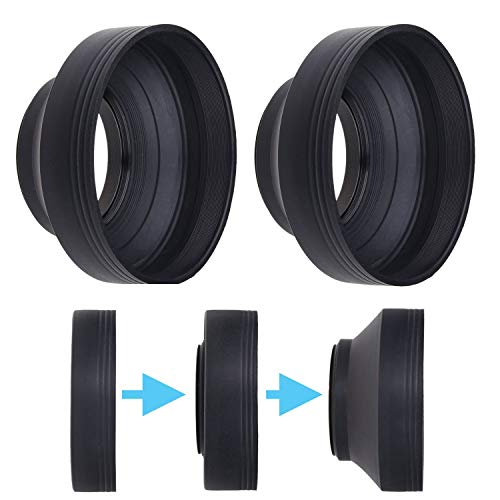
Altura Photo Collapsible Rubber Lens Hood
Rubber folds to three depths, so one hood can shade a wide zoom and a short telephoto. Threads come in common sizes from 49mm up to 77mm, matched to the number printed on your lens. Pressed against a window, the rim also blocks reflections when shooting through glass.
Pros
- Three depths cover several focal lengths
- Folds flat without unscrewing
- Rubber rim kills reflections on glass
Cons
- Rubber loses its shape as it ages
- Deepest stage vignettes on wide zooms

Fotasy Metal Screw-in Lens Hood
Manual focus glass usually arrives secondhand with its factory hood long gone. A machined aluminium tube screws into threads from 39mm to 58mm and stays rigid under pressure. Depth is shallow, which suits standard and short telephoto lenses rather than wide primes.
Pros
- Restores shading to older manual lenses
- Rigid metal guards the front element
- Takes a cap on its own front thread
Cons
- Fixed depth cannot follow a zoom range
- No reversing, so it adds length in a bag

Nikon HB-N106 Lens Hood
Nikon supplies no hood with the AF-P DX 18-55mm VR, which is why most owners end up here. Petal depth is cut for the 18mm end, so corners stay clear at the widest setting. It reverses against the barrel and leaves the front cap usable.
Pros
- Depth matched to the 18mm end
- Reverses flat against the barrel
- Genuine part, so the bayonet aligns first time
Cons
- Fits a short list of Nikon lenses
- Light plastic pops off in a hard knock
What matters most
What a lens hood actually does Two jobs, and neither is optional. Stray light hitting the front element scatters inside the barrel and lifts shadows to a milky grey, which no filter removes afterwards. A hood also takes the first hit when a lens meets a door frame. Depth is the variable that matters, because shading strength depends on how far a hood can extend before entering the frame, and your widest focal length sets that limit.
Petal, round or collapsible shapes Petal hoods are cut for a rectangular sensor, so they reach deeper without clipping corners on wide zooms. Round hoods suit primes and telephotos, where the angle of view is already narrow, and they cannot be mounted crooked. Collapsible rubber trades shading for packed size. Choose the shape around your widest lens and it will work on longer glass too.
Bayonet or screw-in: how the hood mounts Bayonet hoods clip into lugs on the lens front and flip around for storage, leaving the filter thread free. Screw-in hoods occupy that thread, so a filter goes on first and the hood threads onto its front ring. Rotating a polariser is where screw-in mounts frustrate people most. Anyone reaching for a CPL weekly should stay on bayonet.
Best choices for travel, mixed kits and vintage glass Three lenses with three diameters means three dedicated hoods and a fuller bag. KUVRD’s silicone sleeve spans roughly 52mm to 82mm and squashes flat, while Altura’s rubber hood does the same job on a filter thread. Secondhand manual lenses usually just need a plain metal screw-in hood such as the Fotasy in the right thread size. Expect slightly weaker shading from any universal design, since no round hood matches a petal cut made for one lens.
Compared at a glance
| # | Model | Mount | Best for | Score | Price |
|---|---|---|---|---|---|
| 1 | Canon EW-73B Lens Hood | Bayonet, for 67mm filter thread lenses | Best overall | 9.4 | Check price |
| 2 | KUVRD Universal Lens Hood | Moulded silicone | Best for mixed lens kits | 9.2 | Check price |
| 3 | JJC LH-63C Lens Hood | Bayonet, for 58mm filter thread lens | Best value | 9.0 | Check price |
| 4 | Fujifilm LH-XF35-2 Lens Hood | Anodised aluminium | Best for mirrorless primes | 8.8 | Check price |
| 5 | Altura Photo Collapsible Rubber Lens Hood | Flexible rubber | Best budget | 8.6 | Check price |
| 6 | Fotasy Metal Screw-in Lens Hood | Machined aluminium | Best for manual and vintage lenses | 8.3 | Check price |
| 7 | Nikon HB-N106 Lens Hood | Nikon bayonet | Best for Nikon kit zooms | 8.0 | Check price |
Common questions
Do lens hoods really make a difference?
Yes, mostly in contrast. Side light scattering inside the barrel lifts blacks to grey, and backlit frames show the change clearest. Resolution stays unchanged. Rain and fingerprints also stay off the glass.
Can you use any lens hood on any lens?
Only when the bayonet code or filter thread matches and the depth suits your focal length. A hood built for a 50mm prime darkens corners at 18mm. Silicone and rubber universal hoods are the exception, since they grip a range of barrel widths.
What size lens hood do I need?
Look for a number beside a circled symbol on the lens front or inside the cap. That figure in millimetres is your filter thread, and screw-in hoods use it directly. Bayonet hoods instead go by the model code Canon, Nikon or Fujifilm publishes for the lens.
Is a petal lens hood better than a round one?
For wide and standard zooms, yes, because cutouts let it sit deeper before entering the frame. From roughly 50mm upward a round hood shades just as well. Round hoods also cannot be fitted out of alignment, which petal hoods can.
Should you use a lens hood indoors?
Leave it on. Ceiling lights and windows scatter light the same way the sun does, and indoor framing often puts a lamp just outside the edge. Take it off only when an on-camera flash sits close to the lens, where the hood casts a shadow.
Can you fit a filter with a lens hood on?
Bayonet hoods leave the filter thread free inside the mount, so yes. With screw-in or rubber hoods the filter goes on first and the hood threads onto its front ring. Check that ring actually has a thread before buying.
Lens hood vs UV filter: which protects better?
A hood absorbs impact and keeps fingers away from the glass. A filter seals out dust and spray but adds a reflective surface that can worsen flare. Running both is common, and the hood is the part that survives a fall.
Why does my lens hood cause dark corners?
Depth is wrong for the focal length, or a petal hood has been rotated out of position. Long petals belong at top and bottom. Stacking a hood on a thick filter ring pushes it forward and creates the same shading.
Are third-party lens hoods as good as the originals?
On fit and shading, usually yes, as the JJC LH-63C shows against the Canon EW-63C. Differences appear in coatings and plastic quality, which scuff faster. Wobble and vignetting turn up mainly on cheap copies used with unlisted lenses.
Our take
Shooting an EF-S zoom in the 67mm family? Buy the Canon EW-73B and stop thinking about it, since petal depth and bayonet fit are already matched to the lens. Photographers switching between three or four barrel diameters save more space with the KUVRD Universal Lens Hood. Vintage manual glass needs nothing more than the Fotasy metal screw-in hood in the correct thread size.
Marcus Chen
Marcus covered consumer electronics for enthusiast tech publications for six years before joining ChoiceCrest. He specializes in translating manufacturer spec sheets into plain-language buying advice, with a focus on audio, computing accessories and smart-home gear.


