Picking a Lens Cap That Fits and Clears the Hood
Nikon’s LC-67B takes the top slot, since two inner tabs stay reachable inside a deep hood. Shooting 77 mm L-series glass? Canon’s E-77 II moved its tabs inward for the same reason. Mixed thread sizes suit the KUVRD Universal Lens Cap, which stretches over the barrel instead.
Nikon’s LC-67B fits any lens with a 67 mm filter thread, Nikon branded or not. Center tabs release it with a hood mounted, and replacements are easy to find in stock. One thread size is the catch, so a mixed bag of lenses needs several caps.
Sizing trips up most buyers. That number on a cap refers to the filter thread, never the barrel width. We matched listed thread sizes against common kit lenses, read owner feedback on caps loosening over time, and checked which designs still work with a hood in place.
How to pick the right one
What to look for in a lens cap Start with the filter thread number printed on the front rim or inside the barrel. That figure, 58 mm or 77 mm for example, decides which threaded cap fits. Center pinch designs beat older edge-squeeze caps, because their tabs stay reachable inside a hood. Inner lip quality matters as well, since a felt or ribbed lip holds tension far longer than bare plastic.
Do you need one cap per lens? Few photographers own a single thread size. A 35 mm prime might take 52 mm while a telephoto zoom takes 77 mm, so one spare cannot cover both. Two routes work. Buy a branded cap per lens for exact fit, or run a stretch silicone cover such as the KUVRD that ignores thread size and grips the barrel wall.
Using caps with hoods and filters Deep tulip hoods swallow the cap and leave no room for outer squeeze tabs. Center pinch caps answer that, and Canon shifted the E-77 II tabs inward for exactly this reason. Keep a UV or polarizer mounted and the cap now threads onto the filter, not the lens. Slim filter rings can change the effective depth, so check the marking before ordering.
Travel, weather and lost caps Caps disappear on location, usually out of a jacket pocket. Tether cords like the JJC keeper solve that for a small residue trade-off. Beaches and dusty trails favour silicone covers, which seal against the barrel wall rather than resting on a thread. Shipping gear or storing lenses hood-on? Op/Tech’s Hood Hat suits that routine better than any threaded cap.
Our top picks

Nikon LC-67B Snap-On Front Lens Cap
Two tabs sit inside the cap face, so a mounted hood never blocks removal. Molded polycarbonate keeps weight down, and the inner lip holds its tension through months of daily use. Fit follows the 67 mm thread standard, which means third-party lenses take it as well.
Pros
- Inner tabs stay reachable inside deep hoods
- Tension holds after months of daily removal
- Works on any 67 mm thread, not only Nikon lenses
Cons
- Covers one thread size, so mixed kits need several
- No loop for a tether cord

Canon E-77 II Lens Cap 77mm
Canon sizes this one for 77 mm threads, the standard on lenses such as the EF 24-70mm f/2.8L II. Second-generation tabs moved closer to the center than the older E-77U, which matters inside the tulip hoods those zooms ship with. Shell rigidity stops it flexing in a packed bag.
Pros
- Tabs clear tulip hoods on fast zooms
- Rigid shell resists flex under pack pressure
- Very common size, simple to replace
Cons
- Wide diameter eats real pocket space
- Glossy finish picks up scuffs quickly

Sony ALC-F55S 55mm Front Lens Cap
Several E-mount kit zooms ship with this exact 55 mm cap, so a spare keeps every size in the bag uniform. Small pinch tabs suit the shallow hoods found on compact APS-C lenses. Weight barely registers in a jacket pocket.
Pros
- Matches the cap already on many E-mount zooms
- Low profile suits compact mirrorless bodies
- Matte finish hides handling marks
Cons
- Small tabs are fiddly with gloves on
- Useful only if your lenses share a 55 mm thread

JJC Center Pinch Lens Cap with Cap Keeper
Thread options run from 37 mm all the way to 105 mm, and an elasticated keeper cord comes in the box. That cord sticks to the barrel and stops the cap vanishing on a windy shoot. Tolerance sits slightly looser than an original cap, which some owners prefer for quick removal.
Pros
- Keeper cord ends the lost-cap problem
- Covers almost every common thread size
- Felt lining stops rattle against the filter ring
Cons
- Grip is looser than a brand original
- Adhesive pad leaves residue when pulled off

KUVRD Universal Lens Cap
Stretch silicone grips the outside of the barrel, so thread size stops mattering. One cover then serves several lenses and seals out dust, sand and spray. It also goes over a mounted filter, at the cost of noticeable bulk.
Pros
- One cover fits several lens diameters
- Silicone seal keeps sand and drizzle off the glass
- Slips over a mounted UV or polarizing filter
Cons
- Bulkier than a flat plastic cap
- Slower to pull when a shot appears suddenly

Altura Photo Snap-On Lens Cap
Plain pinch caps arrive in the usual thread sizes, often bundled with a keeper string. Construction is basic, though the geometry copies the original design closely enough for storage duty. Stocking one spare per bag is the sensible way to use them.
Pros
- Easy to keep spares in every bag
- Pinch tabs clear most hoods
- Sizes cover the bulk of consumer zooms
Cons
- Plastic feels thinner than brand originals
- Tension loosens after heavy use
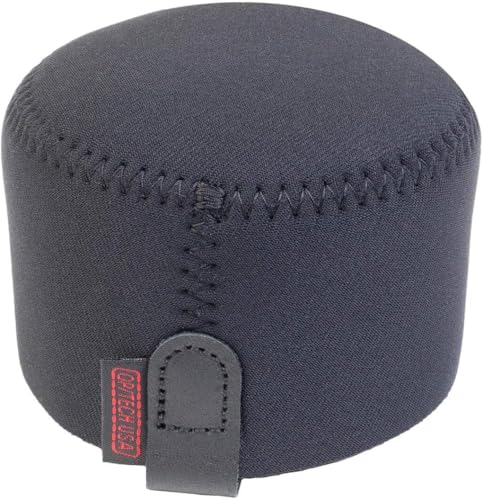
Op/Tech USA Hood Hat
Neoprene slips over the outside of a mounted hood rather than threading into the filter ring. Photographers who leave hoods attached get protection in one step, with nothing to reverse. Sizes follow hood diameter, so measure the hood rim instead of the filter thread.
Pros
- No reversing the hood before packing
- Neoprene padding absorbs knocks in a shoulder bag
- Works with a square filter holder left in place
Cons
- Does nothing without a hood fitted
- Hood-rim sizing confuses first-time buyers
How they stack up
| # | Model | Filter thread | Best for | Score | Price |
|---|---|---|---|---|---|
| 1 | Nikon LC-67B Snap-On Front Lens Cap | 67 mm | Best overall | 9.4 | Check price |
| 2 | Canon E-77 II Lens Cap 77mm | 77 mm | Best for wide pro lenses | 9.2 | Check price |
| 3 | Sony ALC-F55S 55mm Front Lens Cap | 55 mm | Best for E-mount kit lenses | 9.0 | Check price |
| 4 | JJC Center Pinch Lens Cap with Cap Keeper | Sold from 37 mm to 105 mm | Best value | 8.8 | Check price |
| 5 | KUVRD Universal Lens Cap | Stretch over barrel, not thread size | Best for mixed lens kits | 8.6 | Check price |
| 6 | Altura Photo Snap-On Lens Cap | Common sizes from 49 mm to 82 mm | Best budget | 8.3 | Check price |
| 7 | Op/Tech USA Hood Hat | Slips over the lens hood rim | Best for lenses stored hood-on | 8.0 | Check price |
Common questions
What size lens cap do I need?
Use the filter thread size marked on the lens, written after a diameter symbol such as 58 or 67. Cap sizes match that figure exactly. A 67 mm lens therefore takes a 67 mm cap, whatever the brand.
Where is the filter thread size printed on a lens?
Look at the front rim around the glass, or just inside the barrel near the threads. Some lenses print it on the underside of the original cap. Barrel width and mount diameter are different numbers, so ignore both.
Center pinch vs side pinch lens cap: which is better?
Center pinch suits most users. Its tabs sit on the cap face, reachable with a hood mounted. Side pinch caps need clear space around the rim, which a deep hood removes.
Can I use a third-party lens cap on a Nikon or Canon lens?
Yes, since caps follow standard thread diameters rather than lens mounts. A JJC or Altura 67 mm cap seats on any 67 mm lens. Tolerances vary, so a generic cap can feel looser than the original.
Do lens caps protect against scratches?
Dust, fingerprints and light knocks during storage are their real job. Rigid plastic offers almost no impact resistance. A UV filter or a padded neoprene cover such as the Hood Hat guards better against drops.
Which lens cap works with a hood attached?
Center pinch caps and covers that fit outside the hood. Nikon’s LC-67B and Canon’s E-77 II both release from the center. Op/Tech’s Hood Hat sidesteps the problem by sitting over the hood rim.
How do I stop losing my lens cap?
Fit a keeper cord, which sticks to the barrel and clips through the cap. JJC and Altura both include one. Owners who dislike adhesive pads usually assign the cap a fixed pocket instead.
Are universal silicone lens caps worth it?
They pay off for travel and multi-lens kits, because one cover fits several diameters and seals against sand. Bulk and a slower grab-and-shoot workflow are the trade. Studio shooters gain far less.
Should the cap go over a UV filter?
Yes, and size it to the filter thread when the filter has a front thread of its own. Step-up rings change that number completely. Read the filter ring marking before ordering a replacement.
Is a rear lens cap the same as a front lens cap?
No. Rear caps clip to the lens mount, so they are sized by mount type such as E, RF or F. Front caps are sized by filter thread in millimetres.
Our take
Choose the Nikon LC-67B when your lens takes a 67 mm thread, because its center tabs stay usable inside a hood and replacements are easy to source. Photographers juggling several diameters should pick the KUVRD Universal Lens Cap instead, since one stretch cover retires three or four loose caps. Anyone who leaves hoods mounted permanently gets more from the Op/Tech Hood Hat.
Marcus Chen
Marcus covered consumer electronics for enthusiast tech publications for six years before joining ChoiceCrest. He specializes in translating manufacturer spec sheets into plain-language buying advice, with a focus on audio, computing accessories and smart-home gear.