A Lawn Mower That Matches Your Yard Size and Terrain
Honda HRN216VKA leads this list for its dependable engine and clean twin-blade cut. Toro Recycler 22 offers the strongest mulching performance with a drive that matches your walking pace, and Craftsman M105 is the best budget push mower for smaller, flatter lawns.
Honda HRN216VKA suits most homeowners best, thanks to a reliable engine and a consistently clean cut. Toro Recycler 22 follows close behind on mulching value, with a drive that adjusts to your pace. Craftsman M105 covers smaller, flatter lawns as the top budget choice.
Buying a gas mower gets tricky fast, since engine displacement, deck size, drive type and mulching quality all pull in different directions. A mower suited to a flat quarter acre can struggle on a hilly half acre. We compared published specifications and drive systems, then weighed what long term owners report about starting behavior and durability.
What we recommend

Honda HRN216VKA
Honda’s GCV170 engine pairs with twin blades that chop clippings finely for an even finish. Starting stays easy year after year, according to owner reports, which keeps this engine’s reputation intact. Self propelled drive handles slopes without extra effort from the user.
Pros
- Engine starts easily and holds up long term
- Twin blades leave a notably clean cut
- Strong resale value in the used market
Cons
- Heavier than a basic push mower
- Costs more than budget alternatives

Toro Recycler 22 (SmartStow)
Toro’s atomic blade and recycler deck shred clippings into fine mulch that feeds the lawn. A Personal Pace drive matches your own walking speed rather than a fixed setting. SmartStow folds the mower upright, which saves real garage space.
Pros
- Mulching performance stands out in this group
- Personal Pace drive adjusts automatically
- Folds upright for compact storage
Cons
- Personal Pace feels sensitive at first
- Bag fills quickly in thick grass

Craftsman M105
Smaller, flatter lawns are what this straightforward push mower is built for, since it skips the self propelled drive. A Briggs and Stratton engine starts reliably each season. Mulch, bag or side discharge cover the usual cutting choices through one deck.
Pros
- Affordable and simple to operate
- Briggs and Stratton engine starts reliably
- Three-in-one deck covers most needs
Cons
- No self-propelled assist
- Better suited to smaller flat lawns

Troy-Bilt TB105B
Tidy small yards suit this compact push mower, which balances a manageable deck with three-in-one cutting. Its engine starts easily, and the lighter frame maneuvers around beds and tight corners with less effort. Routine trims are handled without complaint, based on owner reports.
Pros
- Lightweight and easy to maneuver
- Three-in-one cutting adds flexibility
- Simple pull-start operation
Cons
- Not ideal for large lawns
- Push-only tires you out on slopes

Cub Cadet SC300
Rear wheel drive grips inclines where front drive models slip, which is the whole point of this mower. A larger deck covers ground quickly, and high rear wheels roll over uneven terrain. Sloped or larger properties suit its drive setup best.
Pros
- Rear-wheel drive grips well on slopes
- High rear wheels handle uneven ground
- Covers larger areas comfortably
Cons
- Heavier to store and transport
- Priced at a premium for the category

PowerSmart DB2321SR
Self propelled convenience arrives here at a lower price than most name brand drives. A 209cc engine brings enough torque for thick grass, and the deck mulches, bags or discharges. Everyday use suits it well, provided you accept a heavier build, according to owner reports.
Pros
- Self-propelled drive at a lower price
- Torquey engine handles thick grass
- Three-in-one cutting deck included
Cons
- Heavier than premium rivals
- Fewer dealer service options
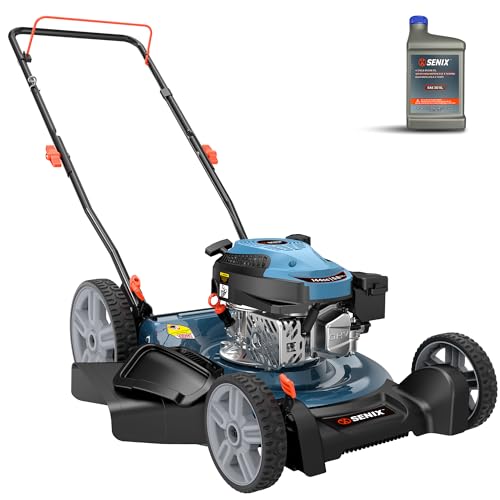
Murray 21-Inch Push Mower
No frills describes this gas push mower well, built for anyone wanting dependable basics without extra features. A Briggs and Stratton engine drives a simple side discharge and mulch deck. Its light frame pushes easily across flat ground.
Pros
- Very affordable and straightforward
- Lightweight for easy pushing
- Trusted Briggs and Stratton engine
Cons
- No bagging on some configurations
- Basic build with few extras
What to look for
Push versus self-propelled: which drive fits your lawn A push mower stays lighter, cheaper and easier to maintain, suited to small flat lawns under a quarter acre. Self propelled models drive their own wheels, so you steer rather than push, a real advantage on larger yards, thick grass or slopes. Rear wheel drive grips better than front wheel drive on any real hill.
Engine size and deck width for a typical yard Engine displacement, measured in cc, roughly tracks torque available for tall or wet grass. A 140cc to 160cc engine handles most residential lawns, while 200cc and up adds headroom for thick growth. Deck width from 21 to 22 inches balances coverage speed against maneuvering around beds and fences.
Mulching, bagging or side discharge: pick by season Most mowers here offer a three-in-one deck. Mulching returns fine clippings to feed the lawn and saves emptying a bag, side discharge clears tall grass fast, and bagging gives the cleanest finish. Mulching suits regular trims best, while bagging shines during spring flush or leaf season.
Maintenance habits that keep a gas mower reliable Gas mowers need routine care: fresh fuel, seasonal oil changes, a clean air filter and an occasional sharpened blade. Engines from established makers like Honda and Briggs and Stratton reward this upkeep with years of easy starting, according to owner reports. Storing the mower dry and stabilizing fuel over winter prevents most spring starting problems.
The lineup, side by side
| # | Model | Engine | Best for | Score | Price |
|---|---|---|---|---|---|
| 1 | Honda HRN216VKA | Honda GCV170 auto choke | Best overall | 9.4 | Check price |
| 2 | Toro Recycler 22 (SmartStow) | Toro 150cc OHV | Best for mulching | 9.2 | Check price |
| 3 | Craftsman M105 | Briggs & Stratton 140cc | Best budget push mower | 8.9 | Check price |
| 4 | Troy-Bilt TB105B | Troy-Bilt 140cc OHV | Best for small yards | 8.7 | Check price |
| 5 | Cub Cadet SC300 | Cub Cadet 159cc OHV | Best for hills | 8.5 | Check price |
| 6 | PowerSmart DB2321SR | PowerSmart 209cc OHV | Best affordable self-propelled | 8.3 | Check price |
| 7 | Murray 21-Inch Push Mower | Briggs & Stratton 140cc | Best basic starter mower | 8.0 | Check price |
Questions worth asking
Is a gas mower better than a battery mower?
Gas mowers usually sustain more power through large yards, tall grass and long sessions without recharging. Battery models run quieter with less maintenance but are limited by runtime, so gas still holds the edge on big or thick lawns.
How much engine power does a residential lawn need?
A 140cc to 160cc engine covers a typical residential lawn without trouble. Thick, tall or damp grass cut often calls for 200cc or more so the blade does not bog down.
What is the difference between mulching and bagging?
Mulching chops clippings finely and drops them back into the lawn to return nutrients. Bagging collects clippings for a tidier look, and most mowers here switch between both depending on the season.
Do I need a self-propelled mower for a small yard?
Not usually. A push mower stays lighter, cheaper and easier to maintain on a small flat lawn. Self propelled drive earns its keep on larger yards, slopes, or whenever steering beats pushing.
How often should mower oil be changed?
Once per season, or roughly every 25 to 50 running hours, covers most owners’ needs, and always change it after the first few hours on a new engine. Check the specific model’s manual, since intervals vary by engine.
Why won’t a gas mower start in spring?
Stale fuel left over winter is the most common cause, since it gums up the carburetor. Draining old gas, adding fresh fuel with stabilizer, and checking the spark plug and air filter resolves most spring starting issues.
What deck size fits a typical residential lawn?
A 21 to 22 inch deck fits most yards, balancing coverage speed with easy turning. Larger decks cut faster but maneuver less easily around trees, beds and narrow gates.
Are gas mowers hard to maintain compared to electric?
Not particularly. Basic upkeep means fresh fuel, seasonal oil changes, a clean air filter and a blade sharpened once or twice a year, which keeps a gas mower starting reliably for many seasons.
Can a gas mower handle wet grass without clogging?
It can, but wet grass clumps and strains any mower’s deck. Use side discharge, raise the cutting height and go slowly, since a higher torque engine handles the load better.
Honda HRN216VKA vs Toro Recycler 22: which cuts better?
Honda’s twin blade system gives a slightly cleaner overall cut, while Toro’s atomic blade and recycler deck mulch more finely. Choose Honda for cut quality overall and Toro if fine mulching matters most to you.
Our pick
Honda HRN216VKA remains the best gas lawn mower for most homeowners, thanks to a reliable engine, a clean twin-blade cut and long term durability. Toro Recycler 22 is the excellent alternative when mulching value matters most. Craftsman M105 covers smaller flat lawns for buyers working with a tighter budget.
Sierra Daniels
Sierra's background is in landscape design and nursery retail. She focuses on lawn and garden equipment, outdoor furniture and gear durability, weighing published specs against how materials actually hold up outside.