Laminators Worth Keeping on a Home Office Desk
The Scotch TL906 is the strongest all-around pick, warming up fast and handling letter-size pouches without jamming. The Fellowes Saturn3i 125 suits offices running higher laminating volume, while the Scotch TL1302 fits anyone who wants a compact machine for occasional home use.
The Scotch TL906 leads this list because its roughly 60 second warm-up and dual-roller design laminate letter-size pages without the jamming common in cheaper machines. Its main limitation is document width, which caps out at letter size rather than accommodating larger office documents.
We compared published warm-up time, maximum pouch thickness support and feed width across each machine rather than running our own durability tests.
Our top picks

Scotch TL906 Thermal Laminator
A roughly 60 second warm-up time keeps the machine ready quickly for occasional use rather than sitting idle while heating. The dual-roller system feeds letter-size pouches evenly, reducing bubbles and wrinkles compared to single-roller designs. An automatic shutoff turns the unit off after a period of inactivity.
Pros
- Fast warm-up suits quick, occasional laminating tasks
- Dual rollers reduce bubbles and wrinkles
- Automatic shutoff adds a safety margin when left on
Cons
- Limited to letter-size documents, no wider format
- Pouch thickness range is narrower than office-grade models

Fellowes Saturn3i 125 Laminator
A wider feed slot accommodates documents up to 12.5 inches, covering larger office handouts and signage that letter-size machines cannot fit. Jam-release lever lets users clear a stuck pouch without powering down the unit. Supports a broader range of pouch thicknesses than compact home machines.
Pros
- Wider feed slot fits larger documents and signage
- Jam-release lever clears stuck pouches without shutdown
- Supports a broader pouch thickness range
Cons
- Larger footprint takes up more desk space
- Costs more than compact home-use laminators
Swingline Fusion 1000L Laminator
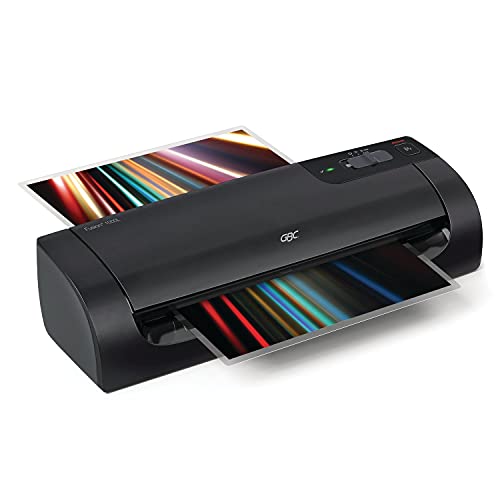
A fast lamination speed reduces wait time between documents compared to standard home laminators, suited to batches of paperwork. The release button provides quick jam clearing without disassembling the machine. Supports both letter and legal size documents through an 11 inch feed width.
Pros
- Faster lamination speed suits laminating in batches
- Quick-release button simplifies jam clearing
- Handles both letter and legal size documents
Cons
- Bulkier than compact single-purpose laminators
- Higher price than basic letter-only machines

Scotch TL1302 Thermal Laminator
A smaller footprint suits desks with limited space, while still laminating standard letter-size documents and photos. The two-roller system keeps feed consistent for its compact size class. A carrying handle makes it easy to store in a closet between uses.
Pros
- Compact size suits desks with limited space
- Carry handle makes storage between uses easier
- Lower price than wider-format laminators
Cons
- Cannot handle documents wider than letter size
- Slower warm-up than the larger Scotch TL906

Apache AL13P Pouch Laminator
A wider heat roller tolerance accepts thicker pouches than typical home laminators, suited to menus, signs and frequently handled documents. The 13 inch feed width covers letter, legal and tabloid-adjacent sizes. Adjustable speed and temperature settings match different pouch thicknesses.
Pros
- Supports thicker pouches than most home laminators
- Adjustable settings match pouch thickness to heat level
- Wide 13 inch feed handles larger documents
Cons
- Takes up more counter space than compact models
- Setup requires more attention to speed and heat settings

Crenova Pro 9-in-1 Laminator
Beyond basic laminating, this machine includes functions like corner rounding and paper cutting built into one compact unit. The multi-function design suits home offices that want fewer separate tools on a desk. A reasonable price point covers most light laminating needs.
Pros
- Built-in corner rounder and cutter reduce desk clutter
- Lower price than single-purpose office laminators
- Compact footprint fits small home office desks
Cons
- Multi-function design means more parts that can wear out
- Not built for high-volume or frequent daily laminating

TOWO A3 Laminator
A wide A3 feed width accommodates posters, large charts and oversized documents that letter-size machines cannot process. Four-roller design helps keep larger sheets feeding straight through the heating chamber. Adjustable temperature settings accommodate different pouch thicknesses at this larger size.
Pros
- A3 feed width handles documents letter-size machines cannot
- Four rollers help keep large sheets feeding straight
- Adjustable temperature suits varied pouch thickness
Cons
- Larger unit needs more desk or shelf space
- Heavier to move or store than compact laminators
The lineup, side by side
| # | Model | Warm-Up Time | Best for | Score | Price |
|---|---|---|---|---|---|
| 1 | Scotch TL906 Thermal Laminator | Approximately 60 seconds | Best Overall | 9.0 | Check price |
| 2 | Fellowes Saturn3i 125 Laminator | 12.5 inches | Best for Office and High Volume | 8.9 | Check price |
| 3 | Swingline Fusion 1000L Laminator | 11 inches, letter and legal | Best for Speed | 8.7 | Check price |
| 4 | Scotch TL1302 Thermal Laminator | Letter size, 9 inches | Best Compact | 8.4 | Check price |
| 5 | Apache AL13P Pouch Laminator | 13 inches | Best for Thick Pouches | 8.6 | Check price |
| 6 | Crenova Pro 9-in-1 Laminator | Letter size | Best Value | 8.3 | Check price |
| 7 | TOWO A3 Laminator | A3, approximately 13 inches | Best for Large Documents | 8.5 | Check price |
Before you buy
What to look for in a laminator Maximum document width decides whether a machine handles only letter-size pages or larger formats like posters and signage. Warm-up time affects how quickly the machine becomes usable, which matters more for occasional home use than high-volume office settings. Pouch thickness support determines how durable the final laminated document will be, with thicker pouches suited to menus or signs handled often.
Home office laminators versus office-volume machines Compact models like the Scotch TL1302 and Crenova Pro 9-in-1 suit occasional home laminating, prioritizing desk space and lower price over speed. Higher-volume machines like the Fellowes Saturn3i 125 and Swingline Fusion 1000L are built for offices laminating many documents in a sitting, with wider feeds and faster processing. Buyers should estimate how often they will laminate before choosing between these two tiers.
Letter size versus wider document formats Most home laminators cap feed width at letter size, around 9 inches, which covers standard paper and small signs. Wider machines like the Apache AL13P and TOWO A3 extend that to 13 inches or A3 format, necessary for posters, menus and larger charts. Anyone laminating oversized materials regularly should rule out letter-only machines early in the search.
Matching pouch thickness to document durability Thin pouches work fine for documents handled occasionally, like certificates stored in a drawer. Thicker pouches, supported by machines like the Apache AL13P, hold up better for menus, signs or ID cards that get handled daily. Checking a laminator’s maximum supported pouch thickness before buying pouches avoids a mismatch that causes jamming.
Frequently asked questions
How long does a laminator take to warm up?
Warm-up time varies by model, with compact home laminators like the Scotch TL906 ready in around 60 seconds, while larger office machines can take longer.
What size documents can a home laminator handle?
Most compact home laminators handle letter-size documents up to about 9 inches wide, while wider models like the TOWO A3 handle larger poster and chart sizes.
Can a laminator handle thick pouches?
Not all laminators support thick pouches. Machines like the Apache AL13P are built with a wider heat roller tolerance specifically for thicker pouch material.
What happens if a pouch jams in a laminator?
Most laminators include a jam-release mechanism, such as the lever on the Fellowes Saturn3i 125, that lets users clear a stuck pouch without fully powering down.
Is a cold laminator different from a thermal laminator?
Yes. Thermal laminators use heat to bond the pouch, while cold laminators use pressure-sensitive adhesive, which is less common for general home or office use.
How many documents can a laminator process in one session?
This depends on the model and pouch size, though office-focused machines like the Swingline Fusion 1000L are built for faster, higher-volume laminating sessions.
Can a laminator round the corners of a document?
Only some multi-function models, like the Crenova Pro 9-in-1, include a built-in corner rounder as part of the unit.
What is the difference between A3 and letter size laminators?
A3 laminators, like the TOWO A3, accept documents around 13 inches wide, while letter-size laminators are limited to roughly 9 inch wide documents.
Do laminators need to be turned off after use?
Many models, including the Scotch TL906, include an automatic shutoff after a period of inactivity, though manually turning off the unit is still good practice.
Our take
For typical home office needs, the Scotch TL906 offers the best balance of fast warm-up and reliable feeding for letter-size documents. Offices laminating higher volumes or wider documents should choose the Fellowes Saturn3i 125 instead for its larger feed width and jam-release design. Anyone laminating posters or oversized charts should skip letter-only machines entirely and go with the TOWO A3.
Jake Monroe
Jake worked as a residential contractor for over a decade before shifting to full-time writing. He evaluates power tools, hand tools and workshop gear through the lens of someone who has actually used them on job sites, not just read the box.