How to Pick Laminating Pouches That Fit Your Machine
Scotch Thermal Laminating Pouches TP3854-20 cover everyday letter documents at 3 mil. Swingline GBC UltraClear ships in 100 and 200 counts for classrooms laminating daily. Fellowes ImageLast adds a UV resistant layer for certificates that sit on display for years.
Scotch TP3854-20 handles routine office paperwork best, with 3 mil sheets sized 8.9 by 11.4 inches that feed through most desktop laminators. Glossy finish keeps print sharp. Anything thicker than paper, such as a menu or a card, needs a heavier pouch instead.
Listings make pouches look interchangeable, yet mil rating and sheet width decide whether your machine accepts them. We compared stated thickness, dimensions, pack counts and manufacturer machine ratings. Owner reports on jamming, hazy edges and yellowing over time shaped the order.
The best picks, ranked

Scotch Thermal Laminating Pouches TP3854-20
Letter sized sheets at 3 mil per side run through most home and office thermal laminators without curling at the leading edge. Scotch rates the pack for photos, recipe cards and standard documents. A 20 count suits occasional batches rather than daily volume.
Pros
- Feeds consistently through entry level laminators
- Glossy surface shrugs off fingerprints
- Stocked almost everywhere as a refill size
Cons
- Fits letter documents only
- 3 mil stays floppy for menus or signage

Swingline GBC UltraClear Thermal Laminating Pouches
Bulk counts reaching 200 pouches make this the sensible refill for a classroom or a small print desk. GBC finishes the film optically clear, avoiding the faint haze cheap pouches show under overhead light. Thickness stays at 3 mil per side across the batch.
Pros
- Per pouch cost drops sharply at bulk counts
- Clarity stays even from first sheet to last
- Standard letter width fits most office machines
Cons
- A 200 count box eats shelf space
- No matte finish in this line

Fellowes ImageLast Thermal Laminating Pouches
Fellowes builds a UV resistant layer into ImageLast film to slow the yellowing that plain pouches develop. Certificates, licences and family photos hold their tone through years of display. Choosing the 5 mil version adds enough stiffness for a wall mounted document.
Pros
- UV layer delays yellowing on displayed documents
- 5 mil option stands up on a wall without curling
- Sized for certificates and licence sheets
Cons
- Per pouch cost sits above Scotch and GBC
- 5 mil needs a laminator rated for thicker stock
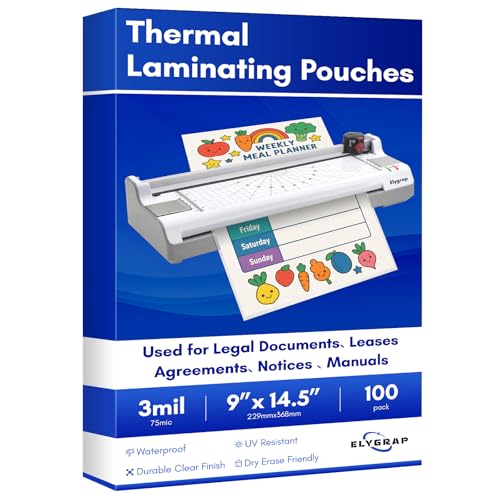
Apache AL13P Legal Size Thermal Laminating Pouches
Legal pages measure 8.5 by 14 inches, so a letter pouch leaves the bottom third exposed. Apache closes that gap at 9 by 14.5 inches with a sealed border all round. Thickness holds at 3 mil, matching what most legal feed office laminators accept.
Pros
- Covers legal pages and long format menus
- Bulk count keeps cost per sheet low
- Works with laminators rated for legal width
Cons
- Wastes film on standard letter documents
- Compact 9 inch machines cannot feed it

TruLam 5 Mil Thermal Laminating Pouches
Doubling thickness to 5 mil per side turns a floppy sheet into something closer to card. Restaurant menus, shelf tags and classroom signs survive daily handling without creasing at the corners. Feed speed matters here, so a laminator with adjustable settings gives the cleanest seal.
Pros
- Stiffness holds up to repeated handling
- Corners resist the creasing 3 mil picks up
- Suits menus, price tags and posted signage
Cons
- Requires a machine rated to 5 mil
- Excessive for single use handouts

Scotch Photo Size Thermal Laminating Pouches TP5900-20
Cut to 4.375 by 6.375 inches, these match a standard 4×6 print with just enough margin to seal. Scotch keeps the gloss neutral so colour stays true on a displayed photo. Small dimensions also suit compact desktop laminators that reject full letter sheets.
Pros
- Matches 4×6 prints without trimming
- Runs through small format laminators
- Neutral gloss avoids colour shift
Cons
- Too small for documents or index cards
- 20 pouches disappear fast on a photo project

Fellowes Business Card Size Thermal Laminating Pouches
Pre cut to 2.35 by 3.7 inches, these skip the trimming step that letter pouches force on you. Fellowes uses 5 mil film, giving cards enough backbone to survive a wallet. Pack sizes of 25 and 100 line up with small print runs.
Pros
- Sized for standard business cards already
- 5 mil film survives pocket and wallet wear
- No guillotine work after lamination
Cons
- Useless for anything larger than a card
- Small sheets need hand centring on wide machines
How they compare
| # | Model | Thickness | Best for | Score | Price |
|---|---|---|---|---|---|
| 1 | Scotch Thermal Laminating Pouches TP3854-20 | 3 mil per side | Best overall | 9.4 | Check price |
| 2 | Swingline GBC UltraClear Thermal Laminating Pouches | 3 mil per side | Best value | 9.1 | Check price |
| 3 | Fellowes ImageLast Thermal Laminating Pouches | 3 mil or 5 mil | Best for archival documents | 8.9 | Check price |
| 4 | Apache AL13P Legal Size Thermal Laminating Pouches | 3 mil per side | Best for legal size pages | 8.7 | Check price |
| 5 | TruLam 5 Mil Thermal Laminating Pouches | 5 mil per side | Best for signage and menus | 8.5 | Check price |
| 6 | Scotch Photo Size Thermal Laminating Pouches TP5900-20 | 3 mil per side | Best for photos | 8.3 | Check price |
| 7 | Fellowes Business Card Size Thermal Laminating Pouches | 5 mil per side | Best for business cards | 8.1 | Check price |
Before you buy
What mil thickness actually means Mil describes the thickness of one side of the pouch, not the pair. A 3 mil pouch therefore seals a document inside 6 mil of film total. Everyday paper, photos and handouts need nothing more. Stepping up to 5 mil buys rigidity for signage and cards, and your laminator has to be rated for it. Manuals list a maximum mil figure, usually on the specification page near the warm up time.
Matching pouch size to your laminator Letter pouches run about 9 by 11.5 inches and fit nearly every home or office machine. Legal pouches at 9 by 14.5 inches need a wider throat, which compact 9 inch laminators do not have. Photo and card pouches create the opposite problem: they are narrow enough to drift sideways in the rollers. Feeding small pouches inside a carrier sheet keeps them straight and stops adhesive reaching the rollers.
Best for classrooms and high volume offices Daily laminating changes the maths, since a 20 count pack lasts about a week in a busy classroom. GBC boxes of 100 or 200 cut the per pouch cost and the reorder cycle at once. Storage is the real tradeoff, because a 200 count box takes several times the shelf depth of a small pack. Buy one size of pouch and one thickness, so staff never have to guess which tray matches the machine.
Best for certificates and long term display Sunlight is what ruins laminated documents, not handling. Standard film yellows across a few years on a wall facing a window. ImageLast uses a UV resistant layer that slows that shift, which justifies its higher cost for diplomas and licences. One warning applies to anything valuable: lamination is permanent, so never laminate an original birth certificate, a passport photo page or a signed document you may need to verify later.
Questions worth asking
What mil thickness is best for laminating pouches?
3 mil covers documents, handouts and photos. Move to 5 mil for menus, signage and cards, and confirm your laminator lists that rating first.
Can you use 5 mil pouches in any laminator?
No. Compact machines often cap out at 3 mil per side, and forcing thicker film through them causes jams and cloudy seals.
Do laminating pouches fit legal size paper?
Letter pouches leave a legal page hanging out the end. Legal pages need a pouch around 9 by 14.5 inches plus a laminator rated for that width.
Why do laminating pouches turn yellow over time?
UV exposure breaks down the adhesive layer in standard film. Pouches with a UV resistant coating, such as Fellowes ImageLast, delay that reaction.
Are glossy or matte laminating pouches better?
Gloss dominates the market and shows print detail sharply. Matte cuts glare on framed or wall mounted pages, though stock is thinner on the ground.
Can laminating pouches be used for business cards?
Card size pouches exist at 2.35 by 3.7 inches and need no trimming. Cutting down a letter pouch afterwards exposes the edges and lets moisture in.
How many laminating pouches come in a pack?
Counts run from 20 to 200. Home users rarely need more than 50, while schools and print desks usually buy 100 or 200 at a time.
What size are letter size laminating pouches?
Roughly 8.9 to 9 inches by 11.4 to 11.5 inches. That extra fraction beyond an 8.5 by 11 page creates the sealed border that keeps moisture out.
Do you need a carrier sheet with laminating pouches?
Modern pouches seal cleanly without one on most machines. Carriers still help with small card pouches and any pouch you feed off centre.
The verdict
Scotch TP3854-20 is the pouch to keep in the drawer, since letter documents make up nearly all home and office laminating. Switch to Fellowes ImageLast for certificates going on a sunlit wall, where the UV layer earns its extra cost. Classrooms laminating every day should buy GBC UltraClear in the 200 count and accept the storage space.
Marcus Chen
Marcus covered consumer electronics for enthusiast tech publications for six years before joining ChoiceCrest. He specializes in translating manufacturer spec sheets into plain-language buying advice, with a focus on audio, computing accessories and smart-home gear.


