Laminating Machines Compared for Home and Office Use
Scotch Thermal Laminator TL901X leads for fast warm-up and reliable jam release. Amazon Basics 9-Inch Thermal Laminator suits occasional home use at a lower cost. Fellowes Saturn 3i 125 handles high-volume classroom work best.
Scotch Thermal Laminator TL901X takes the top spot here, fast to warm up and forgiving when a pouch misfeeds. Amazon Basics 9-Inch model suits occasional home projects at a lower cost, and Fellowes Saturn 3i 125 handles high-volume classroom batches best. All seven machines below are currently sold on Amazon and cover craft projects, classroom materials and wide-format signage.
Listings emphasize warm-up time, but roller count, supported pouch thickness and a working jam release actually decide how a laminator performs day to day. We compared published specifications, entry widths and pouch ratings, along with what owners report about bubbling, curling and long-term reliability.
What matters most
What size laminator do you actually need? Nine inches covers letter and A4 documents with room for the pouch seal, enough for most home and office use. Tabloid sheets, large craft projects and classroom posters need twelve and a half or thirteen inches instead. Buying narrow is the most common regret in this category, since no workaround exists for a sheet that will not fit.
What does pouch mil thickness mean? Pouches come in mil ratings, typically three, five, seven and ten. Three mil stays flexible and works fine for documents, while five mil feels noticeably sturdier and suits menus and reference cards. Seven and ten mil run rigid, suit signage and luggage tags, and need a machine rated for them. Feeding a thick pouch into a machine rated for three mil is the fastest route to a jam.
How do rollers and warm-up time affect the finish? Two heated rollers handle thin document pouches without trouble. Four or more rollers apply pressure over a longer path, which keeps thick pouches flat instead of curling as they cool. Fast warm-up matters mainly for batch work, where waiting several minutes each session adds up across a school term.
How do you feed a pouch without jamming it? Feed the sealed edge of the pouch in first, keep the item centered with an even margin, and let the machine pull the pouch rather than pushing it. A carrier sheet helps if the manufacturer supplies one. Lay finished pouches flat to cool, since pulling one off a hot output tray while still soft causes wavy edges and lifting corners.
What we recommend

Scotch Thermal Laminator TL901X
Warm-up takes just a few minutes, and pouches up to nine inches wide fit through the rollers. A release lever pulls a misfeed back out instead of forcing a full teardown. Owners report consistent results across long classroom sessions with standard three and five mil pouches.
Pros
- Reliable jam release lever
- Consistent results across long runs
- Simple two-setting operation
Cons
- Nine-inch width limits larger craft sheets
- No cold laminating setting on this model
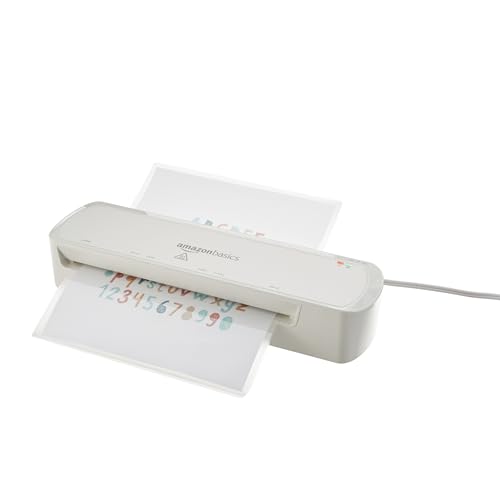
Amazon Basics 9-Inch Thermal Laminator
Laminating a few documents, recipe cards or photos each month suits this straightforward option well. Standard letter-sized pouches, a jam release and a quick warm-up cover casual use easily. Sustained high-volume work exposes its limits, since it needs pauses to hold a stable temperature.
Pros
- Approachable for occasional users
- Compact enough to store in a cupboard
- Jam release included despite the price
Cons
- Struggles with continuous high-volume runs
- Limited to thinner pouches

Fellowes Saturn 3i 125 Laminator
Pouches up to twelve and a half inches wide fit here, and heating takes about a minute, which is what makes large classroom batches practical. Thicker pouches run through it than entry-level machines allow, and a ready indicator confirms when it is set to go. Size and weight increase as a result.
Pros
- Very fast warm-up for batch work
- Wide entry handles larger sheets
- Supports thicker pouches
Cons
- Takes significant desk space
- Heavier to move and store

Swingline GBC Fusion 1000L Laminator
Shared office use drove this design, with a simple control layout and a jam release built for people who skip the manual. Letter-sized pouches produce clean, flat results on documents here. Thick craft pouches or wide-format work fall outside its scope.
Pros
- Simple enough for shared office use
- Flat, bubble-free document results
- Accessible jam release
Cons
- Limited to letter width
- No cold setting for heat-sensitive items

Fellowes Jupiter 2 125 Laminator
Continuous use is what this machine is built for, and pouches up to ten mil fit, covering rigid signage, luggage tags and heavy display cards. A multiple roller design keeps thick pouches flat where two-roller machines let them curl. Home users rarely need this much machine.
Pros
- Handles the thickest common pouches
- Multiple rollers reduce curl on rigid work
- Built for continuous duty
Cons
- Large footprint and heavy
- Overspecified for occasional home projects

Apache AL13P 13-Inch Laminator
Sheets up to thirteen inches wide fit through this machine, covering tabloid documents and larger craft sheets a nine-inch unit cannot accept. Adjustable temperature and a broad range of supported pouch thicknesses add flexibility. Build quality reads functional rather than premium, so treat it as a workshop tool.
Pros
- Accepts tabloid and oversized craft sheets
- Adjustable temperature for varied pouch types
- Four rollers give a flat finish
Cons
- Plain build quality and controls
- Needs a temperature test run for unfamiliar pouches

Crenova A4 Thermal Laminator
A4 and letter-sized documents fit this small laminator, aimed at occasional home projects and photographs. Quick warm-up pairs with hot and cold settings, which helps with heat-sensitive prints. A narrow entry and thin pouch limit define its scope clearly.
Pros
- Cold setting suits heat-sensitive prints
- Light enough to store anywhere
- Quick warm-up for casual jobs
Cons
- Not suited to continuous batches
- Thin pouches only
Side by side
| # | Model | Entry width | Best for | Score | Price |
|---|---|---|---|---|---|
| 1 | Scotch Thermal Laminator TL901X | 9 inches | Best overall | 9.4 | Check price |
| 2 | Amazon Basics 9-Inch Thermal Laminator | 9 inches | Best value | 9.2 | Check price |
| 3 | Fellowes Saturn 3i 125 Laminator | 12.5 inches | Best for high volume | 9.0 | Check price |
| 4 | Swingline GBC Fusion 1000L Laminator | 9 inches | Best for office use | 8.8 | Check price |
| 5 | Fellowes Jupiter 2 125 Laminator | 12.5 inches | Best for thick pouches | 8.6 | Check price |
| 6 | Apache AL13P 13-Inch Laminator | 13 inches | Best for wide format | 8.3 | Check price |
| 7 | Crenova A4 Thermal Laminator | About 9 inches | Best budget | 8.0 | Check price |
Good to know
What size laminator do I need?
A nine-inch machine handles letter and A4 documents, covering most home and office work. Twelve and a half or thirteen inches suits tabloid sheets, posters or large craft pieces. Buying wider than you currently need costs less than a second machine later.
What does mil mean on laminating pouches?
It describes the thickness of each side of the pouch. Three mil stays flexible for documents, five mil feels noticeably stiffer for menus and cards, and seven to ten mil runs rigid enough for signage. Check that a machine supports the thickness before buying pouches in bulk.
Why are there bubbles in my laminated sheets?
Feeding the machine before it reaches temperature, using a pouch thicker than it supports, or moving the sheet while it cools all cause bubbles. Wait for the ready indicator, match the pouch to the rating, and lay the finished piece flat under a book while it cools.
Can I laminate photographs?
Yes, though heat can affect some inkjet prints and older photographs. A machine with a cold setting, such as Crenova A4, or cold laminating pouches avoid that risk. Test with a print you do not mind losing first.
How do I clear a laminator jam?
Use the release lever if the machine has one, which pulls the rollers apart so the pouch comes free. Never force a jammed pouch through, and switch the machine off before reaching near the rollers. Machines without a release are far harder to recover from, which is why the feature is worth prioritizing.
Do laminators need cleaning?
Adhesive builds up on rollers over time and eventually causes streaks and sticking. Run a cleaning sheet through periodically, or a folded sheet of plain paper if the manufacturer recommends it. Never use liquid cleaners on heated rollers.
Can I laminate something twice for extra thickness?
It is not recommended. The outer pouch cannot bond properly to the smooth plastic of the first layer, so it tends to separate at the edges. A thicker pouch rating works better, which is what machines supporting seven or ten mil are for.
Is a hot or cold laminator better?
Hot laminating gives a stronger, more durable seal and is what most machines here do. Cold laminating uses pressure-sensitive adhesive and suits heat-sensitive items such as thermal paper receipts, some inkjet prints and older photographs. Machines offering both settings add flexibility to choose per job.
Which laminator is best for a classroom?
Fellowes Saturn 3i 125 fits classroom use well, since its fast warm-up and wide entry handle large batches of posters and worksheets without long waits between sheets.
The verdict
Scotch Thermal Laminator TL901X is the machine most people should buy, quick and consistent with an easy recovery when something misfeeds. Step up to Fellowes Saturn 3i 125 for batch work or wider sheets, and to Jupiter 2 125 for rigid ten mil pouches. Amazon Basics 9-Inch model covers occasional laminating just fine.
Jake Monroe
Jake worked as a residential contractor for over a decade before shifting to full-time writing. He evaluates power tools, hand tools and workshop gear through the lens of someone who has actually used them on job sites, not just read the box.