What’s the Best Telescope for a Curious Kid Stargazer?
Celestron’s FirstScope 76mm Tabletop leads because its weighted base removes wobble entirely, giving children steady views of lunar craters and Jupiter’s moons. The Gskyer AZ70400 is the best value full height refractor for older siblings. Younger children do best with the Orion FunScope 76mm, light enough to carry outside and set up alone.
Celestron’s FirstScope 76mm Tabletop is the telescope we would hand a child first. Families wanting full height on a tripod should look at the Gskyer AZ70400, and younger children who want to carry their own gear do best with the Orion FunScope 76mm.
Magnification numbers sell telescopes but rarely matter, and a wobbling tripod is what actually ends a child’s interest by night two. We compared aperture, mount stability, eyepiece quality and real setup time, then weighed in what parents report about children using each telescope unsupervised.
The top picks, ranked

Celestron FirstScope 76mm Tabletop Telescope
No tripod means no wobble, since the FirstScope sits on a table or low wall and its weighted base absorbs an accidental nudge. A 76mm mirror pulls in enough light to resolve lunar craters and show Jupiter’s four largest moons. Children aim it by pushing the tube, a motion that clicks faster than any slow motion knob.
Pros
- Weighted base removes tripod wobble entirely
- Push to aim design suits young hands
- Shows real lunar craters and Jupiter’s moons
Cons
- Needs a sturdy table or wall at the right height
- Bundled eyepieces are basic and worth upgrading later

Gskyer AZ70400 Refractor Telescope
Families wanting a standing telescope on a tripod should start here. A 70mm lens needs no collimation, so the AZ70400 works straight from the box and stays aligned for years. Its altazimuth mount swings up and down and side to side, the two motions children expect, though the aluminium tripod flexes if the thin lower legs get extended.
Pros
- Never needs collimation like a reflector would
- Full height tripod suits standing use
- Wide field of view makes targets easy to find
Cons
- Lower tripod legs flex at full extension
- Included phone adapter is fiddly to align
Orion FunScope 76mm TableTop Reflector
A six year old can lift this telescope and carry it outside alone, and that portability decides how often it actually gets used. Its tabletop base shares the steadiness of the FirstScope, while a wide field eyepiece makes the moon easy to locate. Optics are entry level, but the honest comparison is against a telescope left in a cupboard.
Pros
- Light enough for a child to carry unassisted
- Steady tabletop base needs no tripod
- Wide field eyepiece simplifies finding targets
Cons
- Entry level optics cap how much magnification is usable
- Still needs a flat table or wall surface

Celestron StarSense Explorer LT 80AZ
Knowing where to point is the hardest part of astronomy for a beginner, and StarSense solves it with a phone dock: the camera reads the sky and on screen arrows guide you to targets. A child wanting to see Saturn tonight, not learn star hopping first, benefits most. Expect a higher price and a phone dock that needs a compatible handset.
Pros
- Phone guidance removes the hardest beginner barrier
- 80mm aperture is larger than most starter refractors
- Encourages kids to navigate independently
Cons
- Requires a compatible smartphone to use the guidance feature
- Costs more than a basic starter refractor

Meade Instruments Infinity 70mm AZ Refractor
Three eyepieces and a Barlow lens ship in the box, so a child can try different magnifications without buying extra glass. One axis of the mount has slow motion control, useful for tracking a target as the sky drifts. Keep the tripod low on solid ground, since it flexes rather than locks rigid at full height.
Pros
- Generous eyepiece and Barlow lens bundle
- Slow motion control eases tracking
- No collimation needed, unlike a reflector
Cons
- Tripod feels flexible at full extension
- Highest magnification eyepiece is rarely sharp enough to use
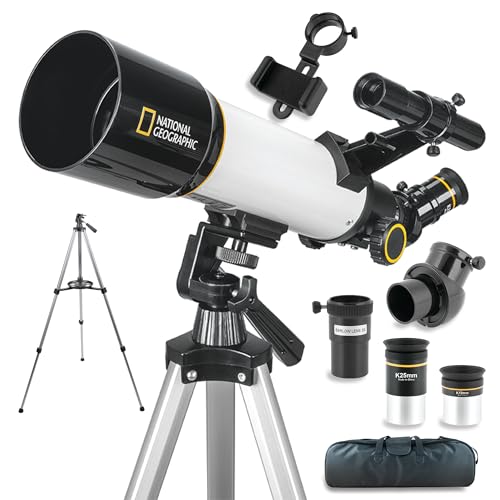
Emarth 70mm Refractor Telescope
Testing whether a child’s interest is genuine before spending more starts here. A 70mm objective, two eyepieces and a finder scope cover the basics, and lunar views come through clearly, which is what most first sessions are about. Parents report the tripod as the weak point, so setting it low on grass rather than decking helps.
Pros
- Lowest entry cost for testing genuine interest
- Shows lunar detail clearly for the price
- Simple enough for a child to run alone
Cons
- Tripod wobbles noticeably at full extension
- Finder scope needs careful alignment before each use

National Geographic 70mm Refractor Telescope
Recognisable branding does real work when a telescope is a gift, and a printed starter guide gives a child somewhere to begin instead of a bare tube. Optically it sits alongside other 70mm refractors, so the choice comes down to presentation and included learning material. Setup needs no collimation and takes only a few minutes.
Pros
- Beginner guide gives kids a place to start
- Presents well as a gift for a birthday or holiday
- No collimation required at setup
Cons
- Optics are typical for the class rather than exceptional
- Light tripod benefits from being kept low
What matters most
What should you look for in a kids telescope? Ignore magnification claims on the box, since any telescope can be fitted with an eyepiece boasting several hundred times zoom, and the resulting view is dim and blurry. Aperture, the diameter of the lens or mirror, is what actually matters, because it decides how much light reaches the eye. A steady 70mm view at fifty times beats a shaking 60mm view at three hundred times, every single night.
How much does mount stability matter for a child? A wobbling image is the single biggest reason a child’s telescope ends up in a cupboard. Tabletop designs with weighted bases sidestep the problem entirely. On a tripod model, extend only the thicker upper leg sections, place it on grass rather than decking, and accept a lower eyepiece height in exchange for a view that holds still.
Refractor or reflector: which suits a first time family? A refractor uses a lens, needs no adjustment and works straight from the box, which suits households with zero interest in maintenance. A reflector uses a mirror and delivers more aperture for the price, though it may occasionally need collimating, a simple mirror alignment. For a first telescope, choose a refractor or a compact tabletop reflector over anything that needs regular tuning.
What should you expect the first night outside? Saturn appears as a small sharp shape with visible rings, not a poster sized image, and galaxies show up as faint grey smudges rather than colourful spirals. Children who know this beforehand find the moon and Jupiter genuinely thrilling. Start a few days after new moon, when craters along the terminator line cast long shadows and detail peaks.
Compared at a glance
| # | Model | Aperture | Best for | Score | Price |
|---|---|---|---|---|---|
| 1 | Celestron FirstScope 76mm Tabletop Telescope | 76 millimetres | Best overall | 9.4 | Check price |
| 2 | Gskyer AZ70400 Refractor Telescope | 70 millimetres | Best value | 9.2 | Check price |
| 3 | Orion FunScope 76mm TableTop Reflector | 76 millimetres | Best for younger children | 9.0 | Check price |
| 4 | Celestron StarSense Explorer LT 80AZ | 80 millimetres | Best for finding objects | 8.8 | Check price |
| 5 | Meade Instruments Infinity 70mm AZ Refractor | 70 millimetres | Best all round refractor | 8.6 | Check price |
| 6 | Emarth 70mm Refractor Telescope | 70 millimetres | Best budget option | 8.3 | Check price |
| 7 | National Geographic 70mm Refractor Telescope | 70 millimetres | Best for gifting | 8.0 | Check price |
Frequently asked questions
What age is right for a first telescope?
Around six with an adult helping, and eight or nine for real independence. Tabletop models suit younger children best since there is no tripod to knock over and less to set up.
Does higher magnification mean a better telescope?
No. The eyepiece sets magnification, and pushing it past what the optics support just produces a dim blur. Aperture and mount stability decide how good a view actually looks.
Can a kids telescope show Saturn’s rings?
Yes, a 70mm or larger telescope shows the rings as a distinct small shape. Jupiter’s four bright moons are easy too, and lunar craters look spectacular through any of these instruments.
Do you need a dark sky to use a telescope?
It helps for faint deep sky objects, but the moon and bright planets cut through suburban light pollution easily. Start with those targets in the garden before planning any trip.
What is collimation and will we ever need to do it?
It means aligning the mirrors in a reflector, done with simple screws. Refractors never need it, and small tabletop reflectors need it rarely, so it is not a reason to avoid one.
Are the eyepieces that come with kids telescopes good enough?
They work, though the highest magnification eyepiece bundled with budget kits is usually too much for the optics to resolve. A single decent mid range eyepiece is the best first upgrade.
Can you take photos through a kids telescope?
Simple phone photos of the moon are achievable with a phone adapter and patience. Planetary and deep sky photography needs tracking equipment well beyond a starter scope, so treat it as a bonus.
Where should a telescope be stored between uses?
Somewhere dry, with dust caps on both ends and eyepieces kept in a case. Avoid an unheated shed with big temperature swings, since repeated condensation degrades lens and mirror coatings over time.
What’s the difference between a tabletop and a tripod telescope for kids?
Tabletop models sit on a weighted base and resist wobble, making them the steadier choice for younger children. Tripod models stand at full height, suiting older kids who want to view while standing.
The bottom line
Celestron’s FirstScope 76mm Tabletop remains the telescope worth buying first, since its weighted base removes the wobble that ends most children’s interest and its aperture delivers real lunar and planetary views. Families wanting a full height instrument should consider the Gskyer AZ70400, while younger children who want to set up alone are better served by the light Orion FunScope 76mm.
Rachel Simmons
Rachel previously worked in child-product retail and brings a practical, detail-first eye to gear reviews, focusing on safety standards, ease of use and the fine print that matters most for new caregivers.