Kayaks for Everything From Calm Lakes to Serious Fishing
The Perception Pescador Pro 12.0 is the strongest all-around pick, combining a stable hull with fishing-ready features like rod holders and ample storage. Buyers with limited storage space should choose the Intex Explorer K2 inflatable kayak instead, while anyone planning long-distance paddling should pick the Wilderness Systems Pungo 120.
The Perception Pescador Pro 12.0 leads this list because its wide, stable hull supports standing to cast while still tracking well enough for general paddling. Its main limitation is size, since a 12-foot hard-shell hull needs a roof rack, truck bed or trailer for transport.
We compared listed hull dimensions, weight capacity, storage features and intended use across each kayak rather than conducting our own water testing.
The top picks, ranked

Perception Pescador Pro 12.0
A wide, flat hull gives this fishing-focused kayak enough stability to stand and cast without feeling tippy. Molded-in rod holders, a tankwell for gear storage and an adjustable lawn-chair style seat cover most angling needs out of the box. At 12 feet long, it tracks straighter across open water than shorter recreational kayaks.
Pros
- Wide stable hull supports standing to cast
- Molded rod holders and tankwell suit fishing out of the box
- 375 pound capacity handles gear-heavy trips
Cons
- 12-foot length requires a roof rack or trailer to transport
- Heavier than recreational kayaks without fishing features

Lifetime Tamarack 10 Angler Kayak
A shorter 10-foot hull keeps this kayak lighter and easier to load solo than longer fishing kayaks, while still including rod holders and a tackle storage area. High-density polyethylene construction resists UV damage and impact from rocks or docks. Multiple footrest positions accommodate paddlers of different heights.
Pros
- Lighter and easier to load solo than longer fishing kayaks
- UV-resistant polyethylene holds up to sun exposure
- Adjustable footrests fit a range of paddler heights
Cons
- Lower weight capacity than longer 12-foot models
- Shorter length tracks less efficiently over long distances

Sun Dolphin Aruba 10
This sit-inside recreational kayak targets calm lakes and slow rivers rather than fishing or open water paddling. A portable accessory carrier doubles as a small dry storage area behind the seat. Its lighter overall weight makes solo loading onto a car roof easier than bulkier fishing kayaks.
Pros
- Lower price point than fishing-specific kayaks
- Lighter weight simplifies solo transport and loading
- Suits calm lake and slow river paddling well
Cons
- Lacks dedicated rod holders or angler-specific features
- Less stable than wide-hull fishing kayaks for standing

Wilderness Systems Pungo 120
A longer, narrower hull than typical recreational kayaks helps this model track straighter and paddle more efficiently over long distances. The Phase 3 seating system adjusts for back support and thigh padding during multi-hour paddling sessions. A large rear storage compartment fits camping gear for day trips or overnight paddling.
Pros
- Efficient hull tracks straighter over long paddling distances
- Phase 3 seat improves comfort on multi-hour trips
- Large rear storage fits camping or overnight gear
Cons
- Less stable for standing than wide-hull fishing kayaks
- Longer hull is harder to maneuver in tight waterways

Old Town Loon 126
A wide, flat-bottomed hull gives this kayak above-average stability for a sit-inside recreational design, reassuring for beginners or nervous paddlers. A large cockpit opening makes entry and exit easier than narrower touring kayaks. Comfort seating and ample legroom suit longer casual paddling sessions on lakes.
Pros
- Wide flat hull gives above-average stability for beginners
- Large cockpit opening simplifies entry and exit
- Ample legroom suits longer casual paddling sessions
Cons
- Wider hull reduces top speed compared to narrower touring kayaks
- Longer length still needs roof rack transport
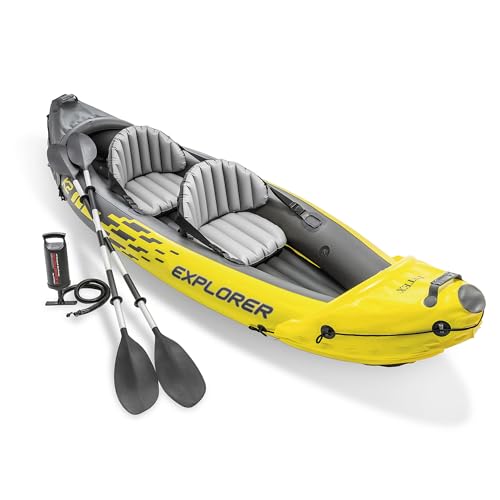
Intex Explorer K2 Inflatable Kayak
This two-person inflatable kayak deflates and packs down into a duffel-sized bag, fitting in a car trunk or apartment closet without roof rack transport. Grab lines at both ends make it easier to pull ashore or load onto a dock. It suits calm lakes and mild rivers rather than whitewater or open ocean conditions.
Pros
- Deflates to a compact size for easy storage and transport
- No roof rack or trailer needed to get it to the water
- Two-person capacity suits paired paddling trips
Cons
- Less durable than hard-shell kayaks against rocks and abrasion
- Not suited to whitewater or rough open water conditions

Pelican Argo 100X
Pelican’s RAM-X material construction keeps this kayak lighter than many comparable hard-shell models at a similar length. A sit-on-top design drains water automatically through scupper holes rather than pooling inside a cockpit. Its lighter weight makes solo carrying from car to shoreline noticeably easier.
Pros
- Lighter weight than many comparable hard-shell kayaks
- Scupper holes drain water automatically from the deck
- Easier for one person to carry from car to water
Cons
- Sit-on-top design exposes paddlers to more splash than sit-inside models
- Lower weight capacity than longer 12-foot kayaks
Compared at a glance
| # | Model | Length | Best for | Score | Price |
|---|---|---|---|---|---|
| 1 | Perception Pescador Pro 12.0 | 12 feet | Best Overall | 9.0 | Check price |
| 2 | Lifetime Tamarack 10 Angler Kayak | 10 feet | Best Value | 8.5 | Check price |
| 3 | Sun Dolphin Aruba 10 | 10 feet | Best Budget Recreational | 8.2 | Check price |
| 4 | Wilderness Systems Pungo 120 | 12 feet | Best for Touring and Distance | 8.7 | Check price |
| 5 | Old Town Loon 126 | 12.6 feet | Best for Stability | 8.4 | Check price |
| 6 | Intex Explorer K2 Inflatable Kayak | 2 person | Best Inflatable for Storage | 7.9 | Check price |
| 7 | Pelican Argo 100X | 10 feet | Best Lightweight | 8.0 | Check price |
How to choose
What to look for in a kayak Hull length and width decide the tradeoff between speed and stability, with wider hulls feeling steadier but tracking less efficiently over distance. Weight capacity determines how much paddler weight plus gear the kayak safely supports. Storage space and features like rod holders or dry compartments matter most for fishing or overnight trips rather than short casual paddles.
Fishing kayaks versus recreational kayaks A fishing kayak like the Perception Pescador Pro 12.0 or Lifetime Tamarack 10 Angler adds rod holders, tankwells and a wider stance for standing to cast. A recreational kayak like the Sun Dolphin Aruba 10 or Old Town Loon 126 skips those angler features for a lighter, simpler setup suited to casual lake paddling. Buyers should match the kayak to their actual activity rather than paying for fishing features they will not use.
Hard-shell versus inflatable kayaks A hard-shell kayak holds up better to rocks, docks and rough handling, while an inflatable option like the Intex Explorer K2 trades some durability for dramatically easier storage and transport. Apartment dwellers or anyone without roof rack access often find inflatable kayaks the only practical option. Open water, whitewater or frequent rocky-shore use still favors hard-shell construction.
Touring kayaks for distance paddling A touring-oriented hull like the Wilderness Systems Pungo 120 tracks straighter and paddles more efficiently over multi-mile distances than a wide recreational hull. This comes at the cost of reduced stability for standing or quick turns. Paddlers planning long lake crossings or multi-hour trips benefit more from touring efficiency than from maximum stability.
Frequently asked questions
What length kayak is best for beginners?
A 10 to 12 foot recreational kayak, like the Sun Dolphin Aruba 10 or Old Town Loon 126, generally offers an easier balance of stability and maneuverability for new paddlers.
Can a kayak be stored without a garage or roof rack?
Yes, an inflatable kayak like the Intex Explorer K2 deflates into a duffel-sized bag that fits in a closet or car trunk.
What weight capacity should a fishing kayak have?
Fishing kayaks typically need higher capacity, often 275 to 400 pounds, to account for gear, coolers and tackle in addition to the paddler’s weight.
Is a sit-on-top or sit-inside kayak better?
Sit-on-top kayaks drain water automatically and suit warm climates, while sit-inside designs keep paddlers drier in cooler conditions.
How much does a fishing kayak weigh?
Fishing kayaks with built-in storage and rod holders typically weigh more than basic recreational kayaks of similar length due to added features.
Are inflatable kayaks durable enough for regular use?
Inflatable kayaks like the Intex Explorer K2 hold up well to calm lakes and mild rivers but are less puncture resistant than hard-shell kayaks on rocky shorelines.
What kayak length is best for long-distance paddling?
Longer, narrower hulls around 12 feet, like the Wilderness Systems Pungo 120, generally track more efficiently over long distances than shorter, wider hulls.
Can one person load a kayak onto a car roof alone?
Lighter kayaks like the Pelican Argo 100X are easier for one person to lift and load than heavier fishing kayaks with built-in storage features.
Our pick
The Perception Pescador Pro 12.0 is the right choice for most buyers who want a stable, fishing-ready kayak that still handles general paddling well. Anyone without a roof rack or garage storage space should pick the Intex Explorer K2 instead, since it packs down to a fraction of the size of a hard-shell hull. Paddlers focused on long-distance lake trips rather than fishing should skip wide recreational hulls and choose the Wilderness Systems Pungo 120.
Sierra Daniels
Sierra's background is in landscape design and nursery retail. She focuses on lawn and garden equipment, outdoor furniture and gear durability, weighing published specs against how materials actually hold up outside.
You might also need

Sweet Home Collection Patio Chair Cushions: Enough Padding for Daily Outdoor Use?

Amagabeli Waxed Canvas Firewood Carrier: A Smarter Way to Haul Logs Indoors?

Town & Country Basics Cabana Curtains: Worth It for a Covered Patio or Porch?
