Why Does a Wheelbarrow’s Wheel Position Change How Easy It Is to Push?
Where the wheel sits relative to the load changes how much weight you actually lift versus roll. A single wheel set well forward under the tray makes the wheel carry most of the load so the handles feel light, but the barrow tips more easily, while a dual wheel design or a wheel set further back carries less load on the wheel and more on your arms, trading tip stability for a heavier carry.
The basic lever mechanics
A wheelbarrow is a second class lever, where the wheel acts as the fulcrum, the load sits between the fulcrum and your hands, and your hands apply the lifting force. The closer the wheel sits under the load’s center of gravity, the more of that weight the wheel supports instead of your arms.
Single wheel vs dual wheel
A single front wheel is narrower and maneuvers through tight gaps and over narrow planks more easily, but it balances on one point, so sideways tipping happens more readily on uneven ground. Dual wheels widen the base for much greater side to side stability, at the cost of maneuverability in tight spaces like between raised beds.
Why some wheelbarrows feel tippy and others feel planted
Wheel placement set too far forward relative to the tray’s balance point shifts extra weight onto your arms the instant a load leans backward, which exaggerates tipping risk especially on sloped or rutted ground.
Pneumatic vs solid tires and how that interacts with wheel position
A pneumatic tire absorbs bumps, so a load that is slightly off balance does not jolt as hard when it hits a rut. Solid or flat free tires transmit terrain irregularities straight into whatever is riding on top, which matters most with heavy, unevenly placed loads like wet soil or stacked bricks.
Two wheeled garden carts vs classic wheelbarrows
Carts with wheels set back near an axle point behave more like a small trailer, carrying nearly all the weight on the wheels and very little on your arms. That trades excellent tipping resistance and easier pushing for noticeably worse maneuverability around tight obstacles and sharp turns.
What this means for choosing one
For navigating narrow garden paths or walking planks, a single wheel design with the wheel positioned well forward keeps the load manageable in your hands. For moving heavy, bulky material like soil or mulch across open ground, a dual wheel or cart style design is more stable and easier on your back, even though it steers less precisely.

True Temper 6 Cu. Ft. Steel Wheelbarrow
A traditional single wheel steel wheelbarrow with the wheel positioned well forward for easier maneuvering through tight garden paths.
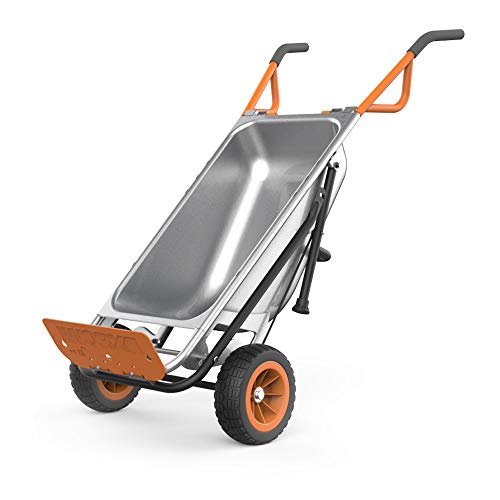
WORX WG050 Aerocart 8-in-1
A dual wheel convertible cart that shifts more weight onto the wheels for heavy loads at the cost of some single wheel maneuverability.
Common questions
Is a dual wheel wheelbarrow actually easier to push than a single wheel?
For straight line pushing with a heavy, evenly distributed load, yes, since the wider base carries more weight on the wheels and resists tipping, though it loses some of the single wheel’s tight turning ability.
Why does my wheelbarrow tip over so easily with a heavy load?
Tipping usually comes from the load’s weight sitting too far back or to one side relative to the wheel, combined with uneven ground that a single contact point cannot compensate for.
Does wheel position affect how much weight I feel in my arms?
Yes, directly. The closer the wheel sits under the load’s center of gravity, the more weight transfers to the wheel and the less your arms have to support.
Are pneumatic tires worth it over solid tires for wheel position stability?
For rough or uneven terrain, pneumatic tires absorb shock that would otherwise transfer directly into an unevenly balanced load, making the wheel position’s effect feel smoother in practice.
Can I adjust wheel position on an existing wheelbarrow?
Not on most standard models, since the wheel mount is welded or bolted into a fixed frame position, though some convertible cart systems allow repositioning the axle for different tasks.
Why do contractor wheelbarrows often use a single wheel instead of two?
Contractors frequently navigate narrow walkways, ramps, and scaffolding where a single wheel’s smaller footprint and tighter turning radius matter more than the extra stability dual wheels would offer.
Is a garden cart more stable than a wheelbarrow because of wheel placement?
Generally yes, since a cart’s wheels sit further back under the load and closer together width wise in some designs, shifting more weight onto the wheels and reducing arm strain, though it maneuvers less precisely.
Does loading weight toward the front or back change tipping risk?
Yes, loading weight too far back toward the handles increases arm strain and tipping risk, while weight too far forward over the wheel can make steering harder but generally feels more stable.
Why does my wheelbarrow feel unbalanced on a slope?
A single contact point has no ability to compensate for a side to side slope the way two wheels spread further apart can, which is why single wheel barrows feel noticeably less stable on hillsides.
Do bigger wheels change how much weight transfers to the wheel versus my arms?
Wheel diameter mainly affects how easily the wheel rolls over obstacles rather than changing the basic lever math of weight distribution, which depends more on wheel position than wheel size.
Is a single wheel design better for narrow paths and planks?
Yes, since its narrower footprint fits where dual wheel designs physically cannot, making it the more practical choice for tight garden paths or walking across a plank.
Does tire width affect stability as much as wheel position?
Tire width helps on soft ground by spreading weight over a larger contact area, but it does not change the fundamental lever relationship that wheel position establishes between the load and your arms.
Why do some wheelbarrows have the wheel set further forward than others?
Manufacturers balance maneuverability against stability differently depending on the intended use, with contractor models often favoring a far forward wheel for tight job site navigation.
Can poor wheel position cause back strain over repeated use?
Yes, a wheelbarrow that puts more sustained weight on your arms and back due to wheel placement can contribute to fatigue and strain over repeated heavy loads, which is a real factor worth considering for frequent use.
Does the depth of the tray interact with wheel position for stability?
Yes, a deeper tray can hold a load higher and further back, which shifts the center of gravity away from the wheel and increases the arm effort and tipping risk regardless of wheel placement.
Can adding a second wheel kit retrofit an old single wheel barrow?
Some aftermarket conversion kits exist for specific models, though they are not universal, and many single wheel frames are not designed to accept a second wheel without modification.
Why do some high end wheelbarrows use a dual pivot axle?
A dual pivot or articulating axle lets each wheel respond independently to uneven ground, which keeps the load more level and stable than a fixed rigid axle on rough terrain.
Does frame material like steel versus poly change how wheel position feels?
The tray material mainly affects weight and durability rather than the lever mechanics of wheel position, though a heavier steel frame does add more weight that the wheel and your arms both have to manage.
Is a flat free tire ever better for wheel position stability than pneumatic?
Flat free tires avoid the risk of a flat ruining a job, but they transmit more terrain shock into the load, which can matter more on rough ground than on smooth, flat surfaces.
How does handle height interact with wheel position for comfort?
Handle height affects the angle at which your arms apply force relative to the wheel’s pivot point, so a mismatched handle height can make even a well positioned wheel feel awkward to control.
Can uneven tire pressure on a dual wheel barrow cause instability?
Yes, one wheel running lower pressure than the other creates an uneven ride height that can make the load lean to one side, undermining the stability benefit dual wheels are meant to provide.
Our take
The wheel is not just there to roll, it is the pivot point that decides how much of every load you actually feel in your arms. Matching wheel position and count to your ground conditions and load type matters more than most buyers realize until they are pushing the wrong one up a slope.
Sierra Daniels
Sierra's background is in landscape design and nursery retail. She focuses on lawn and garden equipment, outdoor furniture and gear durability, weighing published specs against how materials actually hold up outside.
You might also need

How Does a Bug Zapper Actually Attract Different Insect Types?

Portable Greenhouse Wheelbarrows That Actually Fit Narrow Aisles

Why Does a Pressure Washer’s PSI Rating Matter More Than GPM for Some Jobs?
