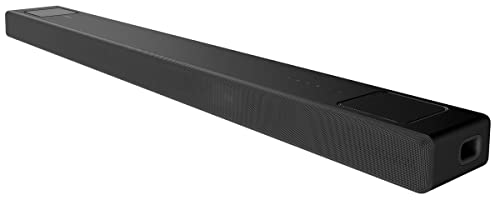
Home Theater Systems That Fill a Room With Real Sound
The Yamaha YHT-4950U gives the fullest 5.1 surround experience for the price, with a real AV receiver and five wired speakers. The Sony HT-S40R suits smaller rooms needing genuine rear channels under budget, while the Samsung HW-Q990F adds Dolby Atmos height channels for movie-heavy households willing to spend more.
Yamaha’s YHT-4950U is the strongest overall pick, since it pairs a real AV receiver with five wired speakers and a subwoofer instead of a soundbar standing in for surround channels. It fits a household that wants a proper 5.1 setup without learning a separate receiver and speaker shopping list. The tradeoff is more cable runs than a soundbar, which matters in a rental or an open floor plan.
Home theater in a box systems vary wildly in what 5.1 or 7.1 actually means, since some ship with phantom surround from a soundbar and others include real rear speakers. We compared receiver power, channel count, included hardware and owner feedback on setup time and room fit before narrowing this list to seven.
Our top picks
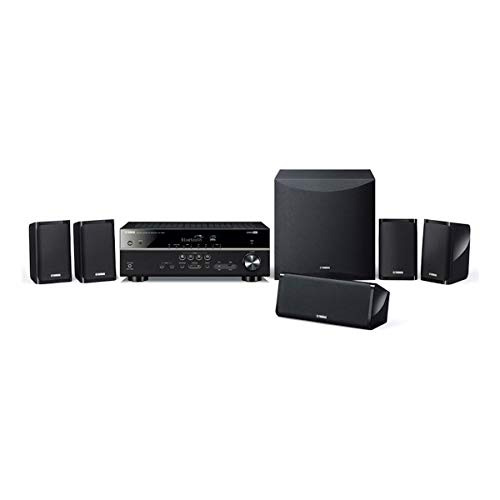
Yamaha YHT-4950U 5.1-Channel Home Theater System in a Box
Yamaha bundles a 4K-ready AV receiver with five matched speakers and a powered subwoofer, so every channel is a real driver rather than a virtual effect. YPAO room correction measures speaker distance and adjusts levels automatically during setup. The receiver also has enough HDMI inputs for a game console and a streaming box alongside the TV.
Pros
- Genuine 5.1 surround with real rear speakers
- Automatic room calibration speeds up setup
- Enough HDMI inputs for extra devices
Cons
- More speaker wire to run than a soundbar
- Receiver menu has a learning curve at first

Sony HT-S40R 5.1ch Dolby Audio Soundbar Home Theater System
Sony pairs its soundbar with a pair of physical rear speakers and a wireless subwoofer, which keeps this a genuine 5.1 package instead of a virtual surround soundbar. The rear speakers need a power outlet near the seating area, since they are not battery operated. Setup uses a single HDMI ARC connection in most living rooms.
Pros
- Real rear speakers instead of virtual surround
- Simple one-cable HDMI ARC setup
- Wireless subwoofer needs no extra cable to the TV
Cons
- Rear speakers need their own power outlet
- No Dolby Atmos height channel

Samsung HW-Q990F Q-Series Dolby Atmos Soundbar System
Samsung’s flagship soundbar system adds upward firing drivers for Dolby Atmos height effects on top of a full wireless rear speaker and subwoofer package. Q-Symphony lets the system work together with compatible Samsung TV speakers for a wider soundstage. It is the heaviest lift for a household focused mainly on movies rather than music.
Pros
- Dolby Atmos height channels for movies
- Wireless rear speakers skip long cable runs
- Works with compatible Samsung TVs for added soundstage
Cons
- Costs more than a standard 5.1 bundle
- Height effects are most noticeable in Atmos-mastered content

Sony BRAVIA Theater System 6
This five-piece Sony package links the soundbar, subwoofer and two rear speakers through a single wireless receiver box, so only the soundbar and receiver need an outlet near the TV. It targets anyone who wants true surround channels without fishing for additional power points around the room. Voice clarity tuning helps dialogue stay audible at lower volumes.
Pros
- Only two outlets needed near the TV
- Genuine surround channels, not virtual effects
- Dialogue stays clear at low volume
Cons
- Rear speakers still need a nearby outlet, just routed through the receiver
- Newer model with a shorter track record than older Sony systems

Yamaha YHT-5960U 7.2-Channel Home Theater System
Yamaha steps up to a 7.2-channel receiver with HDMI 2.1 passthrough, which matters for a household planning to add a 4K120 gaming console or upgrade the TV later. The extra two channels support front height or surround back speakers if the room allows it. YPAO calibration is included, same as the smaller YHT-4950U.
Pros
- HDMI 2.1 passthrough supports newer consoles
- Room for expansion beyond basic 5.1
- Same easy YPAO calibration as the budget model
Cons
- Priced above a standard 5.1 in a box kit
- Extra channels go unused without added speakers

JBL Bar 500MK2 Soundbar with Wireless Subwoofer
JBL concentrates the system into a soundbar and a wireless subwoofer, aiming virtual surround effects from the bar rather than adding rear speakers to wire or place. This suits a studio or small living room where floor space for rear speakers is not realistic. Dialogue and bass both get dedicated attention without a crowded room.
Pros
- No rear speakers to wire or find space for
- Strong bass from the dedicated subwoofer
- Quick Bluetooth pairing for music
Cons
- No physical rear channels, so surround is virtual
- Less immersive than kits with real rear speakers

Klipsch Reference Theater Pack 5.1 Surround Sound System
Klipsch sells this as a speaker package rather than a self-contained system, so it needs a separate AV receiver to power the five satellites. Anyone who already owns a receiver, or wants to upgrade one later without replacing speakers, gets more flexibility here than from a locked soundbar bundle. The subwoofer is powered and does not need the receiver to drive it.
Pros
- Works with any standard AV receiver
- Horn-loaded tweeters add clarity on dialogue
- Powered subwoofer needs no receiver channel
Cons
- Requires buying or already owning a receiver
- More setup steps than a soundbar in a box
The lineup, side by side
| # | Model | Channels | Best for | Score | Price |
|---|---|---|---|---|---|
| 1 | Yamaha YHT-4950U 5.1-Channel Home Theater System in a Box | 5.1 with AV receiver | Best overall | 9.4 | Check price |
| 2 | Sony HT-S40R 5.1ch Dolby Audio Soundbar Home Theater System | 5.1 with wired rear speakers | Best budget 5.1 system | 9.0 | Check price |
| 3 | Samsung HW-Q990F Q-Series Dolby Atmos Soundbar System | 11.1.4 with Atmos height channels | Best for Dolby Atmos movies | 9.3 | Check price |
| 4 | Sony BRAVIA Theater System 6 | Soundbar, subwoofer, 2 rears, wireless receiver | Best simple all-in-one setup | 8.9 | Check price |
| 5 | Yamaha YHT-5960U 7.2-Channel Home Theater System | 7.2 capable receiver | Best for future AV upgrades | 9.1 | Check price |
| 6 | JBL Bar 500MK2 Soundbar with Wireless Subwoofer | Virtual 7.1 from soundbar | Best space-saving option | 8.7 | Check price |
| 7 | Klipsch Reference Theater Pack 5.1 Surround Sound System | 5 passive satellites | Best for pairing with an existing receiver | 8.8 | Check price |
How to pick the right one
What actually counts as a home theater system A true home theater system drives real speaker channels rather than relying entirely on software to fake a surround field. Soundbar-based kits like the Sony HT-S40R or Samsung HW-Q990F still count if they ship with physical rear speakers, not just a wider soundbar. Receiver-in-a-box kits such as the Yamaha YHT-4950U go further with five independent speaker wires and a separate amplifier for each channel. Decide first whether wiring rear speakers is acceptable in your room, since that single factor splits these seven into two groups.
Soundbar systems versus AV receiver bundles A soundbar bundle like the JBL Bar 500MK2 sets up in minutes with one HDMI cable and no speaker wire runs. An AV receiver bundle like the Yamaha YHT-4950U takes longer to wire but gives a wider, more defined surround field once set up. Households that rent or move often tend to prefer the soundbar route for that reason alone.
Best for movie-first versus music-first rooms Dolby Atmos height channels, found on the Samsung HW-Q990F, matter most for movies mixed specifically in Atmos and show up less in older films or most music. A system without height channels, like the Sony BRAVIA Theater System 6, still delivers strong dialogue and surround placement for everyday viewing. Buyers who split time between movies and music streaming get more consistent results from a balanced 5.1 setup than from an Atmos-first one.
Setup space and expansion Rear speakers need either a power outlet nearby or a long enough wireless range to reach the listening area, so measure the room before buying a kit with wired rears. The Klipsch Reference Theater Pack suits anyone who already owns a receiver and wants to swap speakers without replacing the electronics. For a household likely to upgrade the TV to a 4K120 gaming setup, the HDMI 2.1 passthrough on the Yamaha YHT-5960U avoids a second purchase later.
Good to know
What is the difference between a soundbar and a full home theater system?
A soundbar handles all channels from one unit, often using processing to simulate surround. A full home theater system adds separate rear speakers, and sometimes a separate receiver, that produce real surround channels rather than a simulated effect.
Do home theater systems need a separate AV receiver?
Soundbar-based kits like the Sony HT-S40R include their own amplification and do not need a receiver. Speaker-only packages like the Klipsch Reference Theater Pack do need a receiver, since the satellites are passive and unpowered.
Is Dolby Atmos worth it for a home theater system?
Atmos adds height channel effects that are most noticeable in movies specifically mixed for it. Buyers who mainly watch older films, sports or music content notice less difference and can save money with a standard 5.1 system.
How many speakers does a true 5.1 system need?
A true 5.1 setup uses five speakers, front left, front right, center, and two rear surrounds, plus one subwoofer. Systems that use only a soundbar and subwoofer rely on virtual processing instead of five physical speaker locations.
Can a home theater system work without running speaker wire?
Several kits, including the Sony BRAVIA Theater System 6 and Samsung HW-Q990F, use wireless rear speakers and a wireless subwoofer, so only the soundbar or receiver needs a wired power connection near the TV.
What is YPAO or room calibration on a receiver-based system?
YPAO is Yamaha’s automatic room correction feature. It uses an included microphone to measure speaker distance and room reflections, then adjusts volume and timing per channel so the surround field sounds balanced from the main seating position.
Are home theater systems hard to set up?
Soundbar-based kits like the JBL Bar 500MK2 usually connect with a single HDMI cable and take under 30 minutes. AV receiver bundles take longer because each speaker needs its own wire run, though automatic calibration tools simplify the final tuning step.
Will a home theater system work with a gaming console?
Most of these systems pass through HDMI with ARC or eARC support for basic audio return. Systems with HDMI 2.1 passthrough, like the Yamaha YHT-5960U, additionally support 4K120 signals from newer consoles without a separate video switch.
Do rear speakers need their own power outlet?
Wired rear speaker kits, such as the Sony HT-S40R, usually need a nearby outlet since the speakers are not battery powered. Wireless rear speaker systems still need power, but the receiver box handling the wireless link can sometimes be placed more flexibly than the speakers themselves.
The verdict
The Yamaha YHT-4950U remains the strongest all-around choice for anyone willing to run speaker wire, since it delivers genuine 5.1 channels from a real receiver at a reasonable price. Movie-focused households who want height effects should move up to the Samsung HW-Q990F instead. Renters or anyone short on space for rear speakers get the most practical result from the Sony HT-S40R or the soundbar-only JBL Bar 500MK2.
Marcus Chen
Marcus covered consumer electronics for enthusiast tech publications for six years before joining ChoiceCrest. He specializes in translating manufacturer spec sheets into plain-language buying advice, with a focus on audio, computing accessories and smart-home gear.