Full RV Surge Protection Starts With the Right Amp Match
Progressive Industries’ EMS-PT50X earns the top spot among 50-amp RVs by pairing surge suppression with 26 monitored fault conditions. Camco’s 55351 Power Defender protects the same 50-amp service for less money using LED fault lights instead of a screen. Owners running 30-amp trailers get solid coverage from the Camco 55331 at the lowest price here.
Full-time RVers with 50-amp service get the most protection from the Progressive Industries EMS-PT50X, which pairs surge suppression with 26-point fault monitoring. Its LCD readout catches wiring problems that surge-only units miss, though the unit sits exposed at the pedestal and needs a padlock.
Surge protector gets used loosely for two different product types: simple joule-rated clamps and full electrical management systems that also watch for wiring faults. We compared amp rating, joule capacity, monitored fault count, and mounting style against manufacturer specifications and owner feedback to separate real capability from marketing language.
The top picks, ranked

Progressive Industries EMS-PT50X 50 Amp Portable EMS
This unit handles both hot legs on a 50-amp rig, tracking voltage, amperage, and 26 separate fault conditions at once. Power cuts off within nanoseconds of a surge or fault, before appliances take damage. Owners plug it in between the pedestal and shore power cord at any campsite.
Pros
- Cuts power within nanoseconds when a surge or fault hits
- Diagnostic lights name the exact fault without a multimeter
- Travels with the RV, so protection works at any campground
Cons
- Costs more than surge-only protectors in this lineup
- Sits outside at the pedestal, so theft prevention needs a padlock
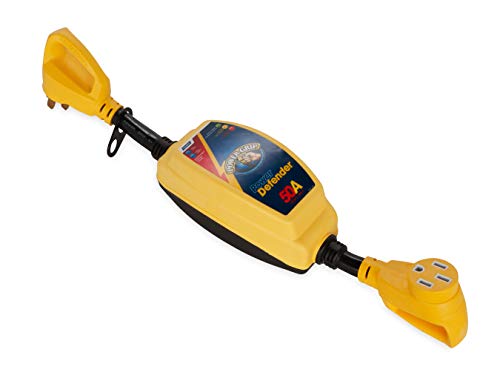
Camco 55351 Power Defender 50 Amp Surge Protector
LED indicators replace a digital readout on this 50-amp surge protector, keeping the price below a full EMS unit. Common campground wiring faults still trigger a warning light. Weather-resistant housing survives repeated outdoor use across seasonal RV sites.
Pros
- Lower price than full EMS models with a comparable joule rating
- LED lights speed up fault diagnosis right at the pedestal
- Compact enough for an outside storage compartment
Cons
- No live voltage or amperage readout like the EMS-PT50X offers
- Monitors fewer fault conditions than a full electrical management system
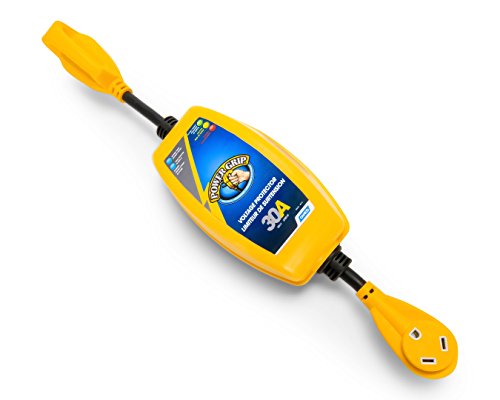
Camco 55331 Power Defender 30 Amp Surge Protector
Travel trailers and campers running 30-amp service get an affordable entry point into surge protection here. Camco scales the same LED fault-indicator design from its 50-amp unit down to a single hot leg. At under 3 pounds, it stores easily in a door-side bin.
Pros
- Lowest price among the 30-amp options in this lineup
- Small enough to fit in tight exterior storage compartments
- Flags the same fault types as pricier 50-amp units
Cons
- Joule rating trails the 50-amp models, expected for 30-amp service
- Skips a digital display for exact voltage or amperage readings

Progressive Industries EMS-PT30X 30 Amp Portable EMS
Truck campers and travel trailers on 30-amp service get the same 26-point fault monitoring as the larger EMS-PT50X here, scaled to a single hot leg. A time-delay restart holds power off briefly after a fault clears. It plugs in ahead of the shore power cord like its 50-amp sibling.
Pros
- Delivers full EMS-level fault monitoring on 30-amp service
- Time-delay restart stops rapid cycling after a fault
- LCD display tracks real-time voltage and amperage
Cons
- Loses protection on one leg if adapted to a 50-amp RV
- Costs more than basic 30-amp surge-only units like the Camco 55331
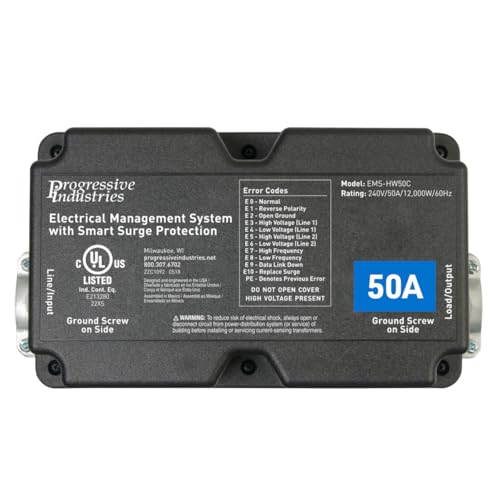
Progressive Industries EMS-HW50C 50 Amp Hardwired EMS
Owners who never want a unit sitting at the pedestal get permanent protection here instead. Installation happens inside the RV’s power bay, wired directly to the main breaker, removing theft risk entirely. A wireless remote display mounted inside the RV shows live voltage and fault status.
Pros
- Removes theft risk since nothing stays outside at the pedestal
- Wireless remote shows status without a trip outside
- Monitors the same 26 fault conditions as the portable EMS-PT50X
Cons
- Needs a one-time install, ideally by an RV technician
- Cannot move between RVs the way a portable unit can

Southwire 34931 Surge Guard 50 Amp Portable Protector
Skipping the diagnostic display of an EMS unit keeps this 50-amp protector simple. Power disconnects automatically once voltage climbs or drops outside a safe range. LED lights confirm status without showing exact readings.
Pros
- LED status system needs no settings to configure
- Automatic voltage cutoff shields appliances during brownouts
- Weatherproof build suits seasonal outdoor storage
Cons
- Skips a display for exact voltage or amperage values
- Diagnoses fewer fault types than Progressive Industries EMS models

Hughes Autoformers Power Watchdog PWD50-EPO-SS 50 Amp
A Bluetooth connection sets this protector apart, streaming live voltage, amperage, and fault alerts to a phone inside the RV. Stainless steel housing resists corrosion better than plastic enclosures over years of outdoor storage. An audible alarm also sounds at the unit itself, not just through the app.
Pros
- App monitoring works from inside the RV without a pedestal check
- Stainless steel housing outlasts plastic in wet climates
- Audible alarm warns nearby owners even without the app open
Cons
- A dead phone battery limits remote monitoring
- Priced above basic surge-only units without app features
What matters most
What an RV Surge Protector Actually Covers Campground power varies more than most owners expect. Pedestals wired decades ago often carry reversed polarity, open grounds, or voltage that swings outside a safe range. Basic surge protectors clip voltage spikes from lightning strikes or grid switching. Full electrical management systems go further, cutting power when voltage sags or wiring faults appear, protecting air conditioners and converters from slow damage a simple clamp never catches.
30-Amp vs 50-Amp: Matching the Protector to Your RV Amp rating has to match the RV’s shore power cord, not the campground pedestal. Smaller trailers and campers typically run 30-amp service on a single hot leg. Fifth wheels and larger motorhomes usually carry 50-amp service with two hot legs, doubling power for multiple air conditioners. A 30-amp unit on a 50-amp rig, even through a dogbone adapter, only protects half the system. Check the plug on the rig’s cord before buying, not the pedestal at the campground.
Portable vs Hardwired: Which Installation Fits Portable units plug in between the pedestal and shore power cord, so they move with the owner between campsites. They also sit outside within reach of passersby, which is why most owners add a padlock through the mounting bracket. Hardwired units install inside the power bay near the main breaker, wiring permanently into the RV. That placement removes theft risk but calls for a one-time installation, usually by an RV technician or someone comfortable with 120/240 volt wiring.
Reading Joule Ratings and Fault Counts Joule rating measures how much surge energy a unit absorbs before failing, similar to a home surge strip but rated for outdoor, higher-current use. Higher joule numbers matter most in regions with frequent lightning or unstable grid power. Fault protection is a separate spec covering conditions like open neutral, reverse polarity, and voltage sag that have nothing to do with surges. Units marketed as full EMS track both categories and display live voltage and amperage, while basic surge protectors only respond to the joule-rated spike.
Compared at a glance
| # | Model | Amp rating | Best for | Score | Price |
|---|---|---|---|---|---|
| 1 | Progressive Industries EMS-PT50X 50 Amp Portable EMS | 50 amp | Best overall | 9.4 | Check price |
| 2 | Camco 55351 Power Defender 50 Amp Surge Protector | 50 amp | Best value | 9.1 | Check price |
| 3 | Camco 55331 Power Defender 30 Amp Surge Protector | 30 amp | Best budget | 8.8 | Check price |
| 4 | Progressive Industries EMS-PT30X 30 Amp Portable EMS | 30 amp | Best for 30-amp RVs | 8.5 | Check price |
| 5 | Progressive Industries EMS-HW50C 50 Amp Hardwired EMS | 50 amp | Best for hardwired installation | 8.3 | Check price |
| 6 | Southwire 34931 Surge Guard 50 Amp Portable Protector | 50 amp | Best for basic voltage protection | 8.1 | Check price |
| 7 | Hughes Autoformers Power Watchdog PWD50-EPO-SS 50 Amp | 50 amp | Best for app monitoring | 8.0 | Check price |
Good to know
Do I need a 30 amp or 50 amp surge protector for my RV?
Match the unit to the shore power cord plug on the RV, not the campground pedestal. A three-prong plug means 30 amp service, while a four-prong plug means 50 amp service with two hot legs.
What is the difference between a surge protector and an EMS for RVs?
A surge protector only absorbs voltage spikes from events like lightning strikes or grid switching. An EMS, or electrical management system, adds continuous monitoring for open ground, reverse polarity, and low or high voltage, cutting power automatically when a fault appears.
Can a hardwired RV surge protector be stolen from a campsite?
It installs inside the power bay near the main breaker rather than sitting outside at the pedestal, so theft is not a concern. Portable units remain the ones at risk, which is why owners typically secure them with a padlock through the mounting bracket.
How many joules should an RV surge protector handle?
Most 50-amp units on the market absorb several thousand joules, with higher-end models rated well above basic household surge strips. Owners in regions with frequent lightning or older grid infrastructure benefit from units at the higher end of that range.
Is a portable RV surge protector better than a hardwired one?
Portable units suit owners who move between campsites often, since the protector travels with the rig. Hardwired units fit full-time or seasonal setups where the RV stays connected to one power source for extended periods.
What does open ground or reverse polarity mean on a surge protector display?
Open ground means the pedestal’s ground wire is disconnected, removing a key safety path for fault current. Reverse polarity means the hot and neutral wires are swapped, which can energize the RV’s chassis if left uncorrected.
Can I use a 30 amp surge protector with a 50 amp RV through an adapter?
A dogbone adapter lets a 30-amp protector physically connect to a 50-amp cord, but it monitors only one of the two hot legs. The second leg runs unprotected, so a properly rated 50-amp unit is the safer choice for 50-amp rigs.
How long do RV surge protectors last?
Surge protection components wear down with each significant event they absorb, similar to a home surge strip, typically over several years of seasonal use. Many owners replace their unit after a major lightning event or once the diagnostic lights stop responding correctly.
Are hardwired EMS units better than portable EMS units?
Hardwired units like the EMS-HW50C remove theft risk and stay connected without daily setup, which suits stationary or full-time RVs. Portable units like the EMS-PT50X fit owners who change campsites often and need protection that travels with the rig.
The verdict
The Progressive Industries EMS-PT50X remains the strongest pick for 50-amp RV owners who want full fault protection alongside surge suppression in one portable unit. Owners running 30-amp trailers or campers should choose the Progressive Industries EMS-PT30X instead, since it matches their electrical system without paying for unused 50-amp capacity. Anyone hardwiring a permanent protector into a fifth wheel or motorhome power bay should pick the Progressive Industries EMS-HW50C for a theft-resistant, always-connected setup.
Tony Russo
Tony trained as an automotive technician and spent years in service and parts retail before moving into writing. He focuses on garage tools, car care products and accessories from a hands-on maintenance perspective.


