Which RV Battery Monitor Handles Heavy Daily Use Best
Victron Energy’s SmartShunt 500A-50mV leads for accuracy and app-based monitoring, a strong fit for owners running solar with multiple battery banks. Renogy’s 500A Battery Monitor delivers similar core specs at lower cost. Bogart Engineering’s TriMetric TM-2030-RV suits large off-grid banks that need a dedicated wired display and long-term data logging.
Victron Energy’s SmartShunt 500A-50mV tops this roundup for RV owners running solar and multiple battery banks. Bluetooth monitoring and a 6.5 to 70 volt range cover 12V, 24V, and 48V systems in one unit. It skips a built-in display, its one real tradeoff.
Monitor accuracy and wiring complexity vary more than most buyers expect between brands. We compared shunt ratings, display types, and owner feedback on installation across seven heavy-duty options to build this list.
The best picks, ranked

Victron Energy SmartShunt 500A-50mV Battery Monitor
A 500A/50mV shunt pairs with built-in Bluetooth here, so owners read voltage, current, and state of charge through the VictronConnect app. No display ships in the box, keeping installation compact under a battery tray. Voltage range spans 6.5 to 70 volts, covering 12V, 24V, and 48V RV systems.
Pros
- Bluetooth range reaches most RV battery compartments
- Programmable relay for low-voltage load disconnect
- Firmware updates delivered through the app
Cons
- Requires a smartphone for any readout
- No wired display option from Victron
Victron Energy BMV-712 Smart Battery Monitor
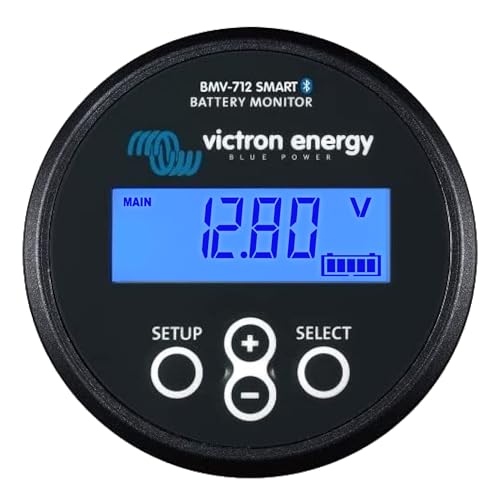
Dual battery inputs set this monitor apart, tracking a starter battery and house bank from one backlit LCD. Bluetooth syncs both readings to the VictronConnect app. The included 500A/50mV shunt handles amperage spikes from inverters and DC-DC chargers.
Pros
- Wired display works without a phone nearby
- Tracks starter battery voltage separately
- Mid-point voltage monitoring for series banks
Cons
- Second input wiring adds setup steps
- Display mounting requires a clean panel cutout
Renogy 500A Battery Monitor
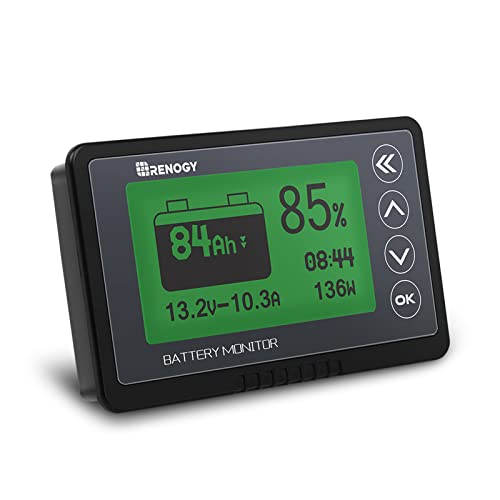
State of charge, voltage, and current show on a dedicated LCD screen here, with an optional Bluetooth module sold separately for app access. Shunt wiring supports 12V, 24V, and 36V battery banks. Owners report straightforward setup alongside Renogy solar charge controllers.
Pros
- Lower cost than most Bluetooth-native monitors
- Compatible with existing Renogy solar components
- LCD readable without a companion app
Cons
- App access needs a separate accessory purchase
- Does not cover 48V battery banks

AiLi 500A Battery Monitor with Shunt
A 500A shunt and wired LCD panel ship together here, skipping Bluetooth entirely to keep the price down. The display cycles through voltage, current, and remaining amp-hours with a button press. Wiring supports 8V to 100V systems, covering most 12V and 24V RV setups.
Pros
- Lowest entry cost among shunt-based monitors here
- Simple wiring with no app setup required
- Wide voltage range covers most RV banks
Cons
- No smartphone monitoring option
- Instructions are limited compared to name-brand units
Bogart Engineering TM-2030-RV TriMetric Battery System Monitor
Solar-heavy, off-grid rigs are the target here, pairing a 500A shunt with a wired LCD meter. An RS232 output lets owners log data to a computer over time, useful for tracking battery health across seasons. This line has served the RV and marine market for years.
Pros
- Programmable low-battery alarm and reset thresholds
- Long track record in off-grid solar setups
- Data logging helps diagnose battery degradation
Cons
- No mobile app for remote checks
- Setup menu is less intuitive than app-based rivals

Ampere Time Battery Monitor
State-of-charge calibration here targets LiFePO4 chemistry, matching the batteries the brand is best known for. A 500A/50mV shunt pairs with Bluetooth app monitoring for voltage, current, and remaining capacity. Voltage range covers 8V to 64V, suited to 12V, 24V, and 48V lithium banks.
Pros
- SOC readings tuned for lithium discharge curves
- Bluetooth app shows real-time amp-hour usage
- Matches Ampere Time lithium battery lineup
Cons
- Lead-acid SOC accuracy is less consistent
- App has fewer features than Victron’s software

Xantrex LinkLite Battery Monitor
Bluetooth is absent by design here, in favor of a straightforward wired LCD panel showing volts, amps, amp-hours, and time remaining. A 500A shunt handles typical RV inverter and charging loads. The panel mounts flush in a wall cutout, a format familiar to owners replacing older Xantrex or Link 10 monitors.
Pros
- Familiar upgrade path for older Xantrex monitors
- Flush panel mount fits standard wall cutouts
- No app account or pairing needed
Cons
- No remote or app monitoring option
- Fewer programmable alarm settings than TriMetric
Before you buy
What to look for in a heavy-duty RV battery monitor Shunt-based monitors measure every amp flowing in or out of the battery bank, unlike voltage meters that only estimate charge. A 500A shunt rating covers most single and dual battery RV setups, including inverters under heavy load. Voltage range matters too: 12V systems need coverage down to about 8V, while 48V lithium banks need a monitor rated closer to 70V. Programmable relays or alarms let the monitor cut a load automatically before batteries drop too low.
Bluetooth app monitors vs wired display panels Bluetooth models like the SmartShunt and Ampere Time monitor send readings straight to a phone app, useful for checking battery status from outside the RV. Wired LCD panels, like the Xantrex LinkLite and AiLi monitor, mount inside the coach and need no phone at all. Owners who want a permanent dashboard tend to favor wired panels, while those managing multiple batteries remotely lean toward app-based options. The BMV-712 offers both a wired display and Bluetooth in one unit, a middle path for undecided buyers.
Lithium versus lead-acid: which monitor fits your battery bank Lithium banks discharge at a flatter voltage curve than lead-acid, which can throw off state-of-charge readings on monitors not tuned for LiFePO4. Ampere Time’s monitor calibrates specifically for lithium chemistry, matching how those batteries actually deplete. Lead-acid owners get more accurate readings from monitors like the Renogy 500A or TriMetric, both proven on flooded and AGM banks. Mixing battery chemistries in one bank complicates any monitor’s accuracy, regardless of brand.
Sizing a monitor for large solar or off-grid setups Off-grid RVs running large solar arrays cycle through frequent charge and discharge swings that a basic monitor may not log well. The Bogart Engineering TriMetric TM-2030-RV stands out here, with RS232 data logging that tracks battery health across months of use. Boondockers running multiple batteries in parallel also benefit from a relay output that disconnects loads automatically overnight. Simpler single-battery setups do fine with a basic wired panel like the Xantrex LinkLite, without the extra complexity.
Compared at a glance
| # | Model | Shunt rating | Best for | Score | Price |
|---|---|---|---|---|---|
| 1 | Victron Energy SmartShunt 500A-50mV Battery Monitor | 500A / 50mV | Best overall | 9.4 | Check price |
| 2 | Victron Energy BMV-712 Smart Battery Monitor | 500A / 50mV, included | Best for dual battery monitoring | 9.1 | Check price |
| 3 | Renogy 500A Battery Monitor | 500A, included | Best value | 8.9 | Check price |
| 4 | AiLi 500A Battery Monitor with Shunt | 500A, included | Best budget | 8.6 | Check price |
| 5 | Bogart Engineering TM-2030-RV TriMetric Battery System Monitor | 500A, included | Best for large off-grid battery banks | 8.4 | Check price |
| 6 | Ampere Time Battery Monitor | 500A / 50mV | Best for lithium (LiFePO4) battery banks | 8.2 | Check price |
| 7 | Xantrex LinkLite Battery Monitor | 500A, included | Best for simple wired installs | 8.0 | Check price |
Good to know
How does a shunt-based battery monitor work?
A shunt sits in the battery’s negative cable and measures the tiny voltage drop created by current passing through it. The monitor converts that reading into amps, then calculates amp-hours used and remaining state of charge over time.
What size shunt do I need for an RV battery monitor?
Most RV setups work well with a 500A shunt, which covers inverters, DC-DC chargers, and solar charging without maxing out the reading. Larger commercial rigs pulling higher continuous loads may need a monitor rated above 500A.
Can I use a battery monitor with lithium and lead-acid batteries together?
Mixing chemistries in one bank is not recommended, since lithium and lead-acid charge and discharge differently. A monitor calibrated for one chemistry reads state of charge inaccurately on the other.
Which RV battery monitor is best for solar setups?
The Bogart Engineering TriMetric TM-2030-RV suits solar-heavy off-grid rigs best, thanks to its data logging and programmable alarm thresholds. Victron’s SmartShunt also pairs well with Victron solar charge controllers through the same app.
Bluetooth battery monitor vs wired display, which is better for an RV?
Bluetooth monitors like the SmartShunt let owners check battery status from a phone without opening a panel. Wired displays like the Xantrex LinkLite stay visible at all times and skip app pairing entirely.
Is a battery monitor necessary for a heavy-duty RV setup?
Voltage alone gives an unreliable state-of-charge estimate once a battery is under load. Owners running inverters, solar, and multiple batteries benefit most from shunt-based monitoring.
What is the best RV battery monitor for a starter and house battery?
The Victron BMV-712 Smart tracks both a starter battery and house bank with two separate inputs, showing both on one backlit display.
How do I install a battery monitor shunt in an RV?
The shunt mounts inline on the negative battery cable, between the battery’s negative terminal and the rest of the electrical system. All negative loads and charging sources must connect on the shunt’s load side, not directly to the battery, for accurate readings.
What is the difference between a battery monitor and a battery management system?
A battery monitor tracks voltage, current, and state of charge without controlling the battery itself. A battery management system, built into most lithium batteries, actively protects cells from overcharge and over-discharge.
Does a battery monitor draw power from the battery it tracks?
Shunt-based monitors draw a small amount of current for their own electronics, typically a few milliamps. Bluetooth models like the SmartShunt use slightly more than wired-only units due to the radio module.
Final word
Victron’s SmartShunt 500A-50mV earns the top spot for its wide voltage range and reliable Bluetooth monitoring, a solid fit for owners running solar and multiple loads. Anyone wanting a permanent wired display without pairing a phone should look at the Xantrex LinkLite instead. Boondockers managing large off-grid battery banks get more long-term value from the Bogart Engineering TriMetric TM-2030-RV, thanks to its data logging.
Tony Russo
Tony trained as an automotive technician and spent years in service and parts retail before moving into writing. He focuses on garage tools, car care products and accessories from a hands-on maintenance perspective.