Which Heavy Duty Battery Charger Suits Your Garage?
NOCO GENIUS PRO 25 handles the widest range of garage batteries, pushing 25 amps into 12 volt lead acid and lithium packs. Schumacher SC1281 adds 100 amp cranking plus 6 volt support. NOCO GENIUS10 covers bikes and mowers at 10 amps and doubles as a winter maintainer.
NOCO GENIUS PRO 25 is the right charger for a garage holding cars, a truck or deep cycle batteries. Twenty five amps refills a flat battery in an afternoon, and mode buttons cover flooded through lithium iron phosphate. Six volt systems are the gap, so vintage tractors need a second unit.
Amperage gets all the attention, yet it decides only how fast the job finishes. Chemistry support matters more: AGM, gel, calcium and lithium iron phosphate each want a different absorption voltage, and the wrong profile shortens battery life. Repair and desulphation stages decide whether a neglected battery wakes up at all. We compared rated output, voltage range, engine start current, maximum amp hour capacity and ingress ratings. Owner feedback filled in long term reliability on seasonal vehicles and how each interface behaves in a cold garage.
What we recommend

NOCO GENIUS PRO 25 Battery Charger
Twenty five amps of 12 volt output reaches car, truck, marine and deep cycle batteries at large capacities. Mode buttons select flooded, AGM, gel or lithium iron phosphate, so absorption voltage matches the label on the case. Force mode pushes current into a pack that has fallen below the voltage most chargers refuse to recognise.
Pros
- Fills a drained car battery inside an afternoon
- Force mode wakes packs other chargers skip
- IP65 sealing shrugs off a dusty garage floor
Cons
- Skips 6 volt systems found on vintage vehicles
- Cannot crank an engine, so no start assist

Schumacher SC1281 Battery Charger and Engine Starter
A wheeled steel case holds 30 amps of boost charging and 100 amps of engine start. Support covers 6 volt as well as 12 volt, which keeps older tractors and garden machinery in scope. Once the battery reads full, automatic mode drops back to a 2 amp maintain rate.
Pros
- Cranks a vehicle with a genuinely flat battery fitted
- Covers 6 volt tractors and classic cars
- Analogue meter shows current draw at a glance
Cons
- Bulk and weight rule out shelf or wall storage
- No lithium iron phosphate profile
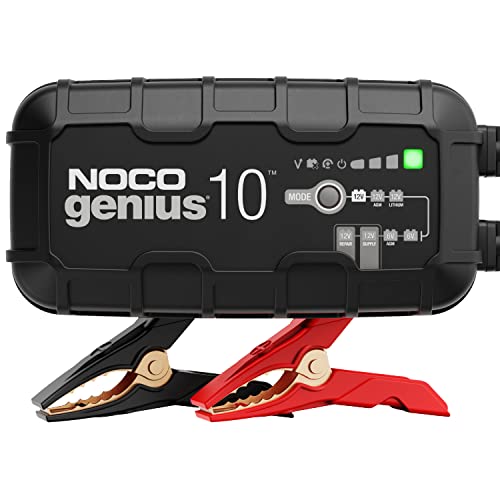
NOCO GENIUS10 Smart Battery Charger
Ten amps suits motorcycles, ride on mowers and a daily driver parked for a week or two. Both 6 volt and 12 volt batteries work, with lithium and AGM modes sitting alongside flooded. Capacity is rated to 230 amp hours, and the same unit can stay connected as a long term maintainer.
Pros
- One unit covers 6 volt and 12 volt batteries
- Float stage lets it maintain a bike over winter
- Small enough to hang on a wall hook
Cons
- Ten amps drags on a large truck battery
- Supplied leads are short for reaching across a bay

DEWALT DXAEC80 Battery Charger
Three rates step from 2 amp maintain through 8 amp standard to 30 amp fast charge. Eighty amps of engine start covers a no start morning without fetching a jump pack. A built in alternator check shows whether the battery or the charging system caused the failure.
Pros
- Alternator test separates battery faults from charging faults
- Three rates cover trickle through to fast charge
- Heavy gauge clamp leads reach across an engine bay
Cons
- Twelve volt only, with no 6 volt setting
- Bench sized case eats shelf space

CTEK MXS 5.0 Battery Charger
An eight stage programme includes desulphation and a recond pass for stratified flooded batteries. Peak output is 4.3 amps, modest for fast work, but the float stage can stay connected for months. Temperature compensation trims voltage when the garage turns cold, and the case carries an IP65 rating.
Pros
- Safe to leave wired up across a whole winter
- Recond pass helps stratified flooded batteries
- Temperature compensation adjusts for a cold garage
Cons
- Too slow to serve as the main fast charger
- The 110 amp hour ceiling rules out large truck batteries

Clore Automotive PL2320 PRO-LOGIX Battery Charger
Workshops that see flooded, AGM, gel and deep cycle batteries in one day are the target here. Twenty amps sits between fast charging and maintenance, and a reflex routine pulses against sulphation. Deep cycle and marine packs get their own programme rather than a generic lead acid profile.
Pros
- Dedicated programmes for deep cycle and marine packs
- Reflex routine recovers neglected lead acid batteries
- Rugged case built for daily workshop handling
Cons
- No lithium iron phosphate mode
- Controls read less clearly than consumer chargers

Battery Tender Plus 12V 1.25A Battery Charger
Output tops out at 1.25 amps, so this is a maintainer rather than a charger. Four steps end in float mode, keeping a motorcycle or mower ready through a stored season. Ring terminals bolt to the battery once, then the unit clips onto the pigtail whenever the vehicle parks up.
Pros
- Lowest outlay for keeping a seasonal vehicle ready
- Ring terminal pigtail makes reconnection a two second job
- Compact enough to mount on the wall beside a bike
Cons
- Far too slow to recover a flat car battery
- No lithium mode and no engine start
What matters most
What to look for in a garage battery charger Size the output to your largest battery first. Around 10 percent of the amp hour rating makes a sensible charge current, so a 70 amp hour car battery wants 7 amps or more. Chemistry support comes next, because AGM and lithium iron phosphate need different absorption voltages than flooded lead acid. Reverse polarity protection and spark free connection keep a wiring mistake from becoming a bang. On a dusty concrete floor, an IP65 rating like the one on the NOCO PRO 25 earns its keep.
Fast charging vs long term maintaining Refilling a flat battery and holding a full one are two different jobs. NOCO GENIUS PRO 25 and DEWALT DXAEC80 do the first, moving real current in an afternoon. CTEK MXS 5.0 and Battery Tender Plus do the second, sitting at float voltage for months without cooking the plates. A daily driver plus a stored classic usually means owning one of each. Buying a single mid output unit to cover both leaves you waiting on charges and overpaying for a maintainer.
Charging AGM, lithium and deep cycle batteries Start stop cars usually ship AGM or EFB batteries, and a dumb charger shortens their life. Lithium iron phosphate packs in bass boats and campers need a charger that stops at the correct cutoff, which is why the NOCO lithium mode matters here. Longer absorption suits deep cycle and marine batteries, and Clore PRO-LOGIX builds a separate programme for them. Calcium batteries finish at a higher voltage than standard flooded cells. Read the chemistry printed on the battery label before pressing any mode button.
Do you need engine start capability? Engine start dumps a large burst of current so a car cranks with the dead battery still fitted. Schumacher SC1281 supplies 100 amps and DEWALT DXAEC80 supplies 80 amps. That feature pays off when vehicles sit for months and then get called on suddenly. Drive everything weekly and it becomes dead weight, since a lithium jump pack rides in the boot where breakdowns actually happen. Skip it if your charger never leaves the bench.
How they stack up
| # | Model | Charge current | Best for | Score | Price |
|---|---|---|---|---|---|
| 1 | NOCO GENIUS PRO 25 Battery Charger | 25 amps | Best overall | 9.4 | Check price |
| 2 | Schumacher SC1281 Battery Charger and Engine Starter | 30 amp boost, 2 amp maintain | Best for jump starting | 9.2 | Check price |
| 3 | NOCO GENIUS10 Smart Battery Charger | 10 amps | Best value | 9.0 | Check price |
| 4 | DEWALT DXAEC80 Battery Charger | 30 amp boost, 8 amp standard, 2 amp maintain | Best for charging faults | 8.8 | Check price |
| 5 | CTEK MXS 5.0 Battery Charger | 4.3 amps | Best for long term storage | 8.6 | Check price |
| 6 | Clore Automotive PL2320 PRO-LOGIX Battery Charger | 20 amps | Best for mixed battery types | 8.3 | Check price |
| 7 | Battery Tender Plus 12V 1.25A Battery Charger | 1.25 amps | Best budget maintainer | 8.0 | Check price |
Frequently asked questions
What amp battery charger is best for a home garage?
Ten to 25 amps covers most cars. NOCO GENIUS PRO 25 at 25 amps also handles trucks and deep cycle packs without a long wait.
Can a battery charger start a car with a dead battery?
Only with an engine start mode. Schumacher SC1281 delivers 100 amps for cranking, while a smart charger such as the CTEK cannot turn a starter.
Is it safe to leave a battery charger connected all winter?
Yes, if it has a float stage. CTEK MXS 5.0 and Battery Tender Plus are both built to stay wired up for months.
Which chargers work with AGM batteries?
NOCO GENIUS PRO 25, NOCO GENIUS10, CTEK MXS 5.0 and Clore PRO-LOGIX all carry AGM programmes at the correct absorption voltage.
Can these chargers charge a lithium car battery?
Both NOCO units include a lithium iron phosphate mode. Schumacher, DEWALT, CTEK and Clore models here are lead acid only.
How long does it take to charge a car battery?
Divide the amp hours you need by the output. A half drained 60 amp hour battery takes about three hours at 10 amps and under two at 25 amps.
Do I need a 6 volt battery charger?
Only for older tractors, classic cars and some garden machinery. Schumacher SC1281 and NOCO GENIUS10 cover 6 volt, while the rest stay at 12 volt.
What does a desulphation or repair mode do?
It pulses a controlled higher voltage to break sulphate crystals off the plates. Owners report mixed results, and no mode saves a shorted cell.
Battery charger vs jump starter: which should you buy?
A charger restores capacity over hours at the bench. A jump starter only cranks the engine once, then travels with the vehicle.
Can one charger handle both a motorcycle and a truck?
Rarely well. Ten amps suits a bike battery, while a group 31 truck battery wants 20 amps or more to finish in one session.
Final word
NOCO GENIUS PRO 25 is the buy for a working home garage, since 25 amps plus AGM and lithium modes covers nearly every battery that rolls in. Pick Schumacher SC1281 instead if you need to crank a vehicle with the flat battery still fitted, and accept the weight that comes with it. For a classic stored all winter, CTEK MXS 5.0 does the slow work the big units handle badly. Owners with nothing but a bike or mower can stop at the Battery Tender Plus.
Tony Russo
Tony trained as an automotive technician and spent years in service and parts retail before moving into writing. He focuses on garage tools, car care products and accessories from a hands-on maintenance perspective.