Hard Coolers vs Soft Coolers: What Keeps Ice Longer
YETI’s Tundra 45 leads on ice retention thanks to thick rotomoulded walls and a full length gasket. RTIC’s 45 Hard Cooler delivers similar performance for less money. Coleman’s Xtreme 70 Quart wins on capacity per dollar for family road trips.
Three day trips demand real insulation, and YETI’s Tundra 45 remains the benchmark for it. RTIC’s 45 Hard Cooler closes most of that gap for a smaller outlay. Coleman’s Xtreme 70 Quart covers family trips where budget matters more than record retention.
Comparing hard coolers gets tricky fast, since quoted quart capacity includes space the insulation itself eats up. Retention claims also assume a full load, a pre chilled box and a lid that stays shut. We compared published wall construction, gasket type, latch systems, empty weights and drain design, alongside what owners report after seasons of camping and fishing use.
What we recommend

YETI Tundra 45 Hard Cooler
Rotomoulded construction packs thick pressure injected insulation into the walls, and a full length freezer style gasket seals the lid. T Rex latches and an interlocking lid feel overbuilt in the best way. Owners report it survives boat decks and truck beds for years with only cosmetic scuffs to show.
Pros
- Class leading ice retention when pre chilled
- Gasket and latch system seals reliably for years
- Certified bear resistant with approved locks fitted
Cons
- Heavy to carry once loaded
- Usable capacity sits well below the model number

RTIC 45 Hard Cooler
Three inches of insulation fill a rotomoulded shell built the same general way as premium rivals. Independent comparisons regularly put its retention within a few hours of the category leader. T shaped latches are easy to work with cold hands, and the squarer interior packs cans efficiently.
Pros
- Retention close to premium rivals for far less money
- Square interior packs cans and ice blocks efficiently
- Latches operate easily even with gloves on
Cons
- Fit and finish sits a step below the category leader
- Heavier empty than similarly sized rivals

Coleman Xtreme 70 Quart Cooler
A light blow moulded shell wraps insulated walls and a matching lid, delivering far more capacity per dollar than any rotomoulded box. It holds roughly seventy cans, and the lid doubles as a seat. Heat performance trails a rotomoulded cooler, but for a two day trip it holds up fine.
Pros
- Huge capacity for a very low outlay
- Light enough for one person to carry empty
- Lid supports sitting weight comfortably
Cons
- Retention falls well short of rotomoulded coolers
- Plastic latch and hinge wear first
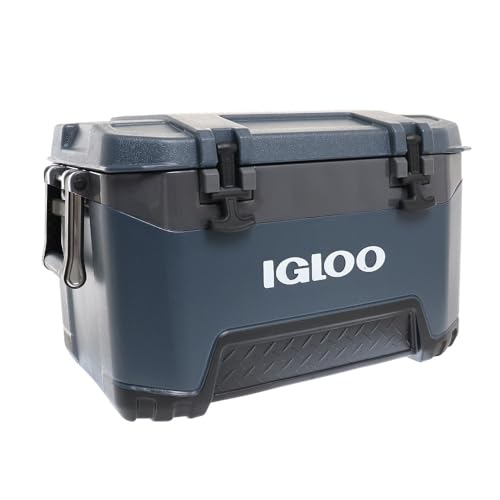
Igloo BMX 52 Quart Cooler
A steel rail and rubberised feet reinforce a blow moulded body, stopping it from sliding around a truck bed. It weighs far less than a rotomoulded box while surviving job site treatment better than a basic cooler. Owners describe it as the practical pick for daily hauling rather than multi day expeditions.
Pros
- Tough enough for job sites and truck beds
- Much lighter to lift than rotomoulded rivals
- Tie down loops secure it during transport
Cons
- Retention covers two days rather than a long weekend
- Gasket seal is less complete than premium models

Pelican Elite 30QT Cooler
Case building experience shows in two inch polyurethane insulation, press and pull latches, and a lifetime guarantee on the box itself. Thirty quarts suits day trips and pairs of anglers rather than families. Weight relative to capacity is the price paid for that construction.
Pros
- Lifetime guarantee covers the cooler body
- Latches operate one handed with ease
- Excellent retention for a compact size
Cons
- Heavy relative to the capacity offered
- Interior is too narrow for wine bottles laid flat

ORCA 40 Quart Cooler
Rotomoulded in the United States, this cooler adds a flexible cargo net on the back for dry storage of towels and gloves. Rubber latches and a single piece lid gasket seal well against spray, and light colour options reflect sun on an open deck. Owners report the moulded handles feel comfortable but a single carry is awkward once full.
Pros
- Cargo net adds useful dry storage
- Seals well against splash and spray
- Light exterior colours reduce solar gain
Cons
- Among the heaviest empty weights compared here
- Handles feel less comfortable than rope style grips

Lifetime 55 Quart High Performance Cooler
Rotomoulded style construction and a gasket sealed lid arrive at a lower cost than premium names charge. It is bulky and heavy, but group camping needs the food and drink capacity it carries for several days. Owners report retention in the four to five day range when the cooler is pre chilled and kept in shade.
Pros
- Large capacity at a mid range outlay
- Sealed lid retains ice for multiple days
- Includes practical extras like a drain plug
Cons
- Very heavy once fully loaded
- Latches feel stiffer than premium designs
Before you buy
What actually drives ice retention in a hard cooler? Wall thickness, a full length gasket and a well fitting lid matter more than the brand printed on the front. Rotomoulded coolers pack two to three inches of foam into the walls, while budget coolers use an inch or less. That difference is why one holds ice for days and the other for an afternoon.
How do I get the most retention from any cooler? A warm cooler spends its first bag of ice cooling the plastic itself rather than your food. Bringing the box down overnight with a sacrificial bag of ice, then packing it tight with cold contents, helps more than upgrading to a pricier model. Empty air space works against you.
How much capacity do I actually need? Quoted quarts include the space insulation eats, so a rotomoulded 45 quart cooler holds far less than a 45 quart budget box. For two people over a weekend, 25 to 35 usable quarts feels comfortable. A family week calls for 55 quarts and above, along with acceptance of the carrying weight.
What should I check about weight, drains and certification? A loaded rotomoulded cooler can be a two person lift, so consider wheeled versions for long carries. A drain plug that works without tipping the box saves a soaked campsite floor. Bear country trips require confirming the specific model carries certification and that approved locks are fitted.
Compared at a glance
| # | Model | Capacity | Best for | Score | Price |
|---|---|---|---|---|---|
| 1 | YETI Tundra 45 Hard Cooler | About 26 quarts usable, 45 series size | Best overall | 9.4 | Check price |
| 2 | RTIC 45 Hard Cooler | About 45 quarts stated | Best value | 9.2 | Check price |
| 3 | Coleman Xtreme 70 Quart Cooler | 70 quarts, about 100 cans | Best budget | 9.0 | Check price |
| 4 | Igloo BMX 52 Quart Cooler | 52 quarts, about 83 cans | Best for rough handling | 8.8 | Check price |
| 5 | Pelican Elite 30QT Cooler | 30 quarts | Best build quality | 8.6 | Check price |
| 6 | ORCA 40 Quart Cooler | 40 quarts | Best for boat and dock use | 8.3 | Check price |
| 7 | Lifetime 55 Quart High Performance Cooler | 55 quarts | Best capacity per dollar | 8.0 | Check price |
Questions worth asking
How long will a hard cooler actually keep ice?
Rotomoulded coolers commonly hold ice for three to six days when pre chilled, packed full and kept in shade. Budget blow moulded coolers typically manage one to two days under the same conditions. Frequent lid opening cuts those figures sharply.
Is a rotomoulded cooler worth the extra money?
Camping more than two days, fishing trips and remote travel where ice is hard to replace all justify the cost. Picnics and single overnight trips get most of the benefit from a good budget cooler like the Coleman Xtreme for far less.
What ice to contents ratio works best?
Two parts ice to one part contents by volume is a common guideline. Block ice lasts longer, cubed ice cools faster, and combining both gives the best of each. Salt water ice or frozen bottles keep drinks cold without adding a wet mess.
Should I drain the melt water from a cooler?
Usually not. Cold melt water helps keep contents chilled and fills air gaps that would otherwise warm faster. Drain only if food packaging is getting soaked or carrying weight needs to come down.
Do hard coolers need bear certification for camping?
Some national parks and wilderness areas require it. Certified models such as the YETI Tundra qualify when fitted with approved padlocks. Always check the specific regulations for the area before you travel.
How do I stop a cooler from smelling?
Empty and dry it completely after every trip, then leave the lid propped open in storage. A mild baking soda or diluted vinegar solution clears lingering odours, and gaskets need wiping separately since residue collects in the channel.
Are wheeled hard coolers worth buying?
Long carries from a parking area to a campsite benefit greatly from wheels. The tradeoffs are added weight, a slightly reduced interior in some models, and wheels that struggle on soft sand or deep gravel.
Can I sit on a hard cooler?
Most rotomoulded models and the Coleman Xtreme are built for it. Check the listing before using a lighter cooler as a seat, since some blow moulded lids flex or crack under adult weight.
What is the difference between rotomoulded and blow moulded coolers?
Rotomoulded coolers use a single moulded shell with thick foam injected inside, giving multi day retention and higher durability. Blow moulded coolers use thinner walls and cost far less, trading retention time for affordability and lighter weight.
Final word
YETI’s Tundra 45 still sets the standard for hard coolers, with insulation and sealing that reward anyone camping or fishing for several days at a time. RTIC’s 45 Hard Cooler gets remarkably close for less money, and Coleman’s Xtreme 70 Quart answers family weekends where capacity beats record retention. Pre chill whichever you buy and pack it full, since that habit outperforms any single spec on the box.
Sierra Daniels
Sierra's background is in landscape design and nursery retail. She focuses on lawn and garden equipment, outdoor furniture and gear durability, weighing published specs against how materials actually hold up outside.