Hand Crank Flashlights That Work Without Batteries
The Goal Zero Torch 250 tops this list, delivering a genuinely bright 250 lumen beam alongside crank, solar and USB charging. Storm-prone households should look at the Eton FRX3+ for its NOAA weather alerts, while the RunningSnail MD-090 gives a capable crank radio and torch combo at low cost for cars or drawers.
Goal Zero’s Torch 250 leads because it doubles as an actual usable flashlight, not just a token emergency glow, and it charges from crank, solar or USB. Eton’s FRX3+ pairs a crank generator with NOAA weather band reception, useful when a storm knocks out cell service. RunningSnail’s MD-090 costs the least of the capable options and fits a glovebox without complaint.
Cranking time claims mislead buyers, because a spec sheet lists minutes turned but rarely states how many minutes of light that effort buys. Dedicated crank-only torches have mostly vanished, replaced by radios with a small light bolted on. We compared lumen output, charging methods, battery capacity and weather features using published specifications and patterns owners describe after real outages.
Our top picks

Goal Zero Torch 250 Flashlight
Goal Zero built this around the light, not the radio, so beam output outshines every crank radio here at 250 lumens. Spot and flood modes cover distance and close work, while a red flood mode preserves night vision. USB charging fills the internal battery fast, and the crank plus a small solar panel exist for prolonged outages.
Pros
- Brightest beam of any model in this comparison
- Three independent charging sources cover most scenarios
- Red flood mode protects night vision during close tasks
Cons
- Larger and heavier than a pocket flashlight
- Built-in solar panel charges slowly in weak light

Eton FRX3+ Emergency Weather Radio with Flashlight
Eton has built emergency radios for decades, and the FRX3+ carries that experience into AM, FM and NOAA weather band reception. A crank generator, solar panel, USB port and replaceable battery back up the radio, so power rarely runs out entirely. Its LED torch and red beacon handle basic light duty, though neither rivals a dedicated flashlight.
Pros
- Receives NOAA weather alerts during storms and outages
- Four separate charging paths reduce dead-battery risk
- Established brand with long-running parts support
Cons
- Torch output is functional rather than bright
- Charging a phone by crank alone takes a long time

RunningSnail MD-090 Emergency Hand Crank Radio and Flashlight
RunningSnail’s MD-090 shows up in car emergency kits more than any other model here. Crank, solar and USB charging back a radio, a torch and a small reading lamp, all at a modest outlay. Owners report the internal battery loses capacity after long stretches unused, so an occasional USB top-up keeps it ready.
Pros
- Combines radio, torch and phone charging cheaply
- Compact enough for a glovebox or go-bag
- Reading lamp adds genuine value during outages
Cons
- Internal battery degrades without periodic charging
- Plastic housing feels lighter-duty than premium models

Kaito KA500 Voyager Emergency Radio with Flashlight
Kaito’s Voyager carries the largest fold-out solar panel in this group, shifting the workload from your arm to the sun during multi-day outages. It also accepts standard AA cells, a useful fallback once the internal pack and the crank both run dry. Bulk is the trade-off, since this is the heaviest unit here and its control layout takes a few minutes to learn.
Pros
- Large fold-out panel captures meaningful solar charge
- Standard AA cells provide a reliable backup power source
- Shortwave reception extends beyond typical weather bands
Cons
- Heaviest and bulkiest unit in this comparison
- Button layout takes time to memorize

Midland ER210 Emergency Crank Weather Radio
Midland’s background in two-way radios shows in the ER210’s alert handling, which can sound an alarm the moment a weather broadcast triggers without anyone monitoring it. An ultrasonic dog whistle and LED flashlight round out this compact household unit. Light output stays secondary, since Midland prioritized dependable radio reception over beam brightness.
Pros
- Sounds an unattended alarm on weather alerts
- Compact body packs in a useful feature set
- Radio reception benefits from Midland’s two-way radio background
Cons
- Flashlight function stays secondary to the radio
- No standard cell fallback if the battery fails
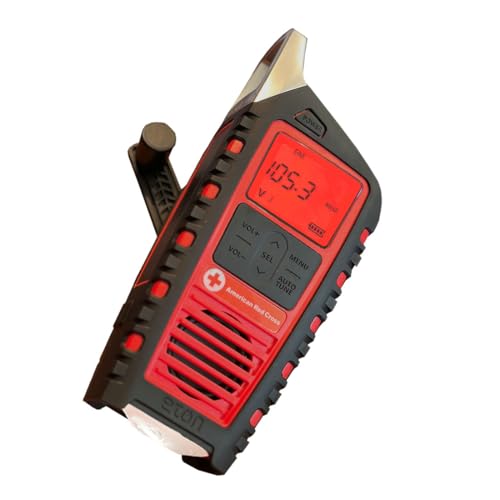
Eton Scorpion II Rugged Portable Emergency Radio
Eton designed the Scorpion II for a rucksack rather than a kitchen counter, adding a splash-resistant body, a carabiner clip and a bottle opener alongside the usual crank, solar panel and torch. Its smaller frame suits campers who count every gram. That smaller body also holds a smaller battery, so its power reserve depletes faster than the household-sized models here.
Pros
- Rugged, packable design suits backpacking trips
- Splash resistance beats most crank radios in this list
- Carabiner clip attaches straight to a pack
Cons
- Smaller internal battery holds less reserve power
- Speaker volume struggles in open, noisy outdoor settings

FosPower Emergency Solar Hand Crank Portable Radio
FosPower undercuts every other model here on cost while still covering crank, solar and USB charging. A torch, a reading light and a NOAA weather band radio round out the feature set. Build quality and light output stay basic, which makes it a sensible second or third unit rather than a household’s only backup.
Pros
- Lowest-cost way to add a crank backup per room
- Covers radio, light and phone charging in one unit
- Light enough to toss in a small bag or kit
Cons
- Basic build quality and modest light output
- Crank mechanism feels less durable than pricier units
Before you buy
How much light does one minute of cranking give you? A minute of steady cranking typically produces several minutes of LED light, not hours. Radio playback drains the reserve faster than a single LED. Phone charging drains it faster still, often adding only a percentage point or two of battery per minute of effort. Treat the crank as a backup generator, not a primary power source, and expect manufacturer figures to represent best-case cranking speed.
Why crank flashlights and crank radios are basically the same product now Dedicated crank-only flashlights have mostly disappeared from Amazon listings, replaced by radios with a small torch attached. Manufacturers made this shift because information matters as much as light during an outage, and a NOAA alert can warn of danger a flashlight never will. Buyers who want a genuinely bright beam should pick one of the few models built around the light itself, like the Goal Zero Torch 250, and accept a bulkier body in exchange for output.
How to store a hand crank flashlight so the battery still works years later Internal lithium cells lose capacity when left fully discharged in storage for years. A USB top-up every three to six months keeps most models ready. Units that also accept standard AA or AAA cells, like the Kaito KA500, give you a fallback once the internal pack fails. Extreme heat accelerates battery wear, which matters if the unit lives in a car through summer.
What else belongs in a power-outage lighting kit besides a crank flashlight A crank light works best as a backup, not a household’s main light source. Pair it with a bright rechargeable flashlight or headlamp for close tasks and a battery lantern for room lighting. Add a charged power bank for phones, since crank charging a phone stays too slow to rely on. Store the full kit in one spot every household member knows, because a flashlight nobody can find in the dark solves nothing.
The lineup, side by side
| # | Model | Output | Best for | Score | Price |
|---|---|---|---|---|---|
| 1 | Goal Zero Torch 250 Flashlight | 250 lumens | Best overall | 9.4 | Check price |
| 2 | Eton FRX3+ Emergency Weather Radio with Flashlight | AM, FM and NOAA weather band | Best for storm kits | 9.2 | Check price |
| 3 | RunningSnail MD-090 Emergency Hand Crank Radio and Flashlight | AM, FM and NOAA weather band | Best value | 9.0 | Check price |
| 4 | Kaito KA500 Voyager Emergency Radio with Flashlight | AM, FM, shortwave and weather band | Best for long outages | 8.8 | Check price |
| 5 | Midland ER210 Emergency Crank Weather Radio | AM, FM and weather band with alerts | Best alert system | 8.6 | Check price |
| 6 | Eton Scorpion II Rugged Portable Emergency Radio | AM, FM and weather band | Best for camping | 8.3 | Check price |
| 7 | FosPower Emergency Solar Hand Crank Portable Radio | AM, FM and NOAA weather band | Best budget | 8.0 | Check price |
Common questions
How long do you have to crank a flashlight for usable light?
Most models deliver several minutes of LED light per minute of steady cranking. Running a radio at the same time drains the reserve faster. Manufacturer figures usually reflect ideal cranking speed, so real-world results run lower.
Can a hand crank flashlight charge a phone?
Models with a USB output can add a small charge, but slowly. Expect a percentage point or two of battery per minute of hard cranking, enough for a short text rather than a full recharge. A charged power bank handles phones far better.
What is the difference between a hand crank flashlight and a crank radio?
A crank flashlight focuses on beam output, like the Goal Zero Torch 250 at 250 lumens. A crank radio, such as the Eton FRX3+ or RunningSnail MD-090, adds AM, FM and NOAA reception with a smaller torch attached. Most current listings fall into the second category.
Do crank flashlights still need a battery inside?
Yes. The crank charges an internal rechargeable cell, and light draws from that cell rather than directly from the handle. Some models, including the Kaito KA500, also accept standard AA cells as a fallback.
Is a crank radio with weather alerts worth buying?
In storm-prone areas, yes. Models like the Midland ER210 sound an alarm automatically when a NOAA broadcast triggers, working through the night or once cell networks fail. A plain flashlight offers no equivalent warning.
How should you store a crank flashlight between emergencies?
Keep it somewhere accessible and charge the internal battery by USB every three to six months. Avoid leaving it in extreme heat, such as a car parked in summer sun. Units with an AA cell fallback tolerate longer storage gaps better.
Does the solar panel on these units actually charge them?
Small built-in panels add only a trickle after many hours of direct sun. Larger fold-out panels, like the one on the Kaito KA500, contribute meaningfully during a multi-day outage. Treat solar as a slow background top-up rather than a primary charging method.
Which hand crank flashlight is best for a car emergency kit?
The RunningSnail MD-090 fits a glovebox and covers radio, torch and USB charging at low cost. Its plastic build is basic, but the feature set matches what a car kit actually needs.
Are hand crank flashlights bright enough to use outdoors?
Most crank radio units put out a modest beam meant for close work, not distance lighting. A handful of dedicated crank torches, like the Goal Zero Torch 250, reach output genuinely usable outdoors. Check the listed lumen figure directly, since many product pages omit it.
Should a crank flashlight be someone’s only emergency light?
No. Use it as a backup that cannot go permanently flat, alongside a rechargeable flashlight or headlamp and a battery lantern. Its limitations matter least at the exact moment everything else has already failed.
The verdict
Goal Zero’s Torch 250 remains the strongest all-around pick, bright enough for real outdoor use and backed by three separate charging paths. Households worried about storms should lean toward the Eton FRX3+ for its NOAA weather alerts alongside basic light. For a car, a shed or a spare drawer, the RunningSnail MD-090 costs little enough to place in several spots at once.
Sierra Daniels
Sierra's background is in landscape design and nursery retail. She focuses on lawn and garden equipment, outdoor furniture and gear durability, weighing published specs against how materials actually hold up outside.