Guinea Pig Habitats That Give Them Room to Roam
MidWest Homes for Pets Guinea Habitat Plus wins for floor area a pair actually needs at a fair cost. Kavee’s C&C Cage offers the most expandable layout for growing setups. Living World Deluxe Habitat fits smaller rooms where a full grid will not.
MidWest Homes for Pets Guinea Habitat Plus leads this list for a bonded pair, with Kavee’s C&C Cage as the most expandable option and Living World Deluxe Habitat for tighter rooms. Each gives guinea pigs real running space instead of the cramped box a pet store shelf often suggests.
New owners get caught out here more than with almost any other pet purchase, since cages marketed for guinea pigs are frequently sized for a hamster. Welfare guidance asks for far more floor area than most boxes provide, and poor ventilation raises the risk of respiratory illness. We ranked these seven on published dimensions, bar spacing, base design, and what owners report about assembly rigidity and cleaning.
Our top picks

MidWest Homes for Pets Guinea Habitat Plus
This habitat is built to the floor area guinea pigs actually need rather than what fits on a shelf. A removable divider lets you separate a pair during introductions or recovery. Assembly needs no tools, and the canvas base wipes clean in minutes.
Pros
- Genuine floor space for a bonded pair
- Divider helps during introductions
- Canvas base lifts out for cleaning
Cons
- Canvas can be chewed by determined pigs
- Open top offers no protection from other pets

Kavee C&C Cage
Cubes and coroplast make up this modular system, letting owners build the footprint a room allows instead of accepting a fixed box. Grids, connectors, and a fitted liner base come included, so a setup can start small and expand later. This flexibility makes it the easiest way to reach the floor area welfare guidance recommends.
Pros
- Footprint expands as a setup grows
- Correx base wipes out easily
- Grids allow loft levels and dividers
Cons
- Assembly takes longer than a ready-made cage
- Grid connectors can loosen if moved often

Living World Deluxe Habitat Extra Large
A deep plastic base paired with a wire top gives this habitat a tidier look than an open grid setup. Bedding and hay stay contained instead of spilling onto the carpet. Space suits one guinea pig comfortably but feels tight for two.
Pros
- Deep base keeps bedding contained
- Neat appearance for a living space
- Wire top protects from cats and dogs
Cons
- Floor area is tight for a bonded pair
- Platform ramp is steep for older pigs

Kaytee My First Home Deluxe Multi-Level Habitat
A second level and connecting ramps add usable area without expanding the floor footprint. Guinea pigs use elevated space less than rats or ferrets do, so treat the upper deck as a bonus rather than a substitute for ground room. Owners report the ramps grip better once covered with fleece.
Pros
- Adds usable area without a bigger footprint
- Multiple doors simplify cleaning
- Wire top keeps other pets out
Cons
- Ramps can be slippery without fleece
- Ground floor area is smaller than open cages

Ferplast Krolik 140 Small Animal Cage
An unusually deep plastic tray gives this cage the best defense against bedding scattering across the room. Its 140 length provides a long run for natural movement. The wire top hinges open across the full width, which simplifies cleaning.
Pros
- Deep tray keeps bedding contained
- Long footprint suits running behavior
- Wide opening top simplifies cleaning
Cons
- Bulky and heavy to move once assembled
- Included accessories are basic
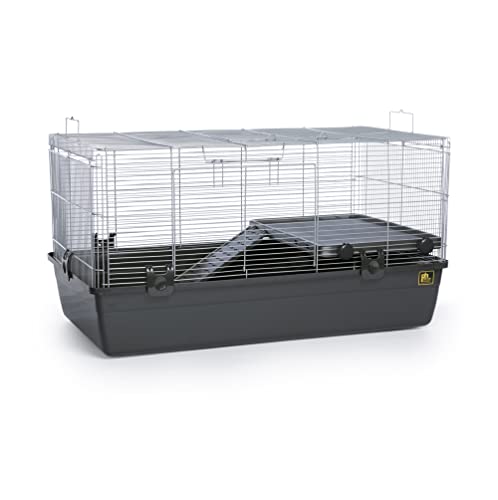
Prevue Pet Products 528 Small Animal Cage
A wire cage on a shallow plastic base with a large front door keeps this design plain and inexpensive. Pairing it with a fleece liner compensates for the shallow tray. Dimensions suit a single guinea pig or work as a temporary setup while building something larger.
Pros
- Low cost entry into a proper cage
- Large door makes handling easier
- Easy to disassemble and store
Cons
- Shallow tray lets bedding spill out
- Floor area suits one pig rather than a pair

Aivituvin Guinea Pig Hutch
A wooden frame with a wire run section and enclosed sleeping area suits owners who want shelter that can sit on a patio in mild weather. A pull-out tray simplifies cleaning between changes. Wood absorbs moisture and odor more than plastic, so it needs regular attention and should stay out of cold or wet conditions.
Pros
- Covered area gives a secure hiding space
- Sturdier appearance than wire cages
- Pull-out tray simplifies cleaning
Cons
- Wood absorbs odor and needs sealing
- Not suitable as a cold-weather outdoor home
How to pick the right one
How much floor space does a guinea pig actually need? Rescues and vets commonly recommend around 7.5 square feet for a single guinea pig and about 10.5 square feet for a pair, with more always welcome. Many cages sold in pet aisles offer half that. Guinea pigs express normal behavior through short running bursts called popcorning, which a small box prevents entirely. Measure your available floor space first, then buy the largest footprint that fits.
Do guinea pigs need multiple levels? Unlike rats or chinchillas, guinea pigs do not climb, and falls from a raised platform can injure them. A second level adds a little space and a hiding spot but never substitutes for ground room. Keep ramps shallow and wide, cover them with fleece for grip, and add side rails so a startled pig cannot run off the edge. Older or overweight guinea pigs often stop using upper levels entirely.
Ventilation vs bedding depth, striking a balance Ammonia from urine is a major trigger for guinea pig respiratory illness, making airflow non-negotiable. Open-topped cages and wire-sided designs ventilate far better than solid-sided tubs or enclosed hutches. At the same time, a deep base keeps hay and bedding contained. Most owners settle on a deep tray paired with open wire sides above it, plus daily spot cleaning and a full weekly change.
What makes daily cleaning easier? You will be inside this habitat every single day, so a design that turns that into a chore is one you will resent. Look for a wide front door or a top that opens fully instead of a small hatch. Removable trays and washable liners cut cleaning time noticeably. Fleece liners over an absorbent layer wash and reuse well, while loose paper bedding is simpler day to day but needs a deep tray to stay contained.
Compared at a glance
| # | Model | Floor area | Best for | Score | Price |
|---|---|---|---|---|---|
| 1 | MidWest Homes for Pets Guinea Habitat Plus | About 8 square feet, divisible | Best overall | 9.4 | Check price |
| 2 | Kavee C&C Cage | Modular grid and correx base | Best for expanding | 9.2 | Check price |
| 3 | Living World Deluxe Habitat Extra Large | Deep plastic tray to contain bedding | Best for small rooms | 9.0 | Check price |
| 4 | Kaytee My First Home Deluxe Multi-Level Habitat | Multi level with ramps | Best for multiple levels | 8.7 | Check price |
| 5 | Ferplast Krolik 140 Small Animal Cage | About 55 inches | Best for a deep base | 8.5 | Check price |
| 6 | Prevue Pet Products 528 Small Animal Cage | Wire cage on plastic base | Best budget | 8.2 | Check price |
| 7 | Aivituvin Guinea Pig Hutch | Wood frame with wire panels | Best for a wooden hutch | 8.0 | Check price |
Questions worth asking
How much space do two guinea pigs need?
Common welfare guidance suggests at least around 10.5 square feet of floor area for a bonded pair, well beyond most pet store cages. The MidWest Guinea Habitat Plus and a four-grid Kavee C&C setup both meet that figure.
Can guinea pigs live alone?
They are social animals that generally do better in pairs or small same-sex groups, which is why some countries treat solo housing as a welfare concern. A single guinea pig needs considerably more human interaction to compensate.
Are wire-bottom cages safe for guinea pigs?
No. Wire floors cause a painful foot condition called bumblefoot and should be avoided entirely. Every habitat here uses a solid base, and any wire floor insert should be removed and covered with fleece or a liner.
What bar spacing is safe for a guinea pig cage?
Around one inch is the usual safe figure for adult guinea pigs. Wider spacing risks a young or small pig getting its head stuck, so check the specification instead of assuming a cage sold for rabbits will work.
Fleece liners or loose bedding, which is better?
Fleece liners over an absorbent layer are reusable, cheaper long term, and produce less dust, which helps sensitive respiratory systems. Loose paper bedding is simpler day to day and more absorbent per change but costs more over a year.
Can guinea pigs live outdoors?
In many climates it is risky, since they are vulnerable to heat above roughly 26 degrees Celsius and to cold, damp conditions. A wooden hutch such as the Aivituvin works best indoors or in a sheltered spot with supervised outdoor time.
How often should you clean a guinea pig habitat?
Spot clean soiled areas and refresh hay daily, then do a full bedding change and wipe-down weekly. Larger habitats need full cleaning less urgently, since waste spreads over more area.
Does a guinea pig cage need a lid?
Guinea pigs do not climb or jump out, so an open top works fine and improves airflow. A lid matters only where cats, dogs, or young children share the house, which is when a wire-top design like the Living World or Kaytee habitats helps.
What is the best guinea pig habitat for small rooms?
A compact deluxe design like the Living World Extra Large fits tighter spaces better than a full C&C grid, though it suits one guinea pig more comfortably than two.
C&C cage vs store-bought habitat, which is better?
A C&C cage expands to fit a room’s available space and usually beats a fixed box on floor area per dollar. A store-bought habitat like the MidWest Plus needs less assembly time and works well for owners who want something ready out of the box.
The bottom line
MidWest Homes for Pets Guinea Habitat Plus suits most owners, delivering real floor area at a reasonable cost with a divider that adds genuine flexibility. Kavee’s C&C Cage is the better long-term investment for a setup that will grow, while the Living World Deluxe Habitat is a tidy compromise where floor space runs short.
Olivia Hartley
Olivia spent several years working at an animal shelter and a pet-supply retailer before joining the editorial team. She researches pet gear with an emphasis on safety, comfort and the fine print that owners often miss.