Which Gimbal Keeps Your Footage Steady in Motion?
DJI RS 4 is the strongest pick for mirrorless shooters, with automated axis locks and enough payload for a full frame body. DJI Osmo Mobile 6 suits phone-only filmmakers who need something pocketable. Zhiyun Crane M3S bridges the gap for compact cameras and light hybrid rigs.
DJI RS 4 tops this list because it balances a mirrorless body and zoom lens within minutes and keeps running through a full shoot day. Phone-only shooters get more from DJI Osmo Mobile 6, which folds flat and needs no rebalancing between takes. Zhiyun Crane M3S sits in between, built for compact cameras and stripped-down mirrorless rigs.
Payload ratings mislead people because a heavy lens shifts the center of gravity forward, straining a motor rated for that same body. Setup time matters just as much: a gimbal that takes ten minutes to balance stays in the bag. We compared payload against realistic camera and lens pairings, checked axis lock and quick release design, reviewed stated battery life, and weighed what owners report about app reliability and motor strength on long handheld takes.
How to choose
What payload rating actually matters? A gimbal rated for three kilograms can still fight you if the lens shifts the center of gravity forward of the mounting plate. Long telephotos and heavy cine lenses cause this most often. Match the payload spec to your actual body and lens pairing, add the weight of any monitor or microphone, and leave headroom instead of buying to the exact limit.
How long does balancing really take? Every camera gimbal needs balancing across three axes before the motors take over. Quick release plates and axis locks can cut that process from ten minutes to under one. Automated locks on newer models shrink it further still. Lens swaps mid-shoot make fast rebalancing worth more than an extra half kilogram of payload.
Phone gimbal or camera gimbal: which one fits your setup? Smartphone gimbals never need balancing, fold into a bag, and add tracking or gesture control a phone cannot manage alone. Camera gimbals demand real setup effort but support interchangeable lenses, external audio, and proper follow focus. Buy for the camera you actually film with, not the one you might upgrade to later.
Which follow mode should you use for each shot? Most visible difference between clips comes down to which axes are following your movement. Pan follow suits walking shots, lock mode suits static subjects, and FPV or full follow suits fast, dynamic movement. Favor a gimbal that switches modes with a button or wheel, since stopping to open an app costs the shot.
What we recommend

DJI RS 4 Gimbal Stabilizer
Automated axis locks make the RS 4 the fastest DJI gimbal to balance, sliding a teflon-coated tilt arm smoothly under a heavy lens. Payload covers a full frame body paired with a standard zoom. A touchscreen puts follow mode changes one tap away, which matters most during narrative or event shoots.
Pros
- Automated axis locks cut setup time sharply
- Payload handles most full frame body and zoom pairings
- Touchscreen speeds up follow mode changes
Cons
- Heavy to hold through long single takes
- Accessories add cost quickly beyond the base kit
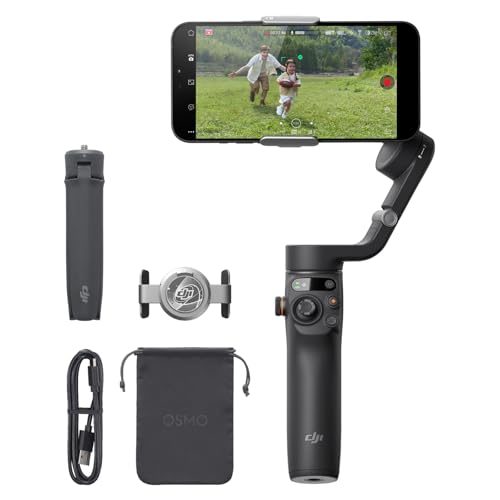
DJI Osmo Mobile 6 Smartphone Gimbal
Folding down to jacket-pocket size, Osmo Mobile 6 unfolds into a stabilized rig in seconds. A side wheel handles zoom or focus, and the built-in extension rod helps with low angles and group shots. Subject tracking runs through DJI’s app rather than the phone’s native camera app, which is the main tradeoff.
Pros
- Folds small enough for everyday carry
- Magnetic clamp makes mounting quick
- Side wheel gives smooth manual zoom or focus
Cons
- Tracking features require the DJI app
- Heavier phones in thick cases can need rebalancing

Zhiyun Crane M3S Gimbal Stabilizer
Sitting between phone gimbals and full camera rigs, Crane M3S suits a compact camera, an action camera, or a small mirrorless body with a pancake lens. Its light build holds up for an arm’s-length shot through a whole scene. A swappable battery avoids downtime on longer shoots, though motors strain once a heavier lens is mounted.
Pros
- Light enough for extended handheld shooting
- Swappable battery keeps a long shoot going
- Works with phones, action cameras and small bodies
Cons
- Motors strain with heavier lens combinations
- Menu system takes time to learn

DJI RS 4 Mini Gimbal Stabilizer
Travel and run-and-gun documentary work suit RS 4 Mini, which keeps the useful parts of the full RS platform in a body light enough to carry all day. It still balances a mid-size mirrorless body with a compact lens. An optional tracking module automates solo pieces to camera, though fast constant-aperture zooms push past its payload.
Pros
- Light enough for all day carry and travel
- Balances quickly with compact lens setups
- Tracking module helps solo creators
Cons
- Lower payload than the full size RS 4
- Tracking module is a separate purchase

Zhiyun Smooth 5S Smartphone Gimbal
Dedicated buttons and a control wheel cover the handle, so operators rarely need to glance at a screen. Bulk is the tradeoff: Smooth 5S does not collapse as small as folding rivals. Payload still copes with a large phone in a case plus a clip-on lens, and the bundled fill light kit earns its keep for indoor vlogging.
Pros
- Physical controls beat menu diving on set
- Handles large phones with cases fitted
- Long stated battery life
Cons
- Does not fold as compactly as rivals
- Bulkier in a bag than folding designs

Hohem iSteady M6 Smartphone Gimbal
Hohem undercuts the two big brands on cost while still bundling a magnetic fill light and a detachable AI tracking sensor. Stabilization holds up well for social clips and casual filming, though fast pans show more correction than premium rivals. Owners report the companion app as the weakest link, so treat the hardware as the real draw.
Pros
- Fill light and tracking sensor included
- Strong feature list for the outlay
- Extension rod helps with low and high angles
Cons
- App is less polished than DJI’s
- Fast pans show more correction than premium rivals

FeiyuTech SCORP Mini 2 Gimbal Stabilizer
Switching between a small mirrorless camera and a phone is where SCORP Mini 2 earns its keep, with a magnetic phone mount alongside a standard camera plate. Its underslung handle grip makes low-angle moves easier than most compact gimbals allow. Accessory choices stay narrower than DJI’s ecosystem, which keeps this a niche pick.
Pros
- Switches between camera and phone quickly
- Underslung grip suits low angle moves
- Compact for a camera capable gimbal
Cons
- Lowest payload of the camera gimbals here
- Smaller accessory ecosystem than DJI
The lineup, side by side
| # | Model | Type | Best for | Score | Price |
|---|---|---|---|---|---|
| 1 | DJI RS 4 Gimbal Stabilizer | Three axis camera gimbal | Best overall | 9.4 | Check price |
| 2 | DJI Osmo Mobile 6 Smartphone Gimbal | Three axis smartphone gimbal | Best for smartphones | 9.2 | Check price |
| 3 | Zhiyun Crane M3S Gimbal Stabilizer | Three axis compact gimbal | Best for compact cameras | 9.0 | Check price |
| 4 | DJI RS 4 Mini Gimbal Stabilizer | Three axis camera gimbal | Best for travel | 8.8 | Check price |
| 5 | Zhiyun Smooth 5S Smartphone Gimbal | Three axis smartphone gimbal | Best for physical controls | 8.6 | Check price |
| 6 | Hohem iSteady M6 Smartphone Gimbal | Three axis smartphone gimbal | Best value smartphone gimbal | 8.3 | Check price |
| 7 | FeiyuTech SCORP Mini 2 Gimbal Stabilizer | Three axis hybrid gimbal | Best for mixed devices | 8.0 | Check price |
Frequently asked questions
Do I need a gimbal if my camera already has stabilization?
In-body stabilization corrects small shakes but cannot smooth the up-and-down motion of walking. A gimbal absorbs that larger movement instead. Many shooters run both together: the camera handles fine vibration, the gimbal handles stride.
How long does it take to balance a camera gimbal?
Expect three to ten minutes the first time with a given lens, then under a minute afterward if the model has axis locks and a marked quick release plate. Switching to a different-weight lens means rebalancing again, which is why fast lock systems matter.
Can a smartphone gimbal hold a phone in a thick case?
Most current models can, but a heavy case plus a magnetic wallet can push the clamp past its comfortable range and make the motors hunt. Drifting during a still hold usually means removing case accessories and rechecking balance before blaming the hardware.
What payload should I look for in a gimbal?
Add your camera body, heaviest lens, and any accessories together, then pick a gimbal rated at least a quarter above that total. Running motors near their limit drains the battery faster and produces jerkier correction on quick moves.
Are gimbal apps required to use the gimbal?
Basic stabilization works without an app on every model here. Subject tracking, gesture control, timelapse, and firmware updates generally require the manufacturer app, and app quality varies more across brands than hardware quality does.
Is a three axis gimbal better than a two axis one?
For video, yes, since the third axis corrects roll, which is what tilts the horizon as you walk. Two axis designs mostly survive in cheap phone mounts and are worth skipping if smooth walking shots are the goal.
Can a gimbal be used for photography?
It can, and it helps with long exposure panning or repeated framing, but gimbals are built for motion. A monopod or tripod stays lighter, cheaper, and more stable for still shots.
How should a gimbal be stored between shoots?
Lock all three axes before packing, remove the camera, and store the gimbal in a padded case rather than loose in a bag. Owners report most motor damage comes from transporting a gimbal unlocked with the camera still attached.
DJI RS 4 vs DJI RS 4 Mini: which one should I buy?
RS 4 carries more payload and suits a full frame body with a standard zoom. RS 4 Mini trades some payload for lighter weight, which favors travel and all-day carry over maximum lens support.
Final word
DJI RS 4 remains the buy for mirrorless video, since its payload and quick axis locks remove the friction that keeps a gimbal in the bag. Phone shooters should pick DJI Osmo Mobile 6 instead, since it folds small enough to actually carry daily. Anyone shooting a camera between those categories fits best with Zhiyun Crane M3S.
Marcus Chen
Marcus covered consumer electronics for enthusiast tech publications for six years before joining ChoiceCrest. He specializes in translating manufacturer spec sheets into plain-language buying advice, with a focus on audio, computing accessories and smart-home gear.

