Which Geography Toy Survives a School’s Bulk Order?
Learning Resources Puzzle Globe wins for classroom bulk orders because its molded-plastic pieces survive a full school year of handling. GeoSafari Jr. Talking Globe delivers strong value for pre-readers through touch-activated audio. Large groups do better with the hand2mind Foam Geography Floor Puzzle, which spreads across enough floor space for several kids at once.
Learning Resources Puzzle Globe fits classroom bulk orders best because thick molded plastic resists the cracking that thinner globes develop under multiple students’ hands. Younger classes with limited supervision may still lose small continent pieces in a shared bin, so storage matters as much as the toy itself.
Bulk classroom orders face heavier wear than a single home unit, so we compared build material, age range, and how each toy performs in group settings using manufacturer specs and owner feedback from repeat buyers.
Our top picks

Learning Resources Puzzle Globe
Continent-shaped puzzle pieces snap together to form a full globe, turning geography into a hands-on assembly task. Thick molded plastic resists cracks that thinner globes develop after a year of student handling. Color-coded pieces let younger kids self-correct without adult help.
Pros
- Molded plastic shell withstands daily classroom handling
- Color-coding lets kids self-correct during assembly
- Combines puzzle-solving with continent recognition
Cons
- Small pieces can go missing in a shared bin
- No audio or quiz feature beyond physical assembly
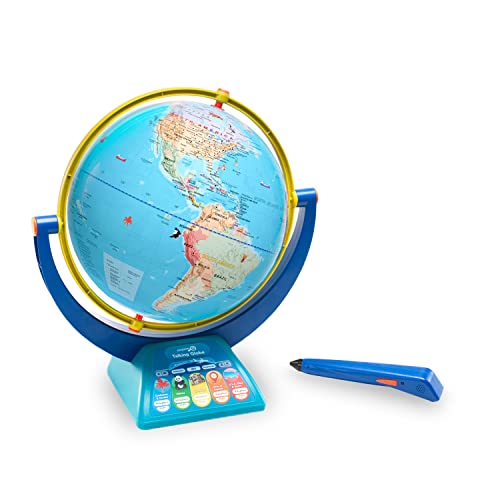
GeoSafari Jr. My First Talking Globe
A touch-activated speaker names countries, animals, and landmarks aloud, giving pre-readers an audio path into geography. Battery power means no app or Wi-Fi setup before class starts. Per-unit cost stays low enough for ordering several at once.
Pros
- Audio narration works for kids who can’t read yet
- No app or internet connection needed to run
- Low per-unit cost suits multi-unit school orders
Cons
- Batteries need regular replacement under shared use
- Speaker volume can get lost in a loud room

Melissa & Doug Round the World Wooden Puzzle
Chunky knob-style pieces shaped like continents suit kids still building fine motor control. Solid wood resists the cracking that plastic pieces show after repeated drops. It undercuts electronic and 3D globe options on price per unit.
Pros
- Solid wood holds up better than plastic after drops
- Knob pieces suit early fine motor development
- Lowest per-unit cost among the seven picks
Cons
- No audio or interactive element included
- Covers fewer geography details than a full globe
Learning Resources World Magnetic Globe
A magnetic surface holds separate country and capital pieces in place while several kids work different regions during one lesson. Magnetic attachment keeps parts secure better than loose puzzle pieces during active handling. Teachers use it for both solo review and whole-class games.
Pros
- Magnetic pieces stay put better than loose puzzle parts
- Several students can work separate regions simultaneously
- Works for both individual review and group games
Cons
- Needs flat storage so pieces don’t warp
- Costs more than basic wooden puzzle sets

hand2mind Foam Geography Floor Puzzle
An oversized foam layout covers enough floor space for a small group to build continents together, unlike tabletop globes. Soft EVA foam is safer than hard plastic during floor sessions with several kids moving around. Circle-time and station-based lessons fit this format well.
Pros
- Floor-size format fits several kids working at once
- EVA foam is safer than hard plastic on the floor
- Suits circle-time and rotating classroom stations
Cons
- Takes up significant floor space during use
- Foam shows wear faster than wood or hard plastic
Educational Insights GeoSafari Talking Globe
A wand-style pointer drives a quiz mode that tests country and capital recall aloud, aimed at older kids than the Jr. version. Battery power runs the unit without any app or account setup. Older elementary classrooms use the quiz format to review completed geography units.
Pros
- Wand quiz mode adds active recall practice
- No app or account needed to operate
- Suits older elementary review sessions well
Cons
- Wand can be separated and lost from the base
- Batteries need regular swaps under group use

Learning Resources Pop-Up World Map Puzzle
Large, easy-grip pieces suit preschool hands better than the finer parts found in globe-style puzzles. A pop-up design lifts finished sections slightly, giving visible progress as kids complete regions. It works as an entry point before moving to a 3D globe.
Pros
- Large pieces suit preschool-age fine motor skills
- Pop-up feedback shows visible progress while assembling
- Serves as a simple first step before 3D globes
Cons
- Offers less country-level detail than full globes
- Kids may outgrow it faster than detailed options
What matters most
What to look for in a bulk geography toy order Durability outweighs novelty when multiple kids share one unit across a school year. Wood and thick molded plastic outlast foam and fragile electronic parts under repeated handling. Check whether a missing piece ruins the whole toy, since loose parts get lost in shared bins fast.
Matching age range across a mixed classroom Preschool rooms do better with large, easy-grip pieces like the Pop-Up World Map Puzzle. Older elementary kids get more from recall-based tools like the GeoSafari Talking Globe’s quiz mode. A single bulk order rarely covers both ends of that range well, so mixed-age schools may need two products.
Group lessons versus individual review time Floor puzzles and magnetic globes let several kids work together during one lesson block. Talking globes and wand-quiz tools suit individual turns better, since only one child hears the audio at a time. Most classroom sets benefit from stocking both formats rather than picking just one.
Battery upkeep versus non-electronic durability Talking globes add audio engagement but need regular battery swaps, an ongoing cost in group settings. Puzzles and floor mats skip that upkeep entirely, trading interactivity for lower long-term maintenance. Schools ordering many units should weigh replacement costs against the engagement electronics add.
Side by side
| # | Model | Format | Best for | Score | Price |
|---|---|---|---|---|---|
| 1 | Learning Resources Puzzle Globe | 3D puzzle globe | Best overall | 9.1 | Check price |
| 2 | GeoSafari Jr. My First Talking Globe | Interactive talking globe | Best value | 8.7 | Check price |
| 3 | Melissa & Doug Round the World Wooden Puzzle | Wooden knob puzzle | Best budget | 8.3 | Check price |
| 4 | Learning Resources World Magnetic Globe | Magnetic globe with pieces | Best for classroom group use | 8.8 | Check price |
| 5 | hand2mind Foam Geography Floor Puzzle | Floor puzzle mat | Best for large groups | 8.6 | Check price |
| 6 | Educational Insights GeoSafari Talking Globe | Interactive talking globe with wand | Best for interactive quizzing | 8.9 | Check price |
| 7 | Learning Resources Pop-Up World Map Puzzle | Pop-up flat map puzzle | Best for younger kids | 8.4 | Check price |
Common questions
What geography toys hold up best for classroom bulk orders?
Durable non-electronic picks like the Learning Resources Puzzle Globe last longest, since they skip batteries and fragile parts.
Are talking globes worth it for schools?
They add audio engagement for pre-readers, but ongoing battery costs are worth weighing against a standard puzzle globe.
Which age group suits a geography puzzle globe?
Most puzzle globes fit ages 3 and up, while wand-based quiz globes work better for kids 6 and older who read confidently.
How do foam floor puzzles compare to tabletop globes for group work?
Floor puzzles let more kids join at once because the format spans more physical space than one tabletop globe.
Do geography toys need supervision during group play?
Younger groups benefit from light supervision to prevent lost pieces, while older kids using quiz globes can usually manage alone.
What is the difference between a puzzle globe and a magnetic globe?
Puzzle globes use interlocking continent pieces, while magnetic globes hold separate country or capital pieces on a magnetic surface.
Can geography toys replace a printed classroom map?
They work well as hands-on supplements, but most classrooms still keep a printed map for quick large-scale reference.
How many units does a classroom need for a bulk geography order?
Group formats like floor puzzles can serve several students per unit, while individual talking globes usually need one per small group.
Is wood or plastic better for a classroom geography toy?
Wood resists cracking from drops better than most plastic, while thick molded plastic like the Puzzle Globe balances durability with lighter weight.
Our take
Learning Resources Puzzle Globe remains the strongest bulk pick thanks to its durable build and low upkeep. Schools working with a tighter budget should choose the Melissa & Doug Round the World Puzzle instead. Classrooms running group lessons get more value from the hand2mind Foam Geography Floor Puzzle.
Rachel Simmons
Rachel previously worked in child-product retail and brings a practical, detail-first eye to gear reviews, focusing on safety standards, ease of use and the fine print that matters most for new caregivers.


