Garden Water Pumps Compared by Flow Rate and Head
Most yards are well served by the Wayne PLV75EL, a 3/4 HP pump built for sprinkler feeds and water transfer. Superior Pump’s 91250 costs less and clears flooded beds quickly. Sun Joe’s SWJ803E suits rain barrel setups, and VIVOSUN’s 800 GPH submersible pump fits quiet pond fountains.
Flow rate alone doesn’t tell the story once head height enters the picture. A 3/4 HP motor rated at 3,480 GPH puts the Wayne PLV75EL ahead of this group for sprinkler feeding and general water transfer. Superior Pump’s 91250 costs less and still clears flooded beds fast. Sun Joe’s SWJ803E and VIVOSUN’s 800 GPH pump instead cover rain barrels and ponds.
Published GPH numbers drop sharply once head height and hose length enter the equation, which trips up a lot of buyers. We compared flow rates, head ratings, motor specs and real use cases like rain barrels, ponds and flood cleanup to sort these seven pumps by task rather than raw horsepower.
What to look for
What GPH and head height actually mean GPH measures gallons per hour at zero vertical lift, the number printed on most pump boxes. Head height cuts that figure down as water climbs uphill or travels through a longer hose. A pump rated for 2,000 GPH might deliver half that at 15 feet of head. Housing material and impeller design affect real output just as much as motor horsepower.
Best setups for rain barrels and drip irrigation Automatic float switches, like the one on Little Giant’s 5.5-ASP, start pumping once rain barrel water rises past a set level. Low-flow drip irrigation lines don’t need high GPH, so EcoPlus’s Eco 396 avoids wasted power at just 8 watts. Garden hose adapters, included on the Sun Joe SWJ803E, skip extra fittings for hand watering straight from a barrel. Sediment at the bottom of a barrel can clog a smaller pump faster than open pond water does.
Choosing a pump for ponds, fountains and water features Pond pumps often run for hours at a stretch, so quiet operation matters more than raw flow. VIVOSUN’s submersible pump uses a ceramic shaft bearing to cut noise near patio seating. Nozzle attachments shape spray patterns for fountains and small waterfalls without a separate fitting kit. Continuous duty ratings matter here, since these units often run all day rather than in short bursts.
Draining flooded beds and shallow puddles fast Flooded garden beds need a pump that draws water down close to the soil line, not just the bulk volume. Superior Pump’s 91250 pulls down to about 1/8 inch remaining, while Wayne’s WWB Waterbug reaches roughly 1/16 inch with a built-in strainer. Grass clippings and mulch can jam an impeller quickly without that strainer in place. Neither pump suits continuous duty beyond a few hours per session.
The top picks, ranked

Wayne PLV75EL 3/4 HP Cast Iron Lawn Sprinkling and Water Transfer Pump
This pump draws from a pond, cistern or rain barrel and pushes water through a garden sprinkler system. A 3/4 HP motor delivers 3,480 gallons per hour at ground level, tapering off as head height climbs. Cast iron housing sheds heat during long cycles, and a built-in thermal overload switch protects the motor.
Pros
- Highest flow rate in this group for large sprinkler zones
- Cast iron construction resists warping in direct sun
- Thermal overload protection extends motor life
Cons
- Needs manual priming since it sits above the water source
- Weighs over 20 pounds, heavier than submersible models

Sun Joe SWJ803E Submersible Electric Water Pump
It sits fully underwater in a rain barrel or shallow pond and pushes water straight through a standard garden hose. An included 3/4 inch adapter skips extra fittings for hand watering or soaker hose use. A stainless steel carry handle keeps the motor housing off wet ground between uses.
Pros
- Garden hose adapter attaches without separate fittings
- Fully submersible design needs no priming
- Stainless handle doubles as a stable base while running
Cons
- 26 ft max head limits use on sloped yards
- Power cord runs shorter than dedicated transfer pumps

Superior Pump 91250 1/4 HP Submersible Utility Pump
This pump clears standing water down to about 1/8 inch, useful for flooded flower beds after heavy rain. Thermoplastic housing keeps the unit under 10 pounds for easy moves between garden zones. A 3/4 inch discharge fits standard garden hose threads without an adapter.
Pros
- Draws water down to roughly 1/8 inch remaining
- Lightweight thermoplastic body stays under 10 pounds
- Direct 3/4 inch garden hose thread on the discharge
Cons
- Lower max head than metal-bodied transfer pumps
- Thermoplastic housing takes impact less well than cast iron

Little Giant 566725 5.5-ASP 1/6 HP Submersible Utility Pump
An automatic float switch turns this pump on once rain barrel water rises past a set point. Oil-free construction avoids leaks into runoff used on vegetable beds. A compact 6.3 inch base fits inside narrow rain barrel openings without wedging.
Pros
- Automatic float switch needs no manual toggling
- Oil-free motor avoids contaminating garden runoff
- Compact base fits standard rain barrel openings
Cons
- 1,200 GPH flow trails larger transfer pumps
- 11 ft max head limits use on raised garden beds

VIVOSUN 800 GPH Submersible Water Pump
This submersible pump circulates water in ponds and small water features rather than pushing it long distances. Four included nozzle heads shape spray patterns for fountains and waterfalls. A ceramic shaft bearing keeps noise low enough for patios near seating areas.
Pros
- Ceramic shaft bearing runs quieter than plastic bushings
- Four nozzle heads cover different fountain styles
- Compact size fits small pond basins
Cons
- 800 GPH flow runs too low for sprinkler feeding
- 10 ft max head rules out uphill transfer jobs

Wayne WWB Waterbug Submersible Pump
This unit removes standing water from flooded lawns and window wells down to about 1/16 inch. A stainless steel strainer base keeps grass clippings and debris out of the impeller. Thermoplastic housing keeps total weight near 6 pounds for one-hand carrying.
Pros
- Draws water down to about 1/16 inch remaining
- Stainless strainer base filters out debris and clippings
- Weighs roughly 6 pounds for quick relocation
Cons
- 12 ft max head limits its use as a transfer pump
- Not rated for continuous duty beyond a few hours
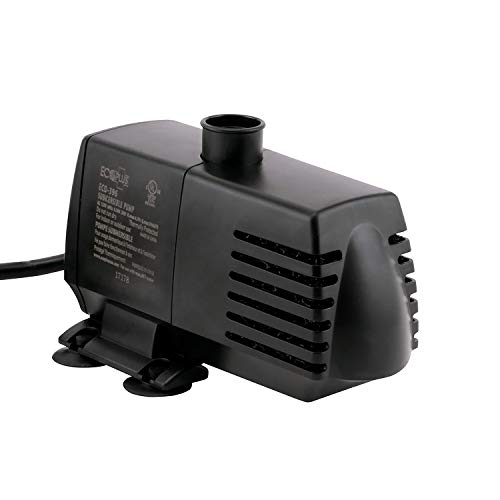
EcoPlus 728310 Eco 396 Submersible Pump
EcoPlus built this pump for low-flow jobs like drip irrigation lines and hydroponic reservoirs rather than whole-yard watering. Energy draw stays near 8 watts, low enough for solar setups with a small battery bank. A quiet ceramic shaft suits pumps running indoors near seed-starting trays.
Pros
- Low 8 watt draw suits small solar or battery setups
- Quiet ceramic shaft works near indoor growing areas
- Compact size fits small reservoirs and buckets
Cons
- 396 GPH flow can’t feed multiple drip lines at once
- 6.6 ft max head limits use to flat garden beds
Compared at a glance
| # | Model | Motor | Best for | Score | Price |
|---|---|---|---|---|---|
| 1 | Wayne PLV75EL 3/4 HP Cast Iron Lawn Sprinkling and Water Transfer Pump | 3/4 HP, 115V | Best overall | 9.4 | Check price |
| 2 | Sun Joe SWJ803E Submersible Electric Water Pump | 1/2 HP, 120V | Best value | 9.2 | Check price |
| 3 | Superior Pump 91250 1/4 HP Submersible Utility Pump | 1/4 HP, 115V | Best budget | 9.0 | Check price |
| 4 | Little Giant 566725 5.5-ASP 1/6 HP Submersible Utility Pump | 1/6 HP, 115V | Best for rain barrels | 8.8 | Check price |
| 5 | VIVOSUN 800 GPH Submersible Water Pump | 40 watts | Best for ponds and fountains | 8.6 | Check price |
| 6 | Wayne WWB Waterbug Submersible Pump | 1/6 HP, 115V | Best for flooded yards and shallow water removal | 8.3 | Check price |
| 7 | EcoPlus 728310 Eco 396 Submersible Pump | 8 watts | Best for drip irrigation and hydroponics | 8.0 | Check price |
Good to know
How many GPH do I need for a garden hose?
A standard garden hose flows around 480 to 600 gallons per hour at typical household water pressure. A pump rated near 800 to 2,000 GPH at low head height comfortably covers hand watering or soaker hose use.
What is the difference between a submersible and a transfer water pump?
Submersible pumps sit fully underwater and push water up and out through a hose. Transfer pumps like the Wayne PLV75EL sit above the water source and pull water in through a suction line, which needs priming first.
Can a garden water pump run on a car battery or solar panel?
Low-wattage models like EcoPlus’s Eco 396, drawing about 8 watts, can run from a small battery bank or solar setup. Larger 3/4 HP transfer pumps need standard household AC power and aren’t practical on solar alone.
Is a 1/4 HP pump strong enough for a vegetable garden?
A 1/4 HP pump like the Superior Pump 91250 handles hand watering, small drip lines and draining puddles between rows. Supplying a full sprinkler system takes higher flow and head height from a 3/4 HP unit instead.
How do garden water pumps handle sediment from rain barrels?
Most submersible garden pumps include an intake screen to block leaves and larger debris. Fine sediment can still wear down an impeller over time, so an automatic float switch, like the one on the Little Giant 5.5-ASP, helps by shutting off before the pump draws in bottom sludge.
What size hose fits most garden water pumps?
Most submersible garden pumps use a 3/4 inch discharge that matches standard garden hose threads directly. Larger transfer pumps like the Wayne PLV75EL step up to 1 inch NPT fittings, which may need an adapter for a standard hose.
Do garden water pumps need to be primed before use?
Submersible pumps never need priming, since the impeller sits underwater from the start. Above-ground transfer pumps like the Wayne PLV75EL need the suction line and pump body filled with water before the motor starts pulling from a distant source.
Sump pump vs garden water pump: what’s the difference?
Sump pumps are built for basement pits and often include a permanent float switch and check valve. Garden water pumps prioritize portability and garden hose compatibility instead, trading some of that basement-specific hardware for lighter weight.
Which garden pump works best for a sloped yard?
Sloped yards need a higher head height rating, since water loses pressure climbing uphill. The Wayne PLV75EL’s 90 ft max head handles slope far better than compact pond or rain barrel pumps rated under 15 feet.
Our take
No single pump handles every garden task well, since sprinkler feeding, pond circulation and flood cleanup all call for different flow rates. The Wayne PLV75EL suits general transfer and irrigation, while Superior Pump’s 91250 and Wayne’s WWB Waterbug handle smaller drainage jobs. Match head height and GPH to the actual distance and elevation water needs to travel.
Sierra Daniels
Sierra's background is in landscape design and nursery retail. She focuses on lawn and garden equipment, outdoor furniture and gear durability, weighing published specs against how materials actually hold up outside.