Gaming Speakers That Deliver Punchy, Clear Sound
Most owners point to the Logitech G560 first, since its subwoofer and reactive lighting suit immersive single-player games. The Creative Pebble Pro fits tighter desks and budgets. The Edifier G2000 balances music and gaming in one stereo pair.
Deep bass and screen-reactive lighting explain why the Logitech G560 tops most owner recommendations for gaming speakers. Tighter desks do better with the Creative Pebble Pro, and the Edifier G2000 splits the difference between music and gaming duty.
Wattage claims on the box rarely predict how a speaker actually sounds. Driver design, cabinet size, and connectivity tell you more. We compared these seven sets on published specs and what long-term owners report, then grouped them by the setup each one fits best.
What we recommend

Logitech G560 LIGHTSYNC
A downward-firing subwoofer sits between two satellites, filling a room in a way stereo-only sets cannot match. LIGHTSYNC RGB reads on-screen color and audio in real time. Owners cite that reactive lighting most often when recommending it for single-player sessions.
Pros
- Deep, room-filling bass from the subwoofer
- Screen-reactive RGB adds real immersion
- Multiple inputs including Bluetooth
Cons
- Subwoofer takes up desk or floor space
- Software needed to unlock lighting effects

Razer Nommo V2
THX Spatial Audio widens the soundstage past what a standard 2.1 setup delivers. A wireless subwoofer keeps cable clutter down without sacrificing low end. Both competitive shooters and cinematic titles benefit, according to owner reports, and Chroma lighting ties into a broader Razer setup.
Pros
- Wide spatial soundstage for positional audio
- Wireless subwoofer simplifies cable routing
- Bright, customizable Chroma lighting
Cons
- Best features rely on Razer Synapse
- Priced above most desktop sets

Creative Pebble Pro
Tilted drivers aim sound directly at ear level instead of bouncing it off a desk surface. Low end punches above what the compact cabinets suggest. USB-C power plus Bluetooth make this a tidy fit for smaller desks that still want an RGB accent.
Pros
- Clear sound from a compact footprint
- Bluetooth and USB-C in a budget set
- Tilted drivers aim audio at the listener
Cons
- Limited bass compared to 2.1 systems
- Not loud enough for large rooms
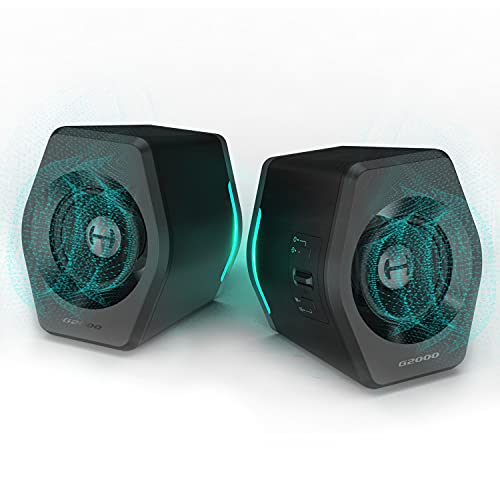
Edifier G2000
Retro bookshelf styling houses a genuinely balanced tuning rather than a bass-heavy gaming profile. Twelve RGB effects let you match a broader setup without overpowering it. Four inputs, including optical, make it as comfortable for music as for games, and owners praise the clean midrange.
Pros
- Balanced tuning suits music and games
- Four input options including optical
- Attractive angled cabinet design
Cons
- No dedicated subwoofer for deep bass
- Controls sit on the rear panel
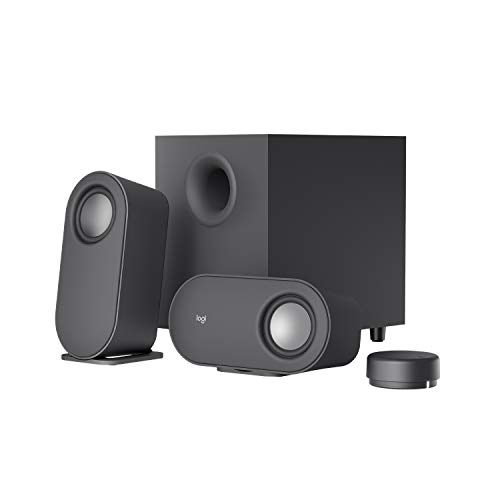
Logitech Z407
A proper subwoofer at this price point is rare, and Logitech pairs it with a wireless control puck for volume and Bluetooth pairing. RGB is skipped entirely, keeping the focus on bass rather than lighting. Anyone who wants low end without extra visual noise fits this pick.
Pros
- Real subwoofer bass at a low price
- Handy wireless control dial
- Multiple wired and wireless inputs
Cons
- No RGB lighting at all
- Puck is battery powered

SteelSeries Arena 3
Custom four-inch woofers deliver solid clarity from a plain 2.0 stereo pair. Front-facing controls and a built-in headphone jack make quick adjustments easier than reaching around the back. Tighter desks benefit most, since the footprint stays small without sacrificing sound quality.
Pros
- Clear, honest stereo sound
- Convenient front-panel controls
- Headphone jack built into the speaker
Cons
- No subwoofer for deep bass
- No lighting effects

Klipsch ProMedia 2.1 THX
Horn-loaded tweeters pair with a beefy subwoofer for aggressive output that gets genuinely loud. THX certification backs up the detailed high end. No RGB and no Bluetooth exist here, yet owners stay loyal year after year for the raw sound alone.
Pros
- Very loud with detailed highs
- Strong, controlled subwoofer bass
- THX-certified proven design
Cons
- Analog input only, no Bluetooth
- No lighting or wireless features
Before you buy
Stereo or 2.1: what actually needs a subwoofer? A 2.0 pair like the Edifier G2000 or SteelSeries Arena 3 saves desk space and often sounds cleaner for music. Deep low end is the tradeoff you give up without a dedicated sub. Explosions and cinematic games hit harder with the extra rumble a 2.1 system like the G560 or Z407 provides. Action-heavy libraries make that footprint worth it.
How much does RGB lighting matter to you? Screen-reactive systems such as the G560 and Razer Nommo V2 sit at one end, a simple accent ring on the Pebble Pro sits in the middle, and the Klipsch ProMedia skips lighting entirely. Reactive RGB does add real immersion in single-player games. Companion software is usually required to unlock it, so skip that tier if you never plan to install extra apps.
Match connectivity to how you actually listen Bluetooth switches easily between a PC and a phone, while USB delivers a cleaner digital signal. Optical suits certain consoles better than either. A wireless subwoofer, like the one on the Nommo V2, cuts down on cable clutter under the desk. Check your devices’ ports before choosing a set.
Peak wattage numbers tell you almost nothing Marketing leans on peak power because it is an easy number to print on a box. Driver size, cabinet design, and tuning shape the actual sound far more. A well-tuned 32W set, like the Edifier G2000, can outperform a poorly designed system rated much higher. Owner reports on real-world volume matter more than the headline figure.
How they stack up
| # | Model | Configuration | Best for | Score | Price |
|---|---|---|---|---|---|
| 1 | Logitech G560 LIGHTSYNC | 2.1 with subwoofer | Best overall | 9.4 | Check price |
| 2 | Razer Nommo V2 | 2.1 with wireless sub | Best for immersion | 9.1 | Check price |
| 3 | Creative Pebble Pro | 2.0 stereo | Best value | 8.9 | Check price |
| 4 | Edifier G2000 | 2.0 stereo | Best sound for the money | 8.7 | Check price |
| 5 | Logitech Z407 | 2.1 with subwoofer | Best 2.1 on a budget | 8.5 | Check price |
| 6 | SteelSeries Arena 3 | 2.0 stereo | Best compact stereo | 8.3 | Check price |
| 7 | Klipsch ProMedia 2.1 THX | 2.1 with subwoofer | Best for loud, punchy audio | 8.2 | Check price |
Frequently asked questions
Are gaming speakers better than regular desktop speakers?
Raw fidelity is not always higher. Gaming-focused sets add extras such as reactive RGB, spatial audio modes, and quick input switching. Bookshelf speakers can match or beat them on pure audio quality if lighting and gaming modes do not matter to you.
Do I need a subwoofer for gaming?
A subwoofer is not required, but it noticeably improves explosions and engine sounds. Action-heavy players with the desk space should consider a 2.1 set like the G560 or Z407. Competitive shooter players often value clarity over bass instead.
Will gaming speakers work with a console?
Most will, though the inputs need checking first. Many consoles output over HDMI or optical, so a set with optical in, like the Edifier G2000, connects more easily. Others rely on a headphone or controller jack, so match your console’s output to the speaker’s ports.
What does RGB lighting do for sound quality?
Nothing changes in the audio itself from RGB alone. Immersion can still improve when lighting reacts to on-screen action. Buyers chasing the best sound per dollar often prefer a set without lighting, since that budget goes toward drivers and tuning instead.
Is Bluetooth good enough for competitive gaming audio?
Music and casual play work fine over Bluetooth. Slight added latency becomes noticeable to competitive players, so a wired USB or 3.5mm connection is the safer choice for ranked matches. Several sets here support both, letting you switch as needed.
How much should I spend on gaming speakers?
Clear, capable stereo sound is available in a budget set like the Creative Pebble Pro. Higher tiers add a subwoofer, spatial audio, and reactive lighting. Base the spend on features you will actually use, since tuning quality matters more than sticker price alone.
Can these speakers connect to a PC and a phone at once?
Sets with both wired and Bluetooth inputs, such as the Logitech Z407 or Razer Nommo V2, keep a PC wired while a phone pairs over Bluetooth. Switching sources becomes quick without swapping cables, which owners find convenient on a shared desk.
Are compact 2.0 speakers loud enough to fill a room?
Desktop distances are what compact sets like the SteelSeries Arena 3 are tuned for, not large rooms. Near-field listening at a desk stays plenty loud on these. Bigger spaces call for a higher-output set such as the Klipsch ProMedia 2.1.
What is the difference between a 2.0 and a 2.1 gaming speaker set?
A 2.0 set uses two stereo speakers and no subwoofer, which keeps the footprint small. A 2.1 set adds a dedicated subwoofer for low end that stereo drivers alone cannot reproduce. Genre and desk space usually decide which configuration fits better.
Do gaming speakers need special software to work?
Basic playback works without any software installed. Advanced features like reactive lighting or spatial audio profiles, seen on the G560 and Nommo V2, typically need a companion app from the manufacturer to unlock fully.
Our take
Deep bass and reactive lighting make the Logitech G560 the sweet spot for most players who want real immersion. Spend less with the Creative Pebble Pro for clean sound in a compact package, or pick the Edifier G2000 for the most balanced audio per dollar. Let your actual bass needs and available inputs decide the final call.
Marcus Chen
Marcus covered consumer electronics for enthusiast tech publications for six years before joining ChoiceCrest. He specializes in translating manufacturer spec sheets into plain-language buying advice, with a focus on audio, computing accessories and smart-home gear.


