Prebuilt Gaming PCs Worth Buying Instead of Building
The Skytech Chronos Mini balances GPU performance and price better than most prebuilt competitors. The CyberPowerPC Gamer Xtreme costs less for lighter 1080p gaming. Buyers chasing 4K performance should look at the Corsair Vengeance i7200 instead.
The Skytech Chronos Mini earns the top spot here by pairing a capable mid-range GPU with enough RAM and fast storage to avoid feeling like a budget build, all without the premium markup of boutique brands. Its main tradeoff is a smaller case, which limits future GPU upgrades compared to full-tower competitors. Buyers planning to upgrade components later should weigh the upgradability-focused option further down this page.
We chose these seven by comparing GPU tier and VRAM, RAM capacity, storage type and size, and cooling design across each listing’s published specifications, then checked that against aggregated owner feedback on thermals and build quality.
The shortlist, ranked

Skytech Chronos Mini Gaming PC
Skytech pairs a mid-range GPU with 16GB of RAM and a fast NVMe SSD, a combination that handles most current games at 1440p without bottlenecking on storage speed. The compact case keeps a smaller footprint than full tower competitors. Three included case fans help manage heat under sustained load.
Pros
- Strong price to performance balance
- Fast NVMe storage avoids load-time bottlenecks
- Compact case fits smaller desk setups
Cons
- Smaller case limits future GPU upgrades
- Stock fans are basic compared to premium coolers

CyberPowerPC Gamer Xtreme GXiVR8060A
CyberPowerPC keeps this build’s price low while still including a dedicated GPU capable of smooth 1080p gaming at high settings in most titles. A 500GB SSD covers the operating system and a handful of installed games before space runs tight. It suits a first gaming PC more than a long-term high-resolution build.
Pros
- Lowest price point among dedicated-GPU prebuilts here
- Handles 1080p gaming smoothly in most titles
- Compact enough for a small desk
Cons
- 500GB SSD fills up quickly with modern games
- Less headroom for 1440p or higher settings

HP OMEN 45L Gaming Desktop
HP designed the OMEN 45L’s case specifically around airflow, with a cryo chamber cooling design that keeps components cooler under sustained load than many rivals in this price bracket. Tool-less access panels make internal upgrades easier without a screwdriver. It costs more than budget-focused competitors for that engineering.
Pros
- Cryo chamber design keeps temperatures lower
- Tool-less panels simplify future upgrades
- Strong build quality for the price tier
Cons
- Costs more than comparable budget prebuilts
- Larger case takes up more desk space

Lenovo Legion Tower 5i Gaming PC
Lenovo backs the Legion Tower 5i with a straightforward warranty process and widely available support, which matters to buyers who want fewer headaches if something goes wrong. The build balances a solid GPU tier with enough RAM for modern titles. It does not push performance extremes the way boutique brands do.
Pros
- Widely available mainstream warranty support
- Balanced specs for the price point
- DDR5 memory keeps it current for future titles
Cons
- Fewer high-end configuration options than boutique brands
- Case design favors function over aesthetics

ABS Cyclone Gaming PC
ABS builds the Cyclone with standard, widely available components rather than proprietary parts, which makes future upgrades to RAM, storage, or the GPU itself far simpler than with some boutique brands. A full-size case leaves room to grow. Configuration options span a wide GPU tier range at purchase.
Pros
- Standard components simplify future upgrades
- Full tower case leaves room to grow
- Wide range of GPU configurations at purchase
Cons
- Stock cooling is basic on lower configurations
- Less brand name recognition than HP or Lenovo
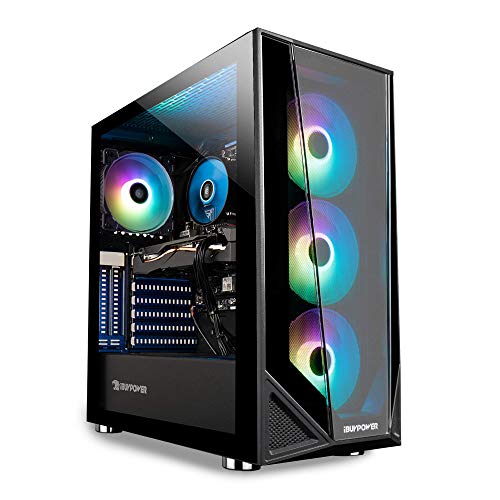
iBUYPOWER Trace MR Gaming PC
iBUYPOWER shrinks the Trace MR’s case down for desks with limited space, without dropping to a weak GPU tier to do it. A mesh front panel keeps intake airflow reasonable despite the smaller chassis. It runs warmer under sustained load than full-size towers with the same components.
Pros
- Compact case suits smaller desk setups
- Reasonable GPU tier for the size class
- Mesh front panel helps with intake airflow
Cons
- Runs warmer than full-size towers under load
- Less room for future component upgrades

Corsair Vengeance i7200 Gaming PC
Corsair outfits the Vengeance i7200 with a high-end GPU tier and ample RAM, built to handle 4K gaming rather than just 1440p. Liquid cooling keeps the CPU stable under extended high-load sessions. The price sits well above the rest of this list, aimed squarely at buyers who will not compromise on resolution.
Pros
- High-end GPU tier handles 4K gaming well
- Liquid cooling keeps the CPU stable under load
- Large 2TB storage fits a sizable game library
Cons
- Highest price point on this list
- Overkill for buyers who only game at 1080p
How to pick the right one
What actually drives gaming performance in a prebuilt The GPU determines frame rates in nearly every modern game more than any other single component, which is why it deserves the first look before RAM capacity or storage type. A strong CPU still matters for avoiding bottlenecks in CPU-heavy titles, but pairing a weak GPU with a great CPU leaves performance on the table.
VRAM and resolution, matching the GPU to your monitor A GPU’s VRAM capacity needs to match the resolution it will run, since 1080p gaming generally performs fine on 6 to 8GB of VRAM while 1440p and 4K benefit from 10GB or more. The Corsair Vengeance i7200’s 12GB-plus VRAM class exists specifically for that higher resolution demand.
Best for 1080p budget builds A buyer gaming primarily at 1080p does not need the GPU tier found in the Corsair Vengeance i7200 or HP OMEN 45L, and will get more value putting that budget difference toward a model like the CyberPowerPC Gamer Xtreme instead, which handles 1080p smoothly at a fraction of the cost.
Best for 4K and upgrade headroom 4K gaming demands both a high-end GPU tier and enough VRAM to avoid stuttering on texture-heavy titles, which is where the Corsair Vengeance i7200 earns its price. Buyers who expect to upgrade components over time should also weigh case design, since a full tower like the ABS Cyclone leaves more room to swap parts later than a compact case does.
Side by side
| # | Model | GPU tier | Best for | Score | Price |
|---|---|---|---|---|---|
| 1 | Skytech Chronos Mini Gaming PC | Mid-range, 8GB VRAM class | Best overall | 9.3 | Check price |
| 2 | CyberPowerPC Gamer Xtreme GXiVR8060A | Entry to mid-range, 6GB VRAM class | Best budget entry-level | 8.9 | Check price |
| 3 | HP OMEN 45L Gaming Desktop | Mid to high-range, configuration dependent | Best cooling and build quality | 8.7 | Check price |
| 4 | Lenovo Legion Tower 5i Gaming PC | Mid-range, configuration dependent | Best for mainstream reliability | 8.5 | Check price |
| 5 | ABS Cyclone Gaming PC | Configurable, wide range of tiers available | Best for upgradability | 8.2 | Check price |
| 6 | iBUYPOWER Trace MR Gaming PC | Mid-range, configuration dependent | Best compact small form factor | 8.0 | Check price |
| 7 | Corsair Vengeance i7200 Gaming PC | High-end, 12GB plus VRAM class | Best for 4K and high-end gaming | 7.8 | Check price |
Good to know
How much RAM is enough for gaming in 2026?
16GB covers the vast majority of current games comfortably, while 32GB, like on the Corsair Vengeance i7200, adds headroom for streaming or running other heavy applications alongside a game.
Is a prebuilt gaming PC worth it over building one?
A prebuilt saves time and removes the risk of compatibility mistakes, often at a similar price to a self-built equivalent once warranty and support are factored in.
What GPU is good for 1440p gaming?
A GPU in the 10 to 12GB VRAM class generally handles 1440p well at high settings in most current titles, sitting between the entry-level and high-end tiers covered on this list.
Do prebuilt gaming PCs come with a warranty?
Yes, every model on this list ships with a manufacturer warranty, though coverage length and support quality vary by brand, with Lenovo and HP generally offering the most widely available service options.
Can a prebuilt gaming PC be upgraded later?
Most can, though ease of upgrading varies by case design. Full tower builds like the ABS Cyclone leave more room for future GPU or storage upgrades than compact cases like the iBUYPOWER Trace MR.
What is the difference between a gaming PC and a regular desktop?
A gaming PC includes a dedicated graphics card built for rendering game visuals, while a regular desktop often relies on integrated graphics that cannot handle modern games at playable frame rates.
Is liquid cooling necessary for a gaming PC?
Not for most builds. Air cooling handles mid-range systems fine, but liquid cooling, like on the Corsair Vengeance i7200, helps more with high-end components that generate more sustained heat.
How much storage does a gaming PC need?
500GB covers a handful of installed games, but 1TB or more is more comfortable for a growing library, since modern game installs frequently exceed 50GB each.
Our pick
The Skytech Chronos Mini is the strongest default choice, delivering 1440p-capable performance without the premium pricing of boutique brands. Buyers focused purely on 1080p should save money with the CyberPowerPC Gamer Xtreme, while anyone committed to 4K gaming should skip straight to the Corsair Vengeance i7200.
Marcus Chen
Marcus covered consumer electronics for enthusiast tech publications for six years before joining ChoiceCrest. He specializes in translating manufacturer spec sheets into plain-language buying advice, with a focus on audio, computing accessories and smart-home gear.