Microphone Arms That Keep Cables Out of Frame
The Elgato Wave Mic Arm LP is the strongest pick for most streamers thanks to its low resting height and fully hidden cable routing. Buyers with a heavier broadcast microphone should choose the Rode PSA1+ instead, while podcasters running multiple microphones get more reach from the Gator Frameworks Desk-Mounted Boom Stand.
The Elgato Wave Mic Arm LP stands out for its low-profile resting height, which keeps it out of webcam frame better than taller arms, paired with fully internal cable routing. Its main limitation is a lower weight capacity than heavy-duty broadcast arms, which matters only with larger shock-mounted microphones.
We compared published reach, load capacity and cable routing specifications across each listing rather than running our own stress tests.
What to look for
What matters in a microphone boom arm Reach determines how far the microphone can extend from the clamp point, ranging from the Samson MBA38’s compact 13.4 inches up to the Gator boom stand’s 39 inch telescoping section. Load capacity decides which microphones actually fit, since a heavy broadcast mic with a shock mount needs more support than a lightweight USB microphone. Cable routing affects how tidy the final desk setup looks, with internal channels on the Elgato Wave Mic Arm LP and Blue Compass hiding wiring completely.
Matching reach and weight capacity to your microphone Lighter USB microphones pair fine with budget arms like the Maono MA-MP60 or Samson MBA38, which are not rated for heavier shock-mounted setups. Broadcast-style dynamic microphones with a shock mount need the higher load tolerance of the Rode PSA1+ or Gator Frameworks boom stand to avoid drooping. Checking a microphone’s actual weight against an arm’s rated capacity avoids the sagging that cheaper arms develop over months of use.
Cable management and desk setup Internal cable routing, found on the Elgato Wave Mic Arm LP and Blue Compass, threads wiring through the arm itself so none of it sits exposed on the desk. External routing, used on the Audio-Technica AT8700 and both budget arms, relies on zip ties or basic clips along the outside of the arm. Streamers who film their setup on camera generally prefer internal routing, while anyone tucking the arm out of view can save money with external cable management instead.
Multi-mic and podcast setups Podcasters recording with a guest need more horizontal reach than a single streamer does, which is where the Gator Frameworks Desk-Mounted Boom Stand’s 39 inch extension stands out. Running two arms on the same desk also means checking each clamp’s footprint, since the Gator’s all-metal base takes up more room than the Elgato Wave Mic Arm LP. Buyers planning a permanent multi-guest setup should prioritize reach and stability over the compact folding size that benefits a single-person streaming desk.
What we recommend

Elgato Wave Mic Arm LP
A low-profile design keeps the arm’s resting height close to the desk, useful for streamers whose camera frame would otherwise catch a tall boom arm. Internal spring tensioning hides the cabling entirely, routing it through the arm rather than along the outside. A quick-release mic mount lets the microphone detach without unscrewing threaded adapters.
Pros
- Low resting height keeps it out of webcam frame better than tall arms
- Internal cable routing hides wiring completely
- Quick-release mount speeds up removing the microphone
Cons
- Lower weight capacity than heavy-duty arms like the Rode PSA1+
- Desk clamp needs a reasonably thin desk edge to mount securely
Rode PSA1+
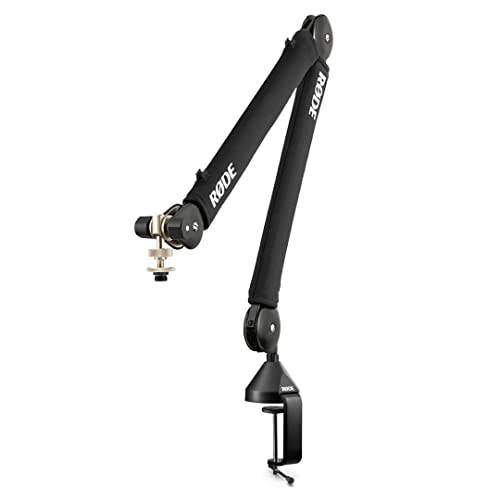
A longer reach and higher load tolerance than most arms here let the PSA1+ support heavier broadcast microphones without drooping over time. Its internal spring mechanism holds position reliably even after repeated repositioning, a common failure point on cheaper arms. The matte black finish and multiple mounting options suit both desk clamps and through-desk setups.
Pros
- Longer reach positions a mic precisely without extending the whole desk setup
- Holds position reliably after months of repositioning
- Supports heavier shock-mounted broadcast microphones
Cons
- Takes up more vertical space than low-profile arms when folded
- Costs more than simpler single-section arms

Blue Compass by Logitech
A built-in cable channel routes USB and XLR cables from the microphone down through the arm and out through the base, keeping the desk free of loose wires. An integrated pop filter mount and headphone hook add functionality the plainer arms here skip. The spring-loaded arm holds position at nearly any angle without drifting downward over a session.
Pros
- Integrated cable channel and pop filter mount reduce desk clutter
- Built-in headphone hook adds storage the other arms lack
- Holds angle reliably without drifting during long sessions
Cons
- Heavier overall footprint than the Elgato Wave Mic Arm LP
- Premium price for features some buyers may not use

Gator Frameworks Desk-Mounted Boom Stand
Built from the same frame design as Gator’s studio boom stands, this desk-mounted version suits podcasters running two or more microphones at once. A telescoping boom section extends further than most single-piece gaming arms, reaching across a table for guest seating. The all-metal construction trades some desk-clearance elegance for raw stability under a heavier microphone.
Pros
- Telescoping boom reaches across a table for multi-guest podcast setups
- All-metal build stays stable under heavier microphones
- Compatible with standard mic clips and shock mounts
Cons
- Bulkier footprint than arms designed for a single streaming desk
- Cable routing is external rather than hidden inside the arm

Audio-Technica AT8700
A simple two-section arm skips the internal cable channel and extra accessories found on pricier models, focused purely on positioning a microphone. Its lighter overall weight makes it easy to mount and adjust on smaller desks. Audio-Technica rates it for lighter microphones, matching the brand’s own podcast and streaming mic lineup.
Pros
- Lightweight design mounts easily on smaller desks
- Simple two-section arm is easy to adjust without extra tools
- Matches well with Audio-Technica’s own lighter microphones
Cons
- Lower weight capacity than the Rode PSA1+ or Gator boom stand
- External cable routing leaves wiring more visible

Maono Boom Arm MA-MP60
This budget arm covers the core function of positioning a microphone away from the keyboard, without the internal cable routing or extra mounts of pricier options. A standard 5/8 inch threaded adapter makes it compatible with most popular streaming and podcast microphones. The spring tension holds reasonably well for lighter microphones, though it is not rated for heavier broadcast models.
Pros
- Lower cost than every other arm on this list
- Standard threaded adapter fits most common microphones
- Compact folded size suits smaller desk setups
Cons
- Lower weight capacity limits it to lighter microphones
- External cable clips look less tidy than internal routing

Samson MBA38
A compact clamp base and shorter overall reach make the MBA38 suited to smaller desks where a long boom arm would overhang unnecessarily. It uses the same basic spring-arm mechanism as pricier models, just scaled down in size and load tolerance. Samson markets it alongside its own compact USB microphones, though it accepts any standard-thread mic clip.
Pros
- Compact base and reach suit small desks better than longer arms
- Spring mechanism holds position despite the smaller size
- Works with standard threaded mic clips beyond Samson’s own mics
Cons
- Shortest reach of any arm on this list limits placement flexibility
- Lower load capacity rules out heavier shock-mounted microphones
Side by side
| # | Model | Reach | Best for | Score | Price |
|---|---|---|---|---|---|
| 1 | Elgato Wave Mic Arm LP | Up to 15.7 inches extended | Best Overall | 9.1 | Check price |
| 2 | Rode PSA1+ | Up to 32 inches extended | Best Heavy-Duty Reach | 9.0 | Check price |
| 3 | Blue Compass by Logitech | Up to 24.5 inches extended | Best Built-In Cable Management | 8.8 | Check price |
| 4 | Gator Frameworks Desk-Mounted Boom Stand | Up to 39 inches extended | Best for Podcast Multi-Mic Setups | 8.6 | Check price |
| 5 | Audio-Technica AT8700 | Up to 20.75 inches extended | Best Lightweight Simple Arm | 8.3 | Check price |
| 6 | Maono Boom Arm MA-MP60 | Up to 15.4 inches extended | Best Budget | 8.0 | Check price |
| 7 | Samson MBA38 | Up to 13.4 inches extended | Best for Small Desks | 7.9 | Check price |
Questions worth asking
Does a heavier microphone need a different boom arm?
Yes. A heavy dynamic microphone with a shock mount needs an arm rated for more weight, like the Rode PSA1+, rather than a lightweight arm like the Samson MBA38.
What is internal cable routing and why does it matter?
Internal routing threads the microphone cable through the arm itself rather than along the outside. Arms like the Elgato Wave Mic Arm LP use this to keep desk setups free of loose wires.
Can a boom arm clamp to any desk?
Most clamp-style arms fit standard desk edges up to a few inches thick, but very thick or glass desks may need a through-desk mount instead, which several arms here also support.
Is a low-profile arm worth it for streaming on camera?
For anyone framed with a webcam, yes. The Elgato Wave Mic Arm LP’s low resting height avoids the microphone or arm intruding into the camera frame.
Do boom arms fit any microphone?
Most use a standard 5/8 inch threaded mount compatible with the majority of streaming and podcast microphones, though very large broadcast mics may need an arm with a higher load rating.
How much reach does a gaming desk actually need?
Most single-desk streaming setups work fine with 15 to 20 inches of reach, which covers arms like the Elgato Wave Mic Arm LP. Longer reach matters more for multi-guest podcast setups.
Can a boom arm support a shock mount and pop filter together?
Arms rated for at least 2 pounds, such as the Rode PSA1+ or Blue Compass, generally handle a microphone, shock mount and pop filter together without drooping.
Do cheaper boom arms droop over time?
Budget arms with lower weight ratings, like the Maono MA-MP60, can droop if paired with a microphone near or over their rated capacity. Staying within the rated weight avoids this.
Is a through-desk mount better than a clamp mount?
Through-desk mounts, offered on the Rode PSA1+ and Audio-Technica AT8700, create a permanent hole but free up desk edge space. Clamp mounts stay easier to remove or reposition.
Our take
The Elgato Wave Mic Arm LP earns the top recommendation for most streamers, since its low profile and hidden cable routing suit on-camera setups better than any other arm here. Buyers with a heavier broadcast microphone should choose the Rode PSA1+ instead, as its higher load rating and longer reach handle that weight without drooping. Anyone running a multi-guest podcast should skip single-desk arms entirely and pick the Gator Frameworks Desk-Mounted Boom Stand for its extended telescoping reach.
Marcus Chen
Marcus covered consumer electronics for enthusiast tech publications for six years before joining ChoiceCrest. He specializes in translating manufacturer spec sheets into plain-language buying advice, with a focus on audio, computing accessories and smart-home gear.