Food Thermometers Worth Trusting for Meat and Baking
The ThermoWorks Thermapen ONE reads in about one second, the fastest and most consistent option compared. The ThermoPro TP19H is the value pick for everyday cooking, and the MEATER Plus is the top wireless probe for long roasts and smoking.
Serious cooks reach for the ThermoWorks Thermapen ONE because its reading is right the first time, every time. Everyday roasting and frying is well covered by the ThermoPro TP19H at a fraction of the cost. Long, slow cuts favor the MEATER Plus, which lets you walk away from the grill entirely.
Every thermometer listing claims to be instant and accurate, yet the numbers underneath vary widely. Reading speed, tip diameter and whether a unit can be recalibrated separate a tool you trust from one you second guess. We compared published specifications, probe design and owner feedback about drift and durability across seven models.
The best picks, ranked

ThermoWorks Thermapen ONE
The Thermapen has set the benchmark for years, and the ONE sharpens it with a full reading in about a second. Its tiny probe tip limits juice loss and targets the exact spot you aim at. It costs more than the rest of this lineup, but it is the only unit here that removes doubt entirely.
Pros
- Fastest and most consistent readings
- Thin tip minimizes juice loss
- Display rotates for either hand
Cons
- Significant outlay for a kitchen tool
- No wireless or logging features

ThermoPro TP19H
ThermoPro has become the default choice for home kitchens, and the TP19H pairs a rugged housing and magnetic back with a fast, accurate read. The ambidextrous backlit display stays readable over a smoky grill. Owners report it holds calibration well across a couple of years of regular use.
Pros
- Strong accuracy for the price
- Magnet and rugged housing suit real kitchens
- Can be recalibrated at home
Cons
- Slower than the Thermapen
- Thicker tip than premium probes

Lavatools Javelin PRO Duo
An oversized display earns its keep when you are leaning over a hot grill in poor light. Lavatools pairs it with a fast read and a magnetic back that sticks to the hood. It lands between the ThermoPro and the Thermapen on both speed and price, a fair place to sit.
Pros
- Easiest display to read at a distance
- Motion sensing backlight saves fumbling
- Sticks to the grill hood between checks
Cons
- Bulkier in a drawer than slim models
- Backlight can trigger unnecessarily

Typhur InstaProbe
Typhur aims directly at the Thermapen with a very fast read and a clean OLED display that stays legible in sunlight. Build quality feels premium, and the probe is thin enough for thin cuts. Being a newer name, its long term track record trails the established brands.
Pros
- Very fast readings for the money
- OLED stays readable in bright sun
- Solid feel in the hand
Cons
- Shorter track record than rivals
- Fewer accessories and spares available

MEATER Plus Wireless Meat Thermometer
A leave in probe with no trailing wire is a different tool from an instant read, and for briskets and roasts, it is the one to reach for. Internal and ambient sensors let the app estimate when the cook will finish. It still pairs best with a fast instant read for spot checks.
Pros
- No wire running through the oven door
- Ambient sensor tracks cooker temperature
- App alerts free you from the kitchen
Cons
- Range can be inconsistent through walls
- Not a substitute for an instant read

Alpha Grillers Instant Read Meat Thermometer
A first thermometer covers the essentials here without any learning curve. The probe folds away, the display reads clearly, and a calibration function appears that most cheap units skip. Reading speed trails the premium models, which matters most when checking several pieces on a grill.
Pros
- Very affordable entry point
- Calibration function included
- Straightforward two button operation
Cons
- Noticeably slower to settle
- Thicker tip leaves a larger hole
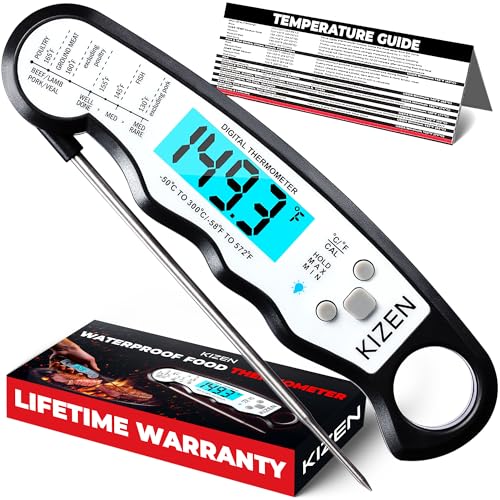
Kizen Instant Read Meat Thermometer
Kizen builds this around outdoor use, with a sealed body that rinses under a tap and a magnetic back for the grill hood. A longer than average probe keeps hands further from the coals. Speed is not its strength, but it survives conditions that kill kitchen thermometers.
Pros
- Rinses clean without damage
- Long probe keeps hands off the heat
- Magnet and hook for grill storage
Cons
- Slower than premium instant reads
- Longer probe is awkward for thin cuts
Compared at a glance
| # | Model | Reading speed | Best for | Score | Price |
|---|---|---|---|---|---|
| 1 | ThermoWorks Thermapen ONE | About one second | Best overall | 9.4 | Check price |
| 2 | ThermoPro TP19H | Around two to three seconds | Best value | 9.2 | Check price |
| 3 | Lavatools Javelin PRO Duo | Around two seconds | Best display | 9.0 | Check price |
| 4 | Typhur InstaProbe | Around one second stated | Best fast alternative | 8.8 | Check price |
| 5 | MEATER Plus Wireless Meat Thermometer | Wireless leave in probe | Best for long cooks | 8.6 | Check price |
| 6 | Alpha Grillers Instant Read Meat Thermometer | Around four seconds | Best budget | 8.3 | Check price |
| 7 | Kizen Instant Read Meat Thermometer | Water resistant sealed housing | Best for grilling on the move | 8.0 | Check price |
What matters most
Why does reading speed matter beyond convenience? A thermometer that takes several seconds keeps the oven door open longer and your hand over the coals longer. It also tempts you to pull the probe before the reading settles, which is where inaccurate numbers come from. A one to two second read, like the Thermapen or InstaProbe, changes how often you check and improves the cooking itself.
Does probe tip size matter for thin cuts? Fat probes are hard to center in a chicken breast or a burger, and they leave a hole that leaks juice. Thin tipped probes read the exact point aimed at, rather than an average of the meat and the pan. Anyone cooking thin cuts often should prioritize tip size over nearly everything else.
Instant read or leave in probe: which one first? An instant read reports the temperature right now at one specific point. A leave in probe like the MEATER tracks a trend through a long cook and alerts before you overshoot. Serious cooks tend to own both, since neither replaces the other, though an instant read is the more useful first purchase.
How often should a thermometer be calibrated? Fill a glass with crushed ice and a little water, stir, and the probe should read close to freezing. Boiling water offers a second reference point, though it shifts with altitude. Models with a calibration function let you correct drift at home, which makes that feature worth seeking out even on a budget unit.
Common questions
How accurate does a food thermometer need to be?
Within about one degree is plenty for home cooking, since medium rare and medium differ by several degrees. Consistency matters more, meaning the same reading every time under the same conditions.
Where should the probe go into the meat?
Into the thickest part, avoiding bone, fat and any hollow cavity, since all three skew the number. Push through, then pull back slowly to find the lowest reading, which is the true center.
Can an instant read thermometer stay in the oven?
No. The electronics in the handle are not rated for sustained oven heat, and leaving it in will destroy the unit. Use a leave in probe or a wireless model built for that job instead.
Are wireless probe thermometers reliable for long cooks?
Yes, though range through walls and appliance doors is a common complaint. Keeping the charging block or repeater close to the cooker helps considerably, and owners report they excel at tracking trends over hours.
How do I clean a food thermometer between uses?
Wipe the probe with hot soapy water or an alcohol wipe and dry it. Only submerge units rated for water resistance, and clean the probe between different foods so raw juices never touch cooked meat.
What internal temperature should meat reach?
Follow national food safety guidance rather than memory, since recommended temperatures differ by meat type and country. Poultry and ground meats generally need higher internal temperatures than whole cuts of beef.
Do food thermometers lose accuracy over time?
Yes, gradually, from drops, thermal shock and moisture inside the housing. An ice water check twice a year catches drift early, and a calibration function lets you correct it in seconds.
Is a thermometer useful for anything besides meat?
Very much so. Bread doneness, frying oil, custards, yoghurt and tempered chocolate all benefit from a quick reading, which is why an instant read makes a better first purchase than a wireless probe.
The bottom line
The ThermoWorks Thermapen ONE earns its price for frequent cooks, since speed and a thin tip remove guesswork entirely. Most households do fine with the ThermoPro TP19H, which stays accurate, rugged and recalibratable. Add the MEATER Plus only when long roasts and smoking sessions are a regular habit.
Dana Whitfield
Dana spent eight years buying and merchandising for a regional kitchenware retailer before moving into editorial work. She has handled thousands of SKUs across cookware, small appliances and kitchen organization, and focuses on the practical differences that matter once a product is actually in daily use.


