How to Pick a Fish Finder That Actually Reads Deep Water
The Garmin Striker Vivid 7cv leads for its clear ClearVu imaging and bright colour screen. The Humminbird HELIX 5 CHIRP GPS G3 suits anglers who build their own contour maps, and the Garmin Striker 4 covers kayaks and tight budgets.
Most anglers should start with the Garmin Striker Vivid 7cv. The Humminbird HELIX 5 CHIRP GPS G3 fits mapping heavy use, and the Garmin Striker 4 handles tight budgets and kayak mounting. Each targets a different fishing style rather than just adding more of the same sonar.
Headline sonar numbers rarely predict what shows up on screen. A wide beam that reads clearly in a deep lake turns to clutter in a shallow river. We compared frequency support, transducer coverage, display brightness and mapping features, then checked what owners report about installs and glare in direct sun.
Our top picks

Garmin Striker Vivid 7cv
Seven inches of screen and Garmin’s vivid colour palettes make structure easier to read than older Striker models, especially in bright sun. ClearVu scanning sonar renders a near photographic view under the boat, so brush piles and drop offs stand out. GPS handles waypoints and trolling paths with no paid chart subscription required.
Pros
- Excellent screen readability in sun
- ClearVu makes structure easy to identify
- No subscription needed for basic mapping
Cons
- No preloaded lake charts
- Large enough to need proper mounting space

Humminbird HELIX 5 CHIRP GPS G3
Built in base maps ship standard, and AutoChart Live lets owners build contour maps of their own water while fishing it. Five inches of screen trails the Garmin’s seven, but the menu stays clear and dual beam CHIRP sonar performs reliably. Repeat visits to the same lakes suit this unit well.
Pros
- Creates custom contour maps of your water
- Reliable dual beam sonar coverage
- Straightforward menu system
Cons
- Smaller screen than similarly priced rivals
- No down imaging at this trim level

Garmin Striker 4
New anglers gravitate toward this one first, and for good reason: CHIRP sonar and GPS waypoints fit in a body small enough for a kayak rail. A 3.5 inch screen is the tradeoff, since reading fine detail takes more attention. Depth readings, spot marking and fish arches all come through clearly.
Pros
- Compact enough for kayaks
- Genuine CHIRP sonar at entry level
- Simple keypad control with wet hands
Cons
- Small screen limits detail
- No down imaging or charts

Lowrance HOOK Reveal 5
Autotuning adjusts sonar settings automatically as conditions change, cutting out the fiddling that puts new anglers off. FishReveal layers traditional sonar targets over DownScan detail on one screen. Genesis Live records contours as you travel, similar in concept to Humminbird’s AutoChart approach.
Pros
- Autotuning takes the guesswork out
- FishReveal blends target and structure views
- Bright SolarMAX display
Cons
- Menu layout takes learning
- Transducer cable is short for larger boats

Garmin ECHOMAP UHD2 73sv
A touchscreen, preloaded inland charts and SideVu scanning step this unit up from the Striker line, revealing structure to either side rather than only beneath the hull. Networking with Garmin trolling motors and other electronics matters on a rigged bass boat. Small tinnies rarely need this much capability.
Pros
- SideVu shows structure beside the boat
- Preloaded lake charts out of the box
- Networks with other Garmin gear
Cons
- More unit than a small boat needs
- Touchscreen is harder to use in spray
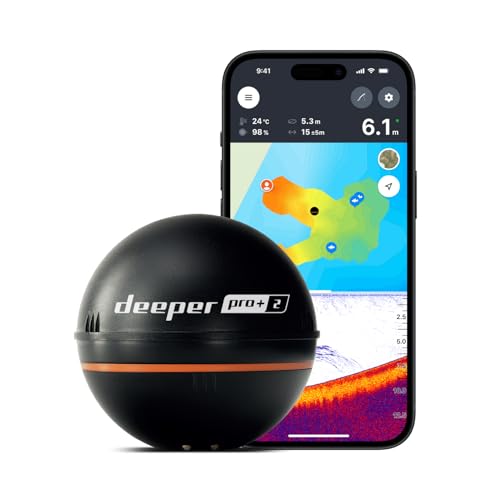
Deeper PRO Plus 2 Smart Sonar
This castable sonar ball pairs with a phone app, the only practical option for anglers fishing from the bank, a float tube or through the ice. Its own Wi-Fi signal replaces reliance on cell coverage. Range and detail fall short of a transom mounted unit, but nothing else works from dry land.
Pros
- Works from bank, kayak or ice
- No installation required
- Maps shorelines from land
Cons
- Depends on a phone screen and battery
- Less detail than fixed transducers

Humminbird PIRANHAMAX 4
Depth, bottom hardness and fish arches show up on a simple dual beam display, with none of the mapping complexity found elsewhere in this lineup. A small aluminium boat or a rented craft gets everything it needs here. GPS is absent, so waypoint marking has to happen on a separate phone app.
Pros
- Very easy to set up and read
- Adequate detail for shallow water
- Low outlay for a first unit
Cons
- No GPS or waypoints
- Limited depth performance
The lineup, side by side
| # | Model | Display | Best for | Score | Price |
|---|---|---|---|---|---|
| 1 | Garmin Striker Vivid 7cv | 7 inch colour, 800 x 480 | Best overall | 9.4 | Check price |
| 2 | Humminbird HELIX 5 CHIRP GPS G3 | 5 inch colour, 800 x 480 | Best for mapping and navigation | 9.2 | Check price |
| 3 | Garmin Striker 4 | 3.5 inch colour, 480 x 320 | Best value | 9.0 | Check price |
| 4 | Lowrance HOOK Reveal 5 | 5 inch colour SolarMAX | Best for automatic tuning | 8.8 | Check price |
| 5 | Garmin ECHOMAP UHD2 73sv | 7 inch touchscreen | Best for serious boat anglers | 8.6 | Check price |
| 6 | Deeper PRO Plus 2 Smart Sonar | Castable Wi-Fi sonar | Best for bank and ice fishing | 8.3 | Check price |
| 7 | Humminbird PIRANHAMAX 4 | 4.3 inch colour | Best budget | 8.0 | Check price |
Before you buy
What to look for in sonar frequency Narrow beams around 200 kHz produce a tight, detailed cone suited to shallow lakes and rivers. Wider beams near 83 kHz cover more ground and hold up better once water gets deep. CHIRP sonar sweeps a range of frequencies instead of transmitting one, separating individual fish more clearly than older single frequency units.
Down imaging versus side imaging Traditional sonar reports depth and shows arches for passing fish. Down imaging technologies like ClearVu or DownScan render a near photographic slice beneath the boat, useful for spotting brush and rock. Side imaging scans structure out to either side, which suits searching open water rather than working a known spot.
How much screen size actually matters A 3.5 inch display shows the same sonar data as a seven inch one, just with less room to interpret it. Sunlight readability is the real constraint, since a dim screen goes unreadable by midday. Anglers who fish mostly in bright conditions should prioritise display brightness over extra sonar modes.
Best fish finder setups for kayaks and small boats Transom mounts remain standard on powered boats, trolling motor mounts suit slow presentations along cover, and kayakers typically need a scupper or arm mount plus a small battery. Cable length becomes a real constraint on larger hulls. Bank anglers are better served by castable sonar such as the Deeper, since no mount is required at all.
Frequently asked questions
What does CHIRP sonar actually do?
CHIRP sweeps a range of frequencies within each pulse instead of sending a single tone. More information comes back as a result, so targets close together separate on screen rather than merging, and bottom detail sharpens.
Do I need GPS on a fish finder?
For returning to productive spots, yes. GPS lets you drop waypoints on brush piles, drop offs and ledges. Without it, shoreline landmarks become the fallback, workable on small water but frustrating on a large lake.
Will a fish finder work from a kayak?
Yes, and compact units like the Striker 4 are popular choices for it. A small sealed battery and a transducer mount are required, either through a scupper hole or on a side arm. Route the cable carefully so it stays clear of your paddle stroke.
Is down imaging or side imaging better for finding fish?
Down imaging looks straight beneath the boat and delivers detailed structure views. Side imaging scans both sides at once, covering far more water, which suits scanning large open areas rather than working a spot you already know.
Can I use a fish finder for ice fishing?
Some units include flasher modes built for fishing through a hole, and castable sonar such as the Deeper PRO Plus 2 was designed with ice anglers in mind. Cold weather drains battery life fast, so pack more capacity than the trip seems to need.
How deep can a fish finder read accurately?
Entry level dual beam units reach a few hundred feet reliably in fresh water, while CHIRP models paired with better transducers go deeper still. Salt water and heavy vegetation both cut into the usable range.
Do fish finders show individual fish on screen?
They display sonar returns, shown either as arches or as fish icons depending on the unit. Arches give the more honest read, since size and depth can be judged directly. Fish ID icons are convenient but misread debris and bubbles fairly often.
Do I need to pay for lake charts?
Not for basic use. Units with GPS mark waypoints with no subscription attached. Preloaded or purchased charts add contour detail, and features like Genesis Live and AutoChart Live let owners record their own contours instead of buying them.
Best fish finder for a tight budget?
The Humminbird PIRANHAMAX 4 covers depth, bottom hardness and fish arches with no GPS or mapping overhead, making it the lowest outlay option here for a first unit.
Garmin Striker versus Lowrance HOOK Reveal, which is easier for beginners?
The Striker line leans on a simpler keypad interface, while the HOOK Reveal’s Autotuning removes manual sonar adjustment. Beginners who want less menu digging tend to prefer the Lowrance approach.
The bottom line
The Garmin Striker Vivid 7cv suits the widest range of anglers, combining readable colour imaging with GPS waypoints and no subscription requirement. Anglers who return to the same lakes and want their own contour maps should pick the Humminbird HELIX 5 CHIRP GPS G3, while kayak and small boat owners are well served by the compact Garmin Striker 4.
Sierra Daniels
Sierra's background is in landscape design and nursery retail. She focuses on lawn and garden equipment, outdoor furniture and gear durability, weighing published specs against how materials actually hold up outside.