Fireplace Fans That Move Stove Heat Without Wiring
Caframo Ecofan AirMax 812 leads on airflow, moving roughly 175 cubic feet per minute once the stove top passes 85C. VODA 4 Blade Heat Powered Stove Fan starts turning earlier and runs quieter. Galafire 4 Blades suits a stove that idles at moderate heat.
Caframo Ecofan AirMax 812 fits households burning wood daily through winter. Airflow reaches about 175 cubic feet per minute with no batteries and no wiring. Its limitation is patience: a surface near 85C is needed before the blade moves at all, so a slow smouldering fire leaves it still.
Two very different products share this search term. Heat powered fans sit on a wood burner and run on temperature difference alone, while blower kits bolt into a gas fireplace and draw mains power. We compared published start temperatures, stated airflow, blade counts, base metal and safety strips, then weighed owner reports about bearing noise and units lifting off an overheating top.
What we recommend

Caframo Ecofan AirMax 812
Anodised aluminium blades spin from a machined base, moving about 175 cubic feet per minute at full stove temperature. A bimetallic foot lifts the fan slightly once the surface nears 345C, which protects the thermoelectric module underneath. Blades detach for replacement, so years on a hot steel top do not end in a bin.
Pros
- Highest stated airflow of the seven picks
- Bimetallic foot guards the module near 345C
- Replaceable blade keeps it serviceable for seasons
Cons
- Needs around 85C before it begins turning
- Single blade design is audible at full speed
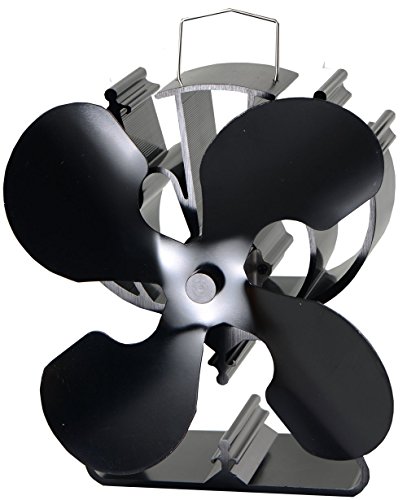
VODA 4 Blade Heat Powered Stove Fan
Four blades split the workload, so rotation stays soft instead of settling into one hard whirr. Movement begins somewhere between 50C and 65C, well before a premium single blade wakes up. Airflow falls short of the Ecofan, though a modest living room rarely feels the gap.
Pros
- Turns from roughly 50C on a gently burning stove
- Four blade layout keeps running noise low
- Bimetal strip tilts the base if the top overheats
Cons
- Moves less air than single blade premium fans
- Owners report blade alignment varies between units
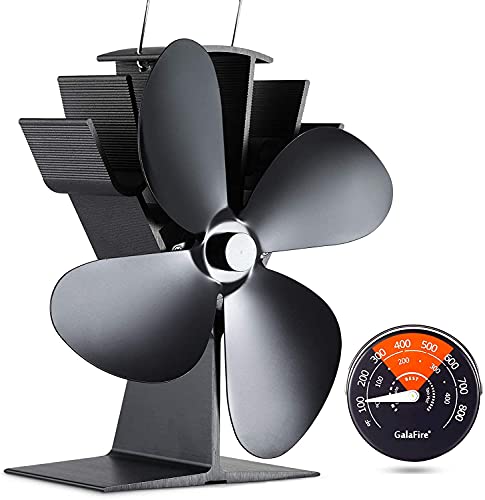
Galafire 4 Blades Heat Powered Stove Fan
Rotation starts near 50C, which matches stoves kept at a steady simmer rather than roaring. Most listings bundle a magnetic stove thermometer, giving you a reading of whether the top sits inside the safe band. Metal thickness is lighter than Caframo units, so treat this as a couple of seasons of service rather than a decade.
Pros
- Spins early on a slow burning fire
- Thermometer included for monitoring surface heat
- Cheapest route into heat powered circulation
Cons
- Lighter build than machined aluminium rivals
- Bearing noise tends to appear after a few winters

Caframo Ecofan UltrAir 810
Tuning favours early rotation: blades begin at roughly 65C, twenty degrees below the AirMax. Output settles around 150 cubic feet per minute once the stove reaches working heat. Footprint is smaller than the 812, which helps on a crowded top holding a kettle and a trivet.
Pros
- Begins turning around 65C, earlier than the AirMax
- Compact base suits a busy stove top
- Shares the replaceable blade design of the range
Cons
- About 25 CFM behind the AirMax at full heat
- Still costs well above generic four blade fans

Tomersun 3 Blades Heat Powered Stove Fan
Narrow footing claims little room on a small wood burner or a pellet stove ledge. Three blades land between the airflow of a single blade and the hush of four. Heat transfer depends on full contact, so a warped or ribbed top cuts performance noticeably.
Pros
- Fits stove tops with very little flat space
- Middle ground between airflow and quiet running
- Light enough to reposition with a stove glove
Cons
- Wants a genuinely flat surface for heat transfer
- Output drops away quickly on a cooling stove

Sonyabecca Heat Powered Stove Fan
Wide blade sweep carries warm air down an open plan room instead of letting it stall by the hearth. Aluminium shedding fins keep the cold side cool, which is what the module needs to generate current. Bigger blades also demand more clearance behind the stove than compact three blade units.
Pros
- Wide sweep pushes air further into open plan space
- Suits knocked through rooms and long lounges
- Bimetal overheat protection matches pricier fans
Cons
- Needs extra clearance between fan and flue pipe
- Bulky to store through summer

Durablow GFK-160 Fireplace Blower Fan Kit
This one is a wired blower kit, built for gas fireplaces and inserts that accept the GFK-160 pattern. A thermal switch starts the blower once the firebox warms and cuts it when things cool, while a variable speed dial trades airflow against noise. Fitting means getting into the firebox cavity and confirming your model number first.
Pros
- Moves far more air than any heat powered fan
- Thermal switch cycles it with the fire automatically
- Speed dial lets you quieten it in the evening
Cons
- Requires mains power and firebox installation
- Fitment must be checked against your fireplace model
What matters most
How a heat powered fireplace fan works Inside the base sits a thermoelectric module. It generates a small current from the temperature gap between the hot stove below and the cooler aluminium fins above. That current drives a low voltage motor, so speed rises as the fire builds. No batteries, wiring or switches are involved, which is why one can sit on a stove all season untouched. Output collapses on a cold or smouldering fire, because the temperature gap is what powers everything.
What to look for: start temperature, airflow and blades Start temperature decides whether a fan is useful on your fire. Budget four blade units move from about 50C, while the AirMax 812 waits until roughly 85C. Stated airflow ranges from around 150 CFM on the UltrAir 810 to 175 CFM on the AirMax. Fewer, larger blades generate more air and more noise; four smaller blades share the load and run softer. Every fan here tops out near 345C, above which a bimetal strip lifts the foot clear.
Where to place the fan and how room size changes the pick Rear of the stove top is the right spot, away from the flue pipe, blades pointing into the room. Leave a few inches behind the unit so it draws cool air rather than recycling its own exhaust. Small rooms do fine on a compact three blade fan such as the Tomersun. Open plan spaces need reach, which favours a wide sweep like the Sonyabecca or the raw output of the AirMax. A magnetic stove thermometer is the cheapest way to stop guessing surface temperature.
Which fireplaces need a wired blower instead Flat steel or cast iron tops are the natural home for a thermoelectric fan. Glass fronted gas inserts and sealed units rarely give you a hot flat surface, so nothing will spin there. Those fireplaces take a blower kit such as the Durablow GFK-160, wired in and triggered by a thermal switch. Anyone with a gas insert should skip stove top fans entirely rather than buy one and hope. Check the kit pattern against your fireplace model before ordering, since blower housings are not interchangeable.
Side by side
| # | Model | Airflow | Best for | Score | Price |
|---|---|---|---|---|---|
| 1 | Caframo Ecofan AirMax 812 | About 175 CFM | Best overall | 9.4 | Check price |
| 2 | VODA 4 Blade Heat Powered Stove Fan | 4 | Best value | 9.2 | Check price |
| 3 | Galafire 4 Blades Heat Powered Stove Fan | 4 | Best budget | 9.0 | Check price |
| 4 | Caframo Ecofan UltrAir 810 | About 150 CFM | Best for cooler running stoves | 8.8 | Check price |
| 5 | Tomersun 3 Blades Heat Powered Stove Fan | 3 | Best for small stove tops | 8.5 | Check price |
| 6 | Sonyabecca Heat Powered Stove Fan | 4 wide sweep | Best for larger rooms | 8.3 | Check price |
| 7 | Durablow GFK-160 Fireplace Blower Fan Kit | Wired blower kit | Best for gas fireplace inserts | 8.0 | Check price |
Frequently asked questions
Do fireplace fans actually work?
Yes, within a clear limit. They circulate warm air that would otherwise pool near the hearth, so a room heats more evenly. No extra heat is created, and output tracks stove top temperature.
What temperature does a stove fan need to start?
Between 50C and 85C on the surface, depending on model. Full speed arrives nearer 250C, and around 345C a safety strip lifts the fan off the top.
Where should you place a stove fan on a wood burner?
Toward the back of the stove top, clear of the flue pipe, with a few inches of space behind it. That position feeds the fins cool air and aims the blades into the room.
How many blades should a stove fan have?
Four blades start earlier and run quieter, which suits smaller rooms. Single blade designs move the most air once a stove is properly hot, at the cost of an audible whirr.
Which fireplace fan is best for a small room?
Tomersun 3 Blades fits tight stove tops and pushes enough air for a snug room. Galafire 4 Blades is the cheaper alternative if your fire runs at moderate heat.
Can you use a heat powered fan on a gas fireplace?
Usually not. Gas inserts seldom offer a hot flat surface, so the module never sees a temperature gap. Fit a wired blower kit such as the Durablow GFK-160 instead.
Ecofan vs a generic stove fan, is the difference real?
Caframo units state higher airflow, use replaceable blades and are assembled in Canada. Generic four blade fans circulate air perfectly well, but bearings tend to grumble sooner.
How long do heat powered stove fans last?
Machined aluminium models with replaceable parts run for many winters. Budget units commonly develop bearing noise within two or three heating seasons of daily use.
Do stove fans reduce heating bills?
Only indirectly. Better circulation brings a room to a comfortable temperature sooner, so the stove is less likely to be over fired. Running cost is zero, since no electricity is used.
Is it safe to leave a stove fan running unattended?
It is designed for exactly that. A bimetal strip tilts the base once the surface nears 345C, breaking full contact and protecting the module while the fire burns down.
The verdict
Buy the Caframo Ecofan AirMax 812 if the stove is lit most evenings, because 175 CFM and replaceable blades pay back across many winters. Weekend cabins and lower burning fires are better served by the VODA 4 Blade fan, which starts around 50C and stays quiet. Gas insert owners should ignore stove top fans completely and fit the Durablow GFK-160 blower kit.
Dana Whitfield
Dana spent eight years buying and merchandising for a regional kitchenware retailer before moving into editorial work. She has handled thousands of SKUs across cookware, small appliances and kitchen organization, and focuses on the practical differences that matter once a product is actually in daily use.