Small Desk Fans Strong Enough to Actually Feel
The Vornado 460 is the strongest pick for actually moving air across a room, using circulator blades instead of a standard oscillating design. The Rowenta VU2531 suits buyers who want quieter operation at a desk, while the OPOLAR Clip-On Fan fits small desks or shelves where a standing fan will not fit.
The Vornado 460 leads this list because its circulator design pushes air further into a room than typical oscillating desk fans of the same size. Its main limitation is that it does not oscillate, relying instead on airflow pattern to cover a wider area.
We compared published airflow specifications, noise ratings and physical dimensions across each fan rather than running our own airflow tests.
The best picks, ranked

Vornado 460 Small Air Circulator Fan
Deep-pitched blades inside a compact housing create a focused airflow pattern that circulates air throughout a room rather than just blowing a narrow stream. Three speed settings let the fan scale from background air movement to a strong direct breeze. The compact base takes up less desk space than full-size oscillating fans.
Pros
- Circulates air throughout a room rather than a narrow path
- Compact footprint fits easily on most desks
- Multiple speed settings cover light to strong airflow needs
Cons
- No oscillation feature compared to standard desk fans
- Runs louder than quieter table fans on higher speeds

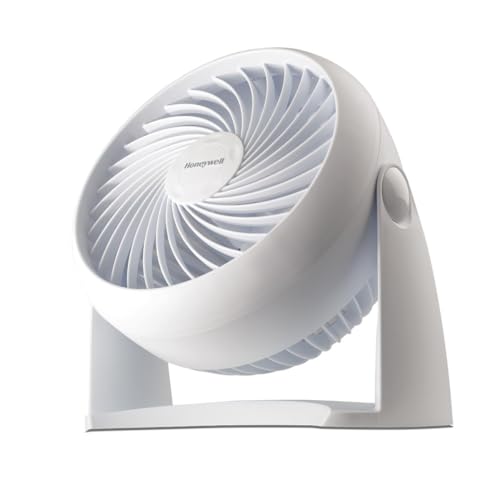
Honeywell HT-900 TurboForce Air Circulator Fan
A pivoting head tilts up to 90 degrees, letting the fan aim airflow at a desk, floor or across a wider cooling zone. Turbocharged blades on the highest setting move more air than standard-size desk fans of similar footprint. The lightweight housing makes it easy to reposition between rooms.
Pros
- Pivoting head aims airflow precisely where needed
- Strong airflow on high speed for its compact size
- Lightweight housing makes repositioning easy
Cons
- Noticeably louder than table fans on turbo setting
- No oscillation, relying instead on manual pivot adjustment

Dreo DR-HFC001 Desk Fan with Remote
A included remote lets users change speed or set a sleep timer without reaching over to the fan directly. Multiple speed settings and an oscillation feature cover a wider range of airflow preferences than basic single-speed fans. A timer function automatically shuts the fan off after a set number of hours.
Pros
- Remote control allows speed changes without reaching the fan
- Programmable timer shuts the fan off automatically
- Oscillation covers a wider desk or room area
Cons
- Larger footprint than compact circulator fans
- Remote adds one more small item to keep track of

Lasko 2554 Oscillating Table Fan
A straightforward oscillating design covers a desk or small room at a lower cost than circulator or remote-equipped fans. Three speed settings handle most everyday cooling needs without extra features to learn. The compact base and lightweight housing make it easy to move between rooms as needed.
Pros
- Lower cost than circulator or remote-equipped fans
- Simple controls with no extra features to learn
- Lightweight design makes repositioning easy
Cons
- Airflow is less focused than dedicated circulator fans
- No remote or timer features included

Rowenta VU2531 Turbo Silence Extreme Table Fan
Specially shaped blades are designed to reduce air turbulence noise compared to standard fan blades, keeping the fan quieter at similar airflow levels. Four speed settings give finer control than the typical three-speed desk fan. A tilting head adjusts the airflow angle without needing to move the whole fan.
Pros
- Shaped blades reduce turbulence noise versus standard fans
- Four speed settings allow finer airflow control
- Tilting head adjusts angle without repositioning the fan
Cons
- Costs more than basic oscillating table fans
- Smaller airflow volume than larger circulator fans

OPOLAR Battery Operated Clip-On Desk Fan
A clamp mount attaches to a desk edge, shelf or headboard, freeing up surface space that a standing fan would otherwise use. A rechargeable battery allows cordless operation for several hours, or it can run plugged in continuously. The flexible neck lets users aim airflow precisely at a chair or pillow.
Pros
- Clamp mount frees up desk surface space
- Battery operation allows cordless use for several hours
- Flexible neck aims airflow precisely
Cons
- Smaller airflow volume than standing or table fans
- Battery life is shorter on higher speed settings

Amazon Basics 3-Speed Small Room Air Circulator Fan
A no-frills circulator design covers the basics of airflow circulation without a remote, timer or oscillation feature. Three speed settings let users scale airflow from light background movement to a stronger direct breeze. The compact housing fits easily on a desk, nightstand or small shelf.
Pros
- Lower cost entry point into circulator-style fans
- Compact footprint fits small desks and nightstands
- Straightforward controls with no extra setup needed
Cons
- No oscillation or remote features included
- Airflow output is lower than larger circulator fans like the Vornado 460
The lineup, side by side
| # | Model | Fan Type | Best for | Score | Price |
|---|---|---|---|---|---|
| 1 | Vornado 460 Small Air Circulator Fan | Air circulator | Best Overall | 9.0 | Check price |
| 2 | Honeywell HT-900 TurboForce Air Circulator Fan | Air circulator | Best for Strong Direct Airflow | 8.8 | Check price |
| 3 | Dreo DR-HFC001 Desk Fan with Remote | Oscillating table fan | Best for Remote Control | 8.6 | Check price |
| 4 | Lasko 2554 Oscillating Table Fan | Oscillating table fan | Best Value | 8.3 | Check price |
| 5 | Rowenta VU2531 Turbo Silence Extreme Table Fan | Table fan | Best for Quiet Operation | 8.7 | Check price |
| 6 | OPOLAR Battery Operated Clip-On Desk Fan | Clip-on fan | Best for Small Desks and Shelves | 8.4 | Check price |
| 7 | Amazon Basics 3-Speed Small Room Air Circulator Fan | Air circulator | Best for Simple Setup | 8.2 | Check price |
What to look for
What to look for in a desk fan Fan type decides how the airflow feels, with circulators pushing air broadly through a room and oscillating fans sweeping a wider but less focused path. Noise level matters most for shared offices or bedrooms, where a loud fan on high speed becomes distracting. Footprint and mounting style, including clip-on options, decide how much usable desk space remains after setup.
Circulator fans versus oscillating table fans Circulator fans, like the Vornado 460 and Honeywell HT-900, use angled blades to move air throughout a room rather than sweeping back and forth. Oscillating fans, including the Dreo DR-HFC001 and Lasko 2554, cover a wider horizontal path but with less concentrated airflow at any single point. Buyers who want air movement across a whole room should lean toward a circulator, while those cooling a fixed desk spot may prefer oscillation.
Noise level and where the fan will sit Fans built with turbulence-reducing blades, like the Rowenta VU2531, run quieter at similar airflow levels, better suited to shared offices or bedrooms. Stronger circulator fans like the Honeywell HT-900 trade some quiet operation for more direct airflow on higher settings. Anyone sensitive to fan noise during work calls or sleep should prioritize the quieter table fan designs over turbo-focused circulators.
Extra features worth considering A remote and timer, found on the Dreo DR-HFC001, add convenience for anyone who wants to adjust the fan without reaching over. Clip-on designs like the OPOLAR free up desk space entirely by mounting to a shelf or desk edge instead. Buyers who want the simplest possible setup should skip extra features and choose a basic circulator like the Amazon Basics 3-Speed model.
Common questions
What is the difference between a circulator and an oscillating fan?
A circulator uses angled blades to move air broadly through a room, while an oscillating fan sweeps side to side to cover a wider path.
Are desk fans loud on high speed?
It varies by design, with turbulence-reducing blades like those on the Rowenta VU2531 running quieter than standard circulator fans at similar speeds.
Can a clip-on fan replace a standing desk fan?
For small desks or shelves, a clip-on fan like the OPOLAR works well, though it moves less air than a full-size table fan.
Do desk fans with remotes cost more?
Yes, remote and timer features, like those on the Dreo DR-HFC001, typically add to the cost compared to basic oscillating fans.
How much airflow does a small desk fan provide?
Airflow varies by design, with circulator-style fans like the Vornado 460 generally moving more air than standard table fans of the same size.
Can a battery operated fan run while plugged in?
Many clip-on models, including the OPOLAR, support both cordless battery use and continuous plugged-in operation.
Is oscillation necessary on a desk fan?
No, oscillation covers a wider path but circulator fans without oscillation often move air more effectively through a room.
What fan type works best for a small office desk?
A compact circulator like the Amazon Basics 3-Speed or a clip-on fan like the OPOLAR both suit limited desk space well.
The bottom line
For most desks, the Vornado 460 delivers the strongest actual airflow for its compact size. Buyers who want quieter operation during calls or focused work should choose the Rowenta VU2531 instead. Anyone with very limited desk space should skip standing fans entirely and pick the OPOLAR clip-on fan to free up the surface.
Dana Whitfield
Dana spent eight years buying and merchandising for a regional kitchenware retailer before moving into editorial work. She has handled thousands of SKUs across cookware, small appliances and kitchen organization, and focuses on the practical differences that matter once a product is actually in daily use.