Which Fine Mesh Strainer Actually Catches Pulp?
OXO Good Grips’ fine mesh strainer leads this list for a resting lip that hooks over a bowl and a mesh fine enough to catch small seeds. Rosle’s conical strainer follows for a finer gauge mesh, and Bellemain’s nesting set suits buyers who strain different volumes.
OXO Good Grips’ fine mesh strainer handles fresh juice straining well because its handle includes a resting lip that keeps the strainer stable over a bowl without tipping.
We compared mesh gauge, frame material, and owner reports on seed and pulp capture to rank these seven strainers, since mesh size is rarely listed in exact microns.
What we recommend

OXO Good Grips Fine Mesh Strainer
A non-slip handle with a resting lip lets this strainer hook over the edge of a bowl and stay put while juice drains through. The fine mesh catches small seeds along with pulp.
Pros
- Resting lip keeps the strainer stable over bowls
- Mesh is fine enough to catch small seeds
- Comfortable handle grip for extended pouring
Cons
- Larger sizes take up more drying rack space
- Mesh can discolor slightly with heavy use

Rosle Fine Mesh Conical Strainer
Rosle’s conical shape channels liquid to a single point, which speeds up straining compared to flat-bottom bowls. The mesh gauge runs finer than most strainers on this list, catching very fine pulp.
Pros
- Conical shape speeds up drainage into narrow containers
- Mesh gauge catches finer particles than flat strainers
- Riveted construction holds up to repeated use
Cons
- Premium pricing compared to most alternatives here
- Conical shape needs a tall enough container underneath

Cuisinart Fine Mesh Strainer Set
This set includes three sizes that nest together for storage, covering small citrus straining up to larger batch juicing. All three share the same fine mesh gauge.
Pros
- Three sizes cover small and large straining jobs
- Nesting design saves cabinet space
- Consistent mesh gauge across all three sizes
Cons
- Smallest size is less useful for large juice batches
- Handles are shorter than single dedicated strainers

Bellemain Fine Mesh Stainless Steel Strainer Set
Bellemain’s set covers three sizes at a lower cost per strainer than most single-piece premium options. The mesh is tight enough for juicing most citrus and soft fruit.
Pros
- Lower cost per strainer than single premium pieces
- Three sizes handle most kitchen straining needs
- Rust-resistant stainless construction
Cons
- Mesh is slightly coarser than Rosle’s conical option
- Handles can feel thin on the largest size
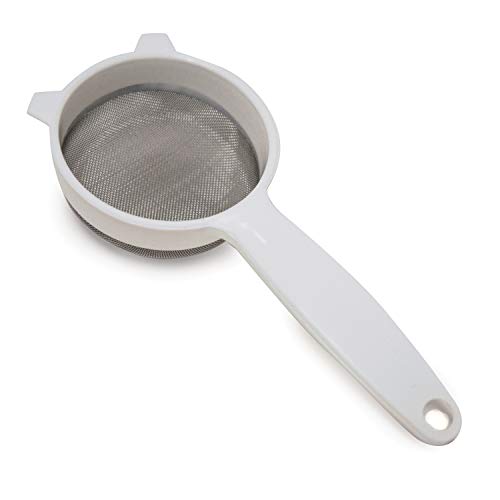
Norpro Fine Mesh Strainer
Norpro’s deeper bowl shape holds more pulp before needing to be emptied, useful for juicing larger quantities of fruit in one session. A single mid-size strainer covers most home juicing needs.
Pros
- Deep bowl holds more pulp before emptying
- Mid-size diameter suits most home bowls
- Simple one-piece design with no nesting pieces to track
Cons
- Only one size, so very small or large jobs are less ideal
- Handle lacks a resting lip for bowl edges
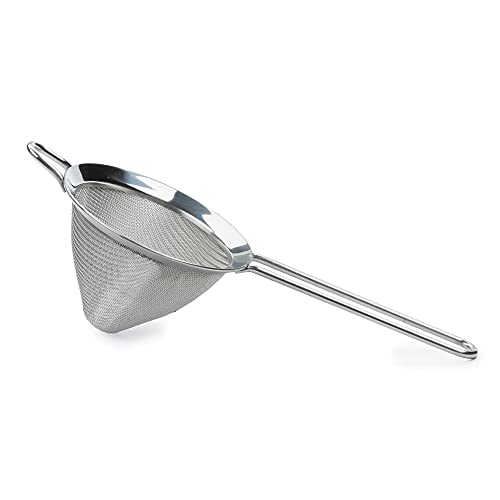
RSVP International Fine Mesh Strainer
RSVP keeps this strainer basic, a straightforward fine mesh bowl on a riveted handle, priced lower than most sets on this list. It handles everyday citrus and soft fruit juicing well.
Pros
- Lower price point than multi-piece sets
- Simple design with nothing extra to break
- Compact size fits small bowls and glasses easily
Cons
- Single small size limits use for larger juice batches
- Mesh gauge is coarser than premium conical options
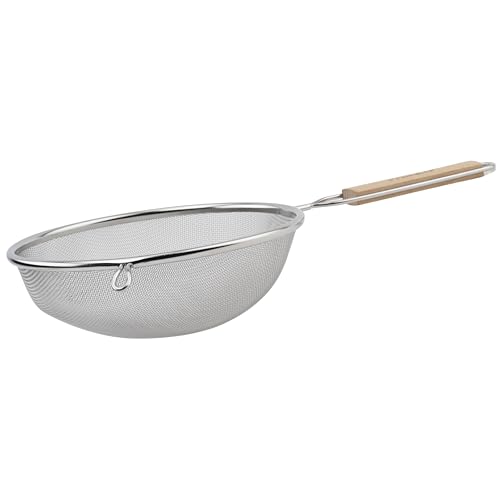
Winco Fine Mesh Strainer
Winco builds this strainer to commercial kitchen standards, with a heavier frame than typical home strainers. That makes it a durable pick for anyone juicing large batches regularly.
Pros
- Heavier frame holds up to frequent, high-volume use
- Larger diameter speeds up big-batch juicing
- Commercial-grade construction resists bending
Cons
- Larger size is overkill for small single-serving juicing
- Takes up more storage space than compact strainers
How to choose
What a fine mesh strainer does for fresh juice Pressed or blended fruit carries pulp, fiber, and sometimes seeds that most people do not want in a finished glass of juice. A fine mesh strainer catches those particles while letting the liquid pass through, without needing a dedicated juicing machine.
Mesh gauge and how much pulp it removes Finer mesh catches more small particles, including tiny seeds from fruits like raspberries, but drains more slowly. Coarser mesh drains faster but lets more fine pulp through, which suits people who prefer juice with some texture.
Single strainers versus nesting sets A single mid-size strainer covers most everyday juicing, while a nesting set adds flexibility for small citrus jobs and larger batch juicing without buying separate pieces. Sets also stack for compact storage.
When a juice strainer is not the right tool Someone juicing hard vegetables like carrots or beets regularly will get more consistent results from a dedicated masticating juicer, since a strainer only removes pulp after the fruit is already crushed or blended. A strainer works best as a finishing step, not as the main extraction method.
Compared at a glance
| # | Model | Mesh Type | Best for | Score | Price |
|---|---|---|---|---|---|
| 1 | OXO Good Grips Fine Mesh Strainer | Fine stainless steel mesh | Best overall | 9.2 | Check price |
| 2 | Rosle Fine Mesh Conical Strainer | Ultra-fine stainless mesh | Best mesh fineness | 9.0 | Check price |
| 3 | Cuisinart Fine Mesh Strainer Set | Fine stainless mesh | Best multi-size set | 8.7 | Check price |
| 4 | Bellemain Fine Mesh Stainless Steel Strainer Set | Fine stainless mesh | Best value multi-pack | 8.6 | Check price |
| 5 | Norpro Fine Mesh Strainer | Fine stainless mesh | Best single mid-size strainer | 8.5 | Check price |
| 6 | RSVP International Fine Mesh Strainer | Fine stainless mesh | Best budget pick | 8.3 | Check price |
| 7 | Winco Fine Mesh Strainer | Fine stainless mesh | Best heavy-duty build | 8.6 | Check price |
Questions worth asking
What is a fine mesh strainer used for in juicing?
It removes pulp, fiber, and small seeds from blended or pressed fruit, leaving a smoother finished juice.
Can a fine mesh strainer replace a juicer?
It can for soft fruit that has already been blended, but it will not extract juice from hard produce on its own.
What mesh size is best for juicing?
A fine gauge mesh catches more pulp and small seeds, though it drains slower than a coarser mesh strainer.
Are fine mesh strainers dishwasher safe?
Most stainless steel versions are dishwasher safe, though hand washing helps the mesh keep its shape longer.
Do fine mesh strainers rust over time?
Quality stainless steel resists rust, but lower-grade metal strainers can develop spots if left wet repeatedly.
What size strainer is best for juicing a full pitcher?
A larger diameter, around 7 to 8 inches, drains faster and holds more volume for batch juicing.
Can a fine mesh strainer catch citrus seeds?
Yes, a fine gauge mesh is tight enough to stop most citrus seeds while letting juice through.
Is a conical strainer better than a bowl-shaped one for juice?
A conical shape drains faster into a narrow container, while a bowl shape holds more pulp before needing to be emptied.
How do you clean pulp residue out of fine mesh?
Rinse immediately after use and scrub gently with a soft brush; dried pulp is harder to remove from fine mesh.
Final word
OXO Good Grips’ fine mesh strainer is the best fit for most home juicing, since the resting lip keeps it stable over a bowl during pouring. Anyone juicing berries with small seeds should choose Rosle’s finer conical mesh instead, and buyers who strain different volumes regularly will get more use out of Cuisinart’s nesting three-piece set.
Dana Whitfield
Dana spent eight years buying and merchandising for a regional kitchenware retailer before moving into editorial work. She has handled thousands of SKUs across cookware, small appliances and kitchen organization, and focuses on the practical differences that matter once a product is actually in daily use.
You might also need

Which Cordless Stick Vacuum Actually Handles Carpet?

How Does a French Press Actually Brew Coffee Differently Than Drip?

Is a Countertop Dishwasher Actually Worth It for a Small Kitchen?