Choosing a Fertilizer Spreader for Your Lawn Size
Scotts Turf Builder EdgeGuard DLX earns top marks for its edge blocking shield and bag matched calibration. Scotts Wizz suits small lawns with a lightweight handheld design. Agri-Fab 45-0463 tow behind spreader covers acreage fast when hitched to a mower or tractor.
Scotts Turf Builder EdgeGuard DLX fits most home lawns best, thanks to its edge shield and bag matched gate settings. Small yards suit the handheld Scotts Wizz better than a push model. Properties measured in acres need the Agri-Fab 45-0463 tow behind instead.
A poorly calibrated spreader either burns stripes into turf or wastes half a bag on the driveway. Bag instructions assume one specific spreader model, so settings rarely transfer directly. We compared hopper capacity, gate calibration, edge guard design and frame materials across seven models. Owner feedback about clogging and gate drift also shaped the rankings.
The best picks, ranked

Scotts Turf Builder EdgeGuard DLX Broadcast Spreader
An EdgeGuard shield blocks the right side of the spread pattern, keeping product off paths, beds and ponds. Gate settings line up with the numbers printed on Scotts fertilizer bags, cutting out most calibration guesswork. Assembly only requires attaching the handle.
Pros
- Edge guard blocks product from paths and beds
- Gate settings match Scotts bag numbers directly
- Large hopper cuts down on refill stops
Cons
- Plastic frame wears faster than steel models
- Wide throw pattern crowds small yards

Scotts Wizz Handheld Spreader
A battery powered impeller replaces the hand crank found on cheaper handheld spreaders, giving a steadier pattern. Four AA batteries run the unit, and storage needs almost no closet space. Seed and ice melt run through it too, so one tool covers three seasons.
Pros
- Powered impeller spreads more evenly than hand crank units
- Stores in a fraction of the space a push spreader needs
- Doubles for grass seed and ice melt applications
Cons
- Small hopper means frequent refills on bigger lawns
- Holding it steady tires the arm over large areas

Agri-Fab 45-0463 Tow Behind Broadcast Spreader
Hitching to a riding mower or garden tractor turns acres of ground into a short job instead of a long walk. A 130 pound hopper capacity means far fewer refill stops. An enclosed gearbox shields the drivetrain from grit, though initial assembly takes real time out of the box.
Pros
- Covers acreage far faster than any push model
- Large hopper cuts refill stops to a minimum
- Enclosed gearbox holds up under load
Cons
- Needs real assembly time before first use
- Requires a riding mower or tractor to tow it

Earthway 2150 Commercial Broadcast Spreader
Earthway built the 2150 for landscapers running routes every day. Pneumatic tyres roll smoothly over curbs and rough turf, and a stainless steel gear drive resists fertilizer corrosion. A three hole drop pattern keeps the spread even, which matters when billing clients by the lawn.
Pros
- Stainless gearing resists corrosion from fertilizer salts
- Pneumatic tyres roll easily over rough or uneven ground
- Built to handle daily commercial workloads
Cons
- Costs more than most homeowner spreaders
- Ships without an edge blocking shield
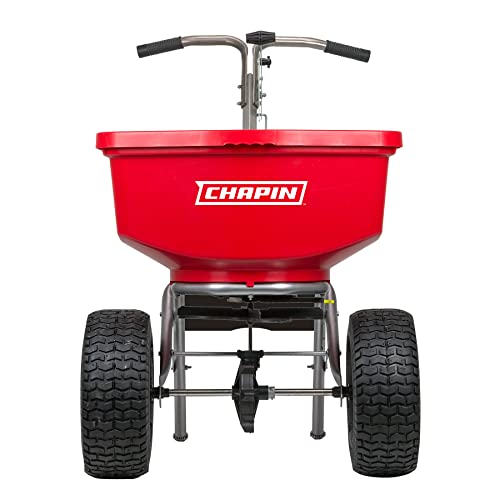
Chapin 8400C Professional Turf Spreader
Chapin fits this spreader with a gate that snaps open and shut instead of dragging. That crisp action keeps the application rate steady from the first step of a pass to the last. Owners report it holds calibration longer than spreaders with looser gate mechanisms.
Pros
- Gate mechanism holds its setting reliably over time
- Powder coated steel frame outlasts plastic models
- Eighty pound hopper covers ground without feeling unwieldy
Cons
- Heavier to push than plastic framed spreaders
- Wide pattern needs care close to flower beds
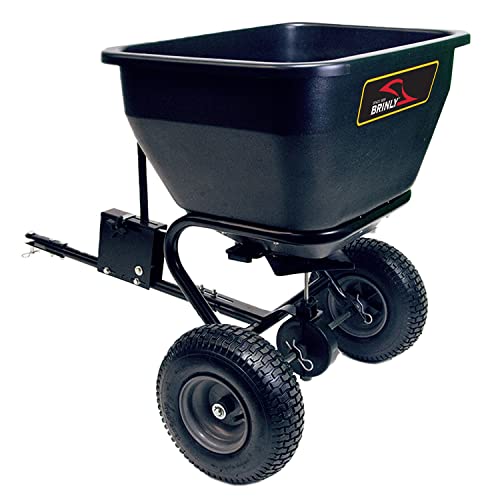
Brinly BS36BH-A Push Broadcast Spreader
Wide set, large diameter wheels keep the hopper level on bumpy or sloped turf where narrower spreaders tip and wander. A screen across the hopper opening stops clumped, damp fertilizer from jamming the impeller. Assembly bolts together quickly, and the enamel coated steel frame feels solid underfoot.
Pros
- Wide wheelbase stays stable on slopes and bumps
- Hopper screen keeps clumps away from the impeller
- Steel frame construction feels solid in daily use
Cons
- Wide track struggles to fit through narrow gates
- Ships without a side edge blocking shield

Solo 421 Portable Chest-Mount Spreader
Steep banks, narrow bed lines and rough paddock edges sit beyond the reach of any wheeled spreader. A hand crank turns the impeller directly, so no battery ever needs charging. Shoulder straps spread the 20 pound hopper load across the body instead of the arms.
Pros
- Reaches ground no wheeled spreader can access
- Crank drive needs no batteries or charging
- Harness distributes hopper weight across the shoulders
Cons
- Slower per square foot than a push spreader
- Crank speed must stay steady or spread width varies
What matters most
Broadcast vs drop: which spreader type fits your lawn? A broadcast spreader flings product outward from a spinning plate, covering wide ground quickly. Passes overlap slightly to prevent stripes. Drop spreaders work differently, releasing product straight down between the wheels with no throw past the track. Open lawns favor broadcast designs, which cover nearly every spreader on this list. Precise edges next to beds, ponds or paths are where drop spreaders actually earn their keep.
How do I calibrate a spreader correctly? Bag labels print settings for common spreader models, but walking speed and product density shift the real rate. Start one notch below the recommended setting as a safety margin. Split the total product into two passes run at right angles to each other. Under application corrects easily with a second light pass. Over application burns stripes that take a full season to grow back.
What hopper size actually matches your lawn? Bigger hoppers mean fewer refills, but added weight makes a spreader harder to push. Fifty pounds of capacity covers a typical suburban lawn without becoming unwieldy. Yards under a couple hundred square metres are faster served by a handheld unit than a push spreader dragged from the shed. Acreage is the real threshold for a tow behind, and that machine still needs a mower or tractor to pull it.
Why does a spreader need rinsing after every use? Fertilizer residue is corrosive and eats into metal gears left uncleaned. A garden hose rinse right after use clears granules from the hopper and gate before they harden. Full drying before storage stops rust from starting in the gearbox. Spreaders rinsed and dried this way regularly last well over a decade; those left dirty can jam within a season or two.
How they compare
| # | Model | Type | Best for | Score | Price |
|---|---|---|---|---|---|
| 1 | Scotts Turf Builder EdgeGuard DLX Broadcast Spreader | Push broadcast spreader | Best overall | 9.4 | Check price |
| 2 | Scotts Wizz Handheld Spreader | Handheld battery powered | Best value for small yards | 9.2 | Check price |
| 3 | Agri-Fab 45-0463 Tow Behind Broadcast Spreader | Tow behind broadcast | Best tow-behind for large lawns | 9.0 | Check price |
| 4 | Earthway 2150 Commercial Broadcast Spreader | Push broadcast spreader | Best for professional and commercial use | 8.8 | Check price |
| 5 | Chapin 8400C Professional Turf Spreader | Push broadcast spreader | Best for calibration accuracy | 8.6 | Check price |
| 6 | Brinly BS36BH-A Push Broadcast Spreader | Push broadcast spreader | Best for sloped or uneven lawns | 8.3 | Check price |
| 7 | Solo 421 Portable Chest-Mount Spreader | Chest mounted hand crank | Best for tight spaces and edges | 8.0 | Check price |
Common questions
What setting should I use on a fertilizer spreader?
Start with the number printed on the fertilizer bag for your spreader model, then drop one setting lower. Apply in two passes run at right angles. Under application is easy to fix; over application burns the lawn.
Broadcast or drop spreader for a home lawn?
Broadcast suits nearly every home lawn, since it covers ground faster with a forgiving overlap. Choose drop spreaders only when precise edges beside beds, paths or water matter most.
Can one spreader handle fertilizer, seed and ice melt?
Most broadcast spreaders manage all three, though gate settings differ because granule size and density change. Rinse thoroughly between fertilizer and ice melt, since salt corrodes metal fast.
Why does my spreader leave stripes on the lawn?
Missed overlap between passes is the usual cause, along with a rate set too high. Overlap the previous wheel track and split product into two passes run at right angles.
How do I stop fertilizer from clogging a spreader?
Keep product dry before loading and break up any clumps by hand. A hopper screen, where fitted, blocks clumps before they reach the impeller and jam it.
Should I water the lawn after spreading fertilizer?
Most granular fertilizers need a watering pass afterward unless the label says otherwise. Water moves granules off leaf blades and into soil, lowering the risk of leaf burn.
How do I keep fertilizer off my driveway or sidewalk?
An edge blocking shield, like the one on EdgeGuard models, stops product from reaching hard surfaces. Close the gate before crossing a path, then sweep any stray granules back onto the lawn.
How should I store a spreader over winter?
Rinse it fully, dry every part, and add a light coat of oil to the gears and moving joints. Store the unit under cover, since leftover fertilizer residue corrodes gate mechanisms over winter.
Is a tow behind spreader worth it for a large yard?
Yes, once a property runs to acres, since walking a push spreader stops being practical. A tow behind hitches to a riding mower or tractor and covers that ground in a fraction of the time.
What is the difference between a push spreader and a handheld spreader?
Push spreaders roll on wheels and suit lawns too large to cover by hand comfortably. Handheld spreaders skip the wheels entirely, working best on small yards or tight strips near beds.
Final word
Scotts Turf Builder EdgeGuard DLX remains the spreader to buy for a typical home lawn, since its edge shield and bag matched calibration remove the two most common mistakes. Small yards are better served by the handheld Scotts Wizz, and anyone tending acreage should go straight to the Agri-Fab 45-0463 tow behind.
Sierra Daniels
Sierra's background is in landscape design and nursery retail. She focuses on lawn and garden equipment, outdoor furniture and gear durability, weighing published specs against how materials actually hold up outside.
You might also need

A Lawn Mower That Matches Your Yard Size and Terrain
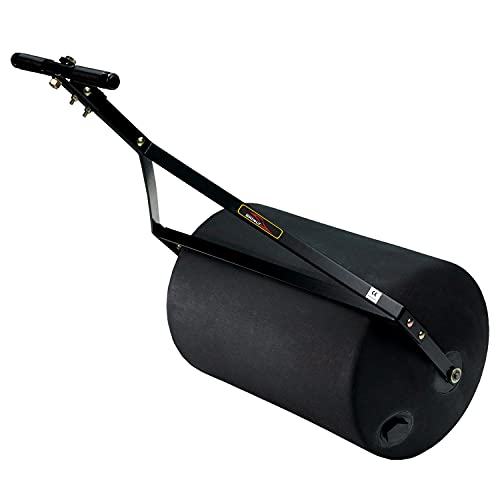
Lawn Rollers Built to Flatten Bumps Before Seeding
