Electrical Tape That Holds Up Under Heat and Moisture
Scotch Super 33+ remains the standard professional roll thanks to its adhesion and wide temperature range. Super 88 adds thickness for outdoor and abrasive work. Temflex 1700 covers everyday household repairs at a lower cost. All three carry proper insulation ratings for safe wiring work.
Scotch Super 33+ is the roll most electricians reach for first. Super 88 takes over when a joint faces weather or abrasion. Temflex 1700 handles ordinary indoor jobs at a lower price. Every other roll on this list fills a narrower job.
Tape failures rarely show up on day one. Unwound ends turn up months later in a hot attic, and cracked wraps appear in an unheated garage after winter. Thickness, elongation and the printed temperature range tell you more than the color of the backing. We compared published manufacturer specifications against what owners report after a full season of use.
Our top picks

3M Scotch Super 33+ Vinyl Electrical Tape
Rubber resin adhesive keeps its grip across a wide temperature swing, from freezing garages to hot attics. Wrapped tight, it conforms around irregular splices without lifting at the edges. The end stays put instead of flagging loose. Owners report rolls staying flexible even after years in storage.
Pros
- Grips through both heat and cold cycles
- Stretches tightly around irregular splices
- Accepted as the professional standard
Cons
- Costs more than store brand vinyl
- Sold only in black
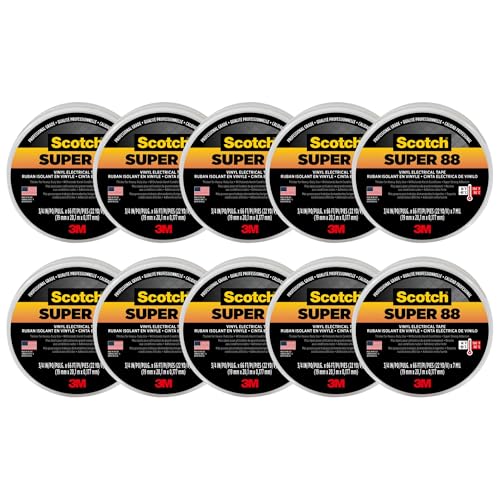
3M Scotch Super 88 Vinyl Electrical Tape
Super 88 shares its adhesive with 33+ but adds nearly two extra mils of vinyl backing. That extra body resists abrasion, moisture and UV exposure on outdoor connections. Tight bends take a little more effort to wrap cleanly. Conduit bodies, outdoor boxes and damp crawlspaces call for this thicker roll.
Pros
- Thicker backing resists cuts and abrasion
- Handles moisture and UV exposure well
- Uses the same trusted adhesive as 33+
Cons
- Harder to conform on small diameter joints
- More roll than simple indoor repairs need

3M Temflex 1700 Vinyl Electrical Tape
Temflex is 3M’s general purpose line, built for bundling wire, insulating a splice or marking a cable run. Adhesion performs well without matching the professional Scotch rolls. Its temperature ceiling sits lower too. For a drawer roll kept on hand for quick jobs, few options beat the price.
Pros
- Strong price to performance balance
- Tears cleanly by hand
- Sold in convenient multipacks
Cons
- Lower heat rating than 33+ or 88
- Adhesive can flag in cold garages

Scotch 35 Vinyl Color Coding Electrical Tape
Scotch 35 shares its construction with the professional black rolls but ships in standard identification colors. Electricians reach for it to mark phases and grounds inside a panel. Pigments stay legible instead of fading to pastel. Buy single colors or a full identification set.
Pros
- Colorfast pigments stay readable over time
- Uses professional grade adhesive
- Full color sets simplify phase marking
Cons
- Priced higher than plain black vinyl
- Full sets include colors you may not need

Gardner Bender GTPC-650 Electrical Tape Multipack
This multipack bundles colored rolls for labeling, bundling and light indoor insulation. Vinyl runs thinner than professional grade, so save it for low stress jobs. Cost per roll drops sharply compared with premium brands. Owners report it works well for organizing cable runs and marking tools.
Pros
- Very low cost per roll
- Useful for labeling and bundling cable
- Colors help organize messy runs
Cons
- Adhesive is weaker than premium rolls
- Not suited to hot or outdoor locations

3M Scotch 130C Linerless Rubber Splicing Tape
This is not vinyl. Self fusing ethylene propylene rubber bonds to itself into a solid, moisture proof block. That construction is how splices above 600 volts get built up correctly. A vinyl overwrap adds the mechanical protection rubber alone lacks. Stretch it thin while wrapping so the layers fuse.
Pros
- Fuses into a watertight insulating mass
- Suited to underground and wet locations
- High dielectric strength per layer
Cons
- Needs a vinyl overwrap for protection
- Sticky and awkward for first time users

Duck Brand Professional Grade Electrical Tape
Duck’s electrical roll tears cleanly by hand and stretches enough to seal a lamp cord or bundle speaker wire. Adhesion holds well at room temperature but slips at extremes. Keep this one in a kitchen drawer rather than a work van. It handles occasional household repairs without complaint.
Pros
- Tears easily without tools
- Inexpensive and widely available
- Conforms well on small cords
Cons
- Adhesive softens in hot attics
- Ends can lift over time on flexed cords
How they stack up
| # | Model | Thickness | Best for | Score | Price |
|---|---|---|---|---|---|
| 1 | 3M Scotch Super 33+ Vinyl Electrical Tape | 7 mil | Best overall | 9.4 | Check price |
| 2 | 3M Scotch Super 88 Vinyl Electrical Tape | 8.5 mil | Best for outdoor use | 9.2 | Check price |
| 3 | 3M Temflex 1700 Vinyl Electrical Tape | 7 mil | Best value | 9.0 | Check price |
| 4 | Scotch 35 Vinyl Color Coding Electrical Tape | 7 mil | Best for phase marking | 8.8 | Check price |
| 5 | Gardner Bender GTPC-650 Electrical Tape Multipack | 7 mil | Best budget | 8.6 | Check price |
| 6 | 3M Scotch 130C Linerless Rubber Splicing Tape | Self fusing rubber | Best for high voltage splices | 8.3 | Check price |
| 7 | Duck Brand Professional Grade Electrical Tape | 7 mil | Best for household repairs | 8.0 | Check price |
What to look for
What temperature range should electrical tape handle? The number printed on the tape core matters more than color or brand. General purpose vinyl typically tops out around 80 C. Professional grade rolls run to 105 C. That gap separates a wrap that survives a hot attic from one that unravels into a sticky mess. Cold matters too, since brittle vinyl cracks when a cable flexes in an unheated garage.
Does thicker tape mean better insulation? Thickness mainly buys resistance to physical damage, not extra insulation. Most 600 volt vinyl already provides adequate dielectric strength in two half lapped layers. An 8.5 mil roll like Super 88 survives rubbing against a metal edge or conduit better than a thin one. Inside a junction box, a standard 7 mil roll usually wraps more easily around tight bends.
How do you wrap electrical tape correctly? Electricians wrap so each turn covers half of the previous one. They also stretch the tape to roughly three quarters of its width as they go. That combination pulls the layers tight and lets the adhesive bond to itself, not just to the conductor. Finish the last turn without stretching so the end has no tension pulling it loose.
When is vinyl tape the wrong choice? Vinyl tape insulates and protects a joint; it never makes the joint itself. Anything above 600 volts, underground work, or a spot where water pools calls for self fusing rubber tape built up to the right thickness. A vinyl overwrap then protects that rubber from abrasion. Wire nuts and proper connectors still do the actual electrical joining.
Common questions
How many layers of electrical tape do I need?
For a typical 600 volt household repair, two half lapped layers over the exposed conductor is standard practice, which works out to four thicknesses of tape. Building up more does not hurt, but it never makes an unsound connection safe.
Why does my electrical tape keep unwinding?
Usually the last turn was applied under stretch, so the vinyl keeps pulling itself back. Heat and a low grade adhesive make it worse. Finish with a relaxed final wrap and use a roll rated to 105 C in hot locations.
What do the different tape colors mean?
Colors mark phase and system identification, with black, red and blue commonly used for phases in 120/208 volt systems and brown, orange and yellow in 277/480 volt systems. Green marks ground and white marks neutral. Local code governs, so check your jurisdiction.
Can electrical tape be used outdoors?
Thicker professional rolls such as Super 88 handle sun and moisture far better than general purpose vinyl. For connections that sit in water or underground, a self fusing rubber tape overwrapped with vinyl is the right build.
Is electrical tape waterproof?
Vinyl tape resists moisture but does not seal, since the spiral wrap leaves a path along the edges. Self fusing rubber tape bonds into a single mass and is the product to use when water exposure is expected.
Does electrical tape expire?
Rolls have a practical shelf life of around five years when stored cool and dry. Old tape gives itself away by tearing unevenly, losing stretch, or leaving adhesive behind on the roll.
Can I use duct tape instead of electrical tape?
No. Duct tape carries no insulation rating, its adhesive fails with heat, and the cloth backing can carry moisture. Use a tape marked with a voltage rating for anything electrical.
What is the difference between Super 33+ and Super 88?
They share the same adhesive and temperature rating, but 88 runs about 8.5 mil thick against 7 mil for 33+. The extra thickness resists abrasion outdoors while 33+ conforms better around tight, small diameter joints.
How wide is standard electrical tape?
Most rolls measure three quarters of an inch wide, the de facto standard for household and light commercial wiring. Wider rolls exist for bundling cable runs but are less common for splicing work.
Can electrical tape catch fire?
Vinyl tape is flame retardant, not fireproof, and it will burn if it reaches a high enough temperature. It should never touch a bulb, ballast or any surface that runs hot during normal use.
Our take
Scotch Super 33+ tops this list because its adhesive holds through temperature swings that defeat cheaper vinyl, and it conforms neatly around real splices. Reach for Super 88 outdoors or anywhere abrasion is a factor. Keep a roll of Temflex 1700 on hand for everyday indoor repairs.
Jake Monroe
Jake worked as a residential contractor for over a decade before shifting to full-time writing. He evaluates power tools, hand tools and workshop gear through the lens of someone who has actually used them on job sites, not just read the box.


