Eco-Friendly Engineering Kits That Hold Up to Real Rebuilds
Thames & Kosmos Wind Power Experiment Kit leads this group thanks to its voltage meter and four turbine builds. 4M Green Science Wind Power Kit trims the price while keeping recycled cardboard construction. Tinkering Labs Wooden Motor Mechanics STEM Building Kit fits families who want FSC-certified birch instead of plastic gears.
Thames & Kosmos Wind Power Experiment Kit tops this group for families chasing real renewable energy lessons. Its geared turbine pairs with a working voltage meter, so kids see measurable output from each blade swap. Steady wind or a fan is required, since the turbine will not spin on stagnant indoor air.
Eco-friendly claims vary widely between STEM brands, from FSC-certified wood to recycled cardboard boxes reused as parts. This list weighs listed materials, power source, owner feedback on durability, and fit across specific age ranges.
Our top picks

Thames & Kosmos Wind Power Experiment Kit
A geared turbine hub swaps between four blade sets, spinning a small generator wired to an LED. Kids read live voltage output on an included meter while comparing blade shapes. The 48 page manual ties each build back to a renewable energy concept.
Pros
- Voltage meter turns blade experiments into measurable data
- 48 page manual links builds to renewable energy concepts
- Plastic gearbox survives repeated teardown and rebuild
Cons
- Indoor use needs a fan since natural airflow rarely spins the turbine
- Small screws and axles are easy to lose during cleanup
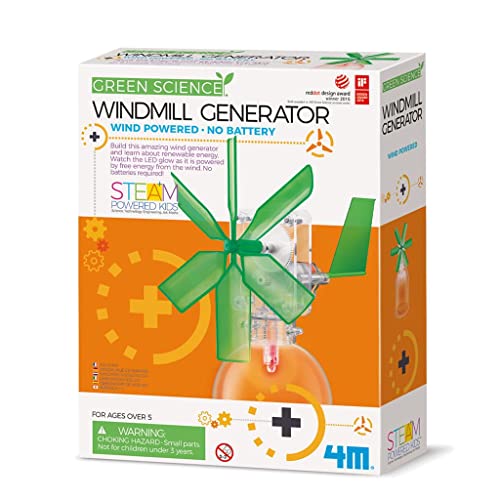
4M Green Science Wind Power Kit
Recycled cardboard forms the bulk of this fan car, turbine generator, and propeller device. A small DC motor works in reverse as a generator once wind reaches the blades. Snap fit joints skip glue and tools entirely, so setup moves fast.
Pros
- Packaging doubles as build material, cutting extra waste
- Snap fit assembly suits kids building without an adult
- Compact box stores flat between building sessions
Cons
- Plastic gear teeth strip after many rebuild cycles
- Three build variations run out of novelty quickly

4M Kidzlabs Salt Water Fuel Cell Car Kit
Saltwater electrolysis powers this reversible fuel cell, mounted on a precut cardboard chassis. Topping off the reservoir keeps the car rolling for several minutes per fill. Fewer parts than any other kit here means the fastest build time.
Pros
- Saltwater fuel cell needs no disposable batteries
- Fastest assembly time thanks to a low part count
- Demonstrates fuel cell chemistry that solar kits skip
Cons
- One build configuration limits replay value over time
- Output drops noticeably on carpet or uneven flooring
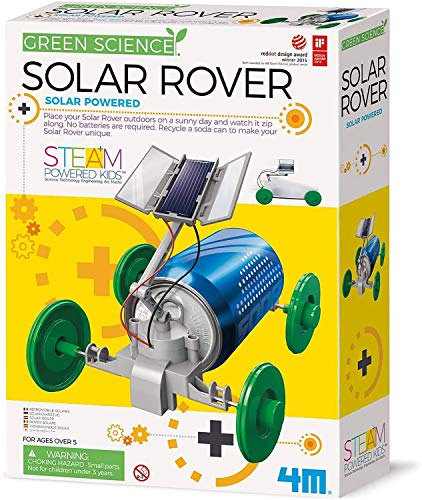
4M Green Science Eco Engineering Solar Rover Kit
Recycled ABS plastic makes up the rover body, driven by a photovoltaic panel wired to a capacitor. That capacitor keeps the rover rolling briefly after it leaves direct light. Three wheel and track setups introduce basic gear ratios along the way.
Pros
- Capacitor bridges short gaps in direct sunlight
- Panel still responds to bright indoor lamp light
- Recycled plastic body cuts down on virgin material
Cons
- Rover slows to a crawl on carpet or rough ground
- Capacitor charge runs out in under a minute

Tinkering Labs Wooden Motor Mechanics STEM Building Kit
FSC-certified birch forms the pegboard and gears, paired with a reusable geared motor unit. Idea cards walk through more than 15 mechanisms, from cranks to conveyor belts. Peg-and-slot connections need no tools across any of the builds.
Pros
- FSC-certified birch cuts reliance on virgin plastic
- Toolless assembly holds up to shared classroom use
- One motor unit powers all 15-plus mechanisms
Cons
- Two AA batteries are needed but not included
- Wood pieces can splinter after repeated drops

National Geographic Mega Solar Robot Building Kit
One parts set builds 12 robot configurations, from a walking bug to a wheeled roller, off a shared solar array. Battery backup keeps builds moving when a classroom lacks direct sunlight. A parts tray helps student groups keep small pieces sorted.
Pros
- 12 configurations stretch across multiple class periods
- Backup battery mode works around limited classroom light
- Parts tray cuts down on lost small components
Cons
- Battery mode requires AA batteries sold separately
- Small gears go missing fast without the tray

4M Green Science Recycled Paper Maker Kit
A hand-operated screen and mould frame turn scrap paper into new sheets. No motors, gears, or batteries make this the simplest build on this list. The two-piece frame goes together without a single tool.
Pros
- No small electronics lower choking risk for younger kids
- Turns household scrap paper into a usable material
- Two-piece frame skips tools during assembly
Cons
- Water and drying space make this a messier activity
- Single-purpose build skips mechanical or electrical concepts
The lineup, side by side
| # | Model | Age range | Best for | Score | Price |
|---|---|---|---|---|---|
| 1 | Thames & Kosmos Wind Power Experiment Kit | 8-14 years | Best overall | 9.4 | Check price |
| 2 | 4M Green Science Wind Power Kit | 8 years and up | Best value | 9.1 | Check price |
| 3 | 4M Kidzlabs Salt Water Fuel Cell Car Kit | 8 years and up | Best budget | 8.8 | Check price |
| 4 | 4M Green Science Eco Engineering Solar Rover Kit | 8 years and up | Best for solar energy learning | 8.6 | Check price |
| 5 | Tinkering Labs Wooden Motor Mechanics STEM Building Kit | 6-12 years | Best wooden and sustainable materials | 8.4 | Check price |
| 6 | National Geographic Mega Solar Robot Building Kit | 8-12+ years | Best for classroom use | 8.2 | Check price |
| 7 | 4M Green Science Recycled Paper Maker Kit | 5-8 years | Best for younger kids | 8.0 | Check price |
What to look for
What Counts as an Eco-Friendly Engineering Kit Material choice matters most, since FSC-certified wood or recycled cardboard cuts new plastic use compared with standard STEM kits. Power source counts just as much, and solar panels, hand cranks and saltwater fuel cells replace disposable batteries. Packaging plays a quieter role, with several 4M boxes doubling as build parts. None of these swaps depend on a certification badge to matter in daily use.
Matching Kit Complexity to a Child’s Age A five-year-old running a papermaking screen needs a far simpler build than a twelve-year-old wiring a solar rover. Kits with fewer than five pieces and no loose batteries, like the 4M Recycled Paper Maker, fit early elementary kids best. Idea-card kits such as the Tinkering Labs wooden set reward kids who can already follow multi-step instructions alone. Printed age ranges often run a year or two below where a kit keeps a child genuinely interested.
Wood, Recycled Plastic or Solar: Picking a Material Birch pieces in the Tinkering Labs kit resist wear better across rebuilds than the thin plastic gears found in cardboard kits. Recycled plastic construction, as in the 4M Solar Rover, keeps manufacturing costs down while still skipping virgin material. Solar and wind components add a renewable energy lesson that wood and plastic alone cannot teach. That lesson comes with a tradeoff, since both depend on available light or airflow to function.
Choosing Between a Classroom Set and a Solo Home Kit Twenty students sharing one kit need a parts tray and several build configurations, which is why the National Geographic Mega Solar Robot suits classroom rotations. A single child at home gets more from a kit built for slow, repeated experimentation, like the Thames & Kosmos turbine with its voltage meter. Battery backup matters more in group settings, since sunlight or wind access varies by room. Solo builders at home can lean fully into weather-dependent power without that constraint.
Frequently asked questions
What makes an engineering kit eco-friendly?
Eco-friendly kits swap virgin plastic for FSC-certified wood, recycled cardboard or recycled ABS, and often pair that material with a renewable power source such as solar, wind or a saltwater fuel cell instead of disposable batteries.
Which eco-friendly kit works best for beginners?
The 4M Kidzlabs Salt Water Fuel Cell Car Kit has the fewest parts here and the fastest build time, making it a solid first project before moving to multi-model kits.
Can solar-powered kits work indoors?
The 4M Green Science Solar Rover Kit charges its capacitor under bright household lamp light, though run time and speed drop compared with direct outdoor sun.
Are wooden STEM kits more durable than plastic ones?
Based on listed materials, FSC-certified birch pieces in the Tinkering Labs kit hold up to repeated rebuilds better than the thinner ABS gears found in budget cardboard kits.
How many pieces do eco-friendly engineering kits include?
Piece counts range from a single-build papermaking frame in the 4M Recycled Paper Maker to more than 15 buildable mechanisms in the Tinkering Labs wooden set.
Is the 4M Green Science line good for younger kids?
The Recycled Paper Maker Kit in that line skips small batteries and motors, fitting kids around 5 to 8 years old better than the line’s solar or wind kits aimed at 8 and up.
Wooden building kits vs plastic gear kits, which lasts longer?
Owner feedback on wood-based sets like Tinkering Labs points to better longevity through repeated rebuilds, while plastic gear teeth in cardboard kits such as the 4M Wind Power Kit can strip over time.
Do eco-friendly engineering kits need batteries?
Some do: the Tinkering Labs motor unit and the National Geographic robot’s backup mode both need AA batteries, while the solar, wind and saltwater fuel cell kits run without any disposable batteries.
Which kit works best for a classroom setting?
The National Geographic Mega Solar Robot Building Kit fits classroom rotations best, since its 12 build configurations and parts tray support group use across multiple class periods.
The verdict
Thames & Kosmos Wind Power Experiment Kit takes the top spot for its detailed manual and working voltage meter, giving kids measurable feedback on turbine output. Families wanting fewer plastic parts should choose the Tinkering Labs Wooden Motor Mechanics kit instead, since its FSC-certified birch swaps in for gears that strip over time. Budget shoppers get strong value from the 4M Green Science Wind Power Kit, which reuses its own recycled cardboard packaging as a build material.
Rachel Simmons
Rachel previously worked in child-product retail and brings a practical, detail-first eye to gear reviews, focusing on safety standards, ease of use and the fine print that matters most for new caregivers.