Which Driveway Alarms Actually Catch Approaching Cars?
The Guardline Wireless Driveway Alarm leads on transmission range and sensor tuning against false triggers. Hosmart’s 1/2 Mile system is the value pick with expandable receivers, and the eMACROS solar model suits long driveways where battery changes become a chore.
Long rural driveways favor the Guardline Wireless Driveway Alarm, since its range holds up better than most through trees and outbuildings. Hosmart’s 1/2 Mile system serves shorter runs at a lower cost, and the eMACROS solar model removes battery replacement trips entirely.
Headline range figures assume line of sight across open ground, and real properties add brick walls, metal siding, mature trees and steel gates that cut those numbers sharply. Detection method matters just as much, since infrared sensors react to sunlight and animals while magnetic probes see only vehicles. We compared stated ranges, sensor types, adjustable sensitivity, power sources and sealing, then weighed those against what owners report about false alerts and winter reliability.
What we recommend

Guardline Wireless Driveway Alarm
A quarter mile rating and a weather sealed infrared sensor support up to four zones, each with a distinct chime. Aiming and shielding the sensor is the main defense against constant false alerts, and this unit allows both. Owners report the range holds up well through typical rural obstructions.
Pros
- Range holds up better than most through obstacles
- Separate chimes identify which zone triggered
- Adjustable aim cuts down on nuisance alerts
Cons
- Sensor batteries need periodic replacement
- Infrared still reacts to large animals

Hosmart 1/2 Mile Wireless Driveway Alarm
A rechargeable receiver and a half mile open air rating anchor a system built to grow, since extra sensors and receivers add on as coverage needs expand. Volume adjusts across a wide range, useful when the receiver sits in a workshop. It suits a suburban property with one or two approach points.
Pros
- Expandable to cover several approaches
- Rechargeable receiver skips constant batteries
- Wide volume range down to a quiet setting
Cons
- Quoted range assumes clear line of sight
- Sensitivity adjustment is coarse

eMACROS Long Range Solar Wireless Driveway Alarm
Solar power removes the main maintenance chore with these systems, the walk down the drive to replace batteries. A long distance rated transmitter pairs with a mains powered indoor receiver that simply plugs in. Placement still matters, since the panel needs real daylight to keep up with demand.
Pros
- Solar panel removes battery replacement trips
- Strong stated transmission distance
- Simple plug in receiver setup
Cons
- Needs a sunny mounting position
- Shaded winter placement reduces reliability

HTZSAFE Solar Wireless Driveway Alarm
Sensitivity and detection angle both adjust on this solar sensor, letting the field narrow to just the driveway. That control matters on properties where deer or cats otherwise trigger nightly alerts. Multiple chime tones and volume levels round out the receiver.
Pros
- Fine grained sensitivity and angle control
- Solar charging backed by rechargeable cells
- Multiple chime tones cover different zones
Cons
- Setup takes more adjustment than rivals
- Housing is bulkier on a slim post

Mighty Mule FM231 Wireless Driveway Alarm
A buried magnetic probe replaces infrared motion here, responding only to metal so cars and trucks trigger it while wildlife, weather and pedestrians do not. Properties plagued by false alerts gain the most from that trade off. Walking visitors will not register, since the probe cannot see them.
Pros
- Effectively immune to animal false alerts
- Unaffected by sun, rain and blowing leaves
- Hidden installation with nothing visible above ground
Cons
- Detects vehicles only, not people on foot
- Requires digging to bury the probe
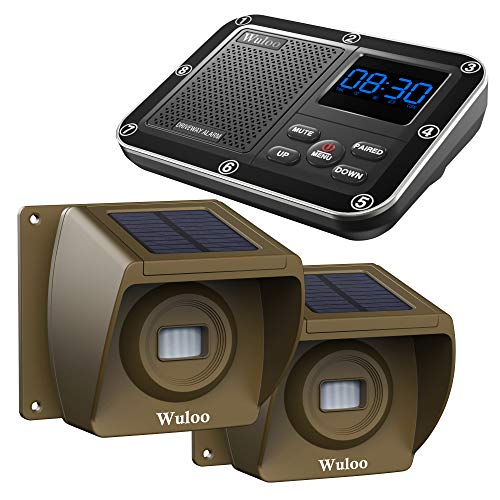
Chamberlain CWA2000 Wireless Motion Alert
Suburban driveways, garages and side gates fit this compact system better than long rural approaches. Setup runs close to plug and play, and the receiver is small enough to sit unnoticed on a shelf. Based on specifications, range here is the shortest on this list, so match it to actual distance needed.
Pros
- Very quick to set up out of the box
- Compact receiver suits small rooms
- Additional sensors pair easily later
Cons
- Effective range drops sharply through walls
- Limited sensitivity adjustment

Dakota Alert DCMA-2500 Wireless Motion Alert
Farm and rural use shaped this rugged sensor and receiver pair, with housing built to survive weather that kills consumer grade units. A plain tone replaces a menu of chimes, suiting anyone who wants reliability over features. Owners report it keeps working through winters that defeated cheaper systems.
Pros
- Built for sustained outdoor exposure
- Simple, reliable alert behavior
- Solid transmission over open ground
Cons
- Fewer features than consumer rivals
- Plain tone offers limited customization
Compared at a glance
| # | Model | Range | Best for | Score | Price |
|---|---|---|---|---|---|
| 1 | Guardline Wireless Driveway Alarm | Rated up to 1/4 mile | Best overall | 9.4 | Check price |
| 2 | Hosmart 1/2 Mile Wireless Driveway Alarm | Rated up to 1/2 mile open air | Best value | 9.2 | Check price |
| 3 | eMACROS Long Range Solar Wireless Driveway Alarm | Rated for long distance transmission | Best for long driveways | 9.0 | Check price |
| 4 | HTZSAFE Solar Wireless Driveway Alarm | Rated up to 1/2 mile open air | Best for adjustable sensitivity | 8.8 | Check price |
| 5 | Mighty Mule FM231 Wireless Driveway Alarm | Rated up to 400 feet | Best for vehicles only | 8.6 | Check price |
| 6 | Chamberlain CWA2000 Wireless Motion Alert | Rated up to 1/2 mile open air | Best for short driveways | 8.3 | Check price |
| 7 | Dakota Alert DCMA-2500 Wireless Motion Alert | Rated up to 2,500 feet | Best for harsh weather | 8.0 | Check price |
How to choose
Treat the quoted range as a best case number Manufacturers measure range across open ground with nothing in the way. A brick wall, a metal outbuilding, mature trees or a hill between sensor and receiver can cut that figure to a fraction of the headline. As a working rule, buy at least double the range actually needed, and plan on more if the receiver sits in a basement or behind foil backed insulation.
Detection method decides which false alerts you get Passive infrared sensors detect heat movement, so deer, dogs, cats and even sunlight crossing a cold surface can trigger them. Magnetic probe systems detect only metal, ignoring everything except vehicles. Anyone who wants to know about people on foot needs infrared and should plan on tuning the aim carefully. Anyone who only cares about vehicles can remove the nuisance with a probe.
Power source sets the ongoing maintenance burden A battery powered sensor at the end of a long drive means a cold weather walk every few months to swap cells. Solar removes that step, provided the panel gets real daylight, which is not guaranteed under trees or on a north facing post. Mains powered indoor receivers are the easy half of the equation, so focus on how shaded the sensor’s mounting spot really is.
Aim and shield the sensor before blaming the product Most complaints about constant false alerts trace back to placement rather than the hardware. Mount the sensor so its detection field crosses the drive instead of pointing down it, keep it out of direct afternoon sun, and use a hood or simple shield to mask off a road or footpath. Mounting height matters too, since a sensor low enough to see a cat will report every cat that walks by.
Frequently asked questions
How far do wireless driveway alarms really transmit?
Expect roughly a third to a half of the quoted figure on a typical property with buildings and trees in the path. Systems rated at half a mile in open air often deliver a few hundred yards through real obstructions, still enough for most driveways.
How do I stop animals from setting off the alarm?
Raise the mounting height so small animals pass below the detection field, narrow the sensitivity if the model allows it, and aim the sensor across the drive rather than along it. A magnetic vehicle probe removes the problem completely if false alerts persist.
Do driveway alarms still work in cold weather?
Infrared sensors actually perform well in cold, since the contrast between a warm body and cold surroundings increases. Battery performance is the weak point, dropping sharply below freezing, so lithium cells outlast alkaline through winter.
Can more sensors be added to an existing system later?
Most modern systems support additional sensors paired to one receiver, often with different chimes to identify which zone triggered. Confirm the maximum sensor count before buying if a gate, a shed and a driveway all need coverage eventually.
Do these alarms need wifi or a monthly subscription?
No. The systems here are self contained radio pairs with no internet connection and no ongoing fees. That also means no phone notifications while away, the trade off against camera based alternatives.
Where is the best spot to mount a driveway sensor?
Around waist height on a post beside the drive, aimed across the path of travel rather than down it, and shaded from direct sun. Keep it far enough from the road that passing traffic falls outside the detection field.
Will a driveway alarm work through a metal building?
Poorly. Metal siding and roofing block radio signals badly. Position the receiver near a window facing the sensor, or pick a system with a repeater option, since this is a common cause of range that falls short of expectations.
Is a magnetic probe better than an infrared sensor?
Better for ignoring animals and weather, worse for detecting people on foot, since probes sense only metal. Many rural properties run one of each, a probe for vehicles and infrared near the house.
What is the difference between a driveway alarm and a security camera?
A driveway alarm only alerts locally with a chime and has no recording or remote viewing. A camera adds video and often phone alerts but usually needs power, wifi and sometimes a subscription that an alarm avoids.
Our take
The Guardline Wireless Driveway Alarm suits most properties best, since its range and sensor tuning hold up where cheaper systems flood the receiver with false alerts. Choose the Hosmart system for a shorter driveway with room to expand later, and the eMACROS solar model if walking down to change batteries is the chore to avoid. Properties plagued by animal triggers do better with the Mighty Mule FM231 probe instead.
Marcus Chen
Marcus covered consumer electronics for enthusiast tech publications for six years before joining ChoiceCrest. He specializes in translating manufacturer spec sheets into plain-language buying advice, with a focus on audio, computing accessories and smart-home gear.