Digital Battery Testers That Catch a Dying Battery
TOPDON BT200 suits most home garages. One hookup reports state of health, cranking voltage and charging output, so you learn which part actually failed. KONNWEI KW208 runs the same three checks through a shorter menu. For a quick pass or replace verdict on one car, ANCEL BA101 is enough.
TOPDON BT200 is the tester to keep in a home garage. It separates a tired battery from a weak starter or a failing alternator in one session, which saves guessing at parts. Learning its menus costs an evening. Drivers who want a yes or no on a single car battery will be happier with the ANCEL BA101.
Battery testing turns confusing the moment two readings disagree. Resting voltage says almost nothing about behaviour under a starter load, and a conductance tester returns nonsense if the chemistry or CCA rating is entered wrong. We compared published CCA ranges, supported chemistries, cranking and charging coverage, clamp and cable build and screen legibility. Owner reports on erratic readings and clamp failure broke the ties.
The top picks, ranked

TOPDON BT200 Battery Tester
One hookup runs three checks in sequence: battery health, cranking draw, then charging output. Chemistry coverage spans 12V flooded, AGM, gel and EFB from 100 to 2000 CCA. Results land on a color screen and print out, which makes the diagnosis easier to act on than a bare voltage figure.
Pros
- Separates battery, starter and alternator faults
- Covers AGM and EFB stop start batteries
- Color screen stays readable under a hood
Cons
- Menu structure takes a session to learn
- 12V only, so no 24V truck systems

KONNWEI KW208 Battery Load Tester
Same three checks as the BT200, reached through fewer menu layers. Flooded, AGM and gel packs are supported on 12V systems from 100 to 2000 CCA. Clamps are the weak point, so scrub the posts before trusting a low number.
Pros
- Few steps between hookup and result
- Charging test included, not just health
- Small enough to live in a glovebox
Cons
- Light clamps slip on corroded terminals
- Monochrome screen washes out in direct sun

ANCEL BA101 Battery Tester
Answers the one question most owners have: is this battery still good. Enter the rating, clamp on, and it returns state of health, state of charge and measured CCA for any 12V pack from 100 to 2000 CCA. Power comes from the battery under test, so nothing internal goes flat between uses.
Pros
- Verdict arrives in well under a minute
- No internal cell to recharge
- Plain pass or replace output
Cons
- Charging system detail is thin
- Wrong CCA entry skews the health figure
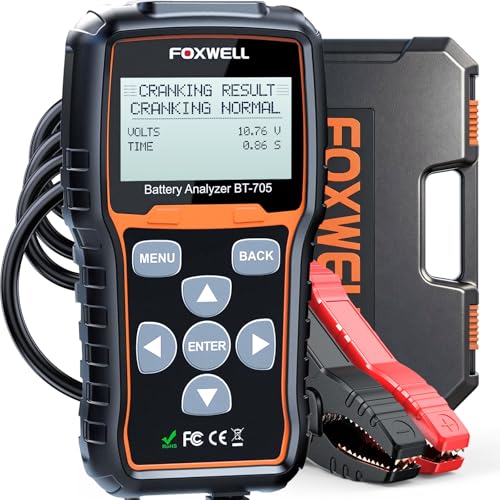
FOXWELL BT705 Battery Analyzer
Charging tests reach 24V systems, which pulls light trucks, RVs and some diesel setups into range. Starter and charging results report ripple and load voltage instead of a plain pass mark. That detail catches an alternator that only misbehaves when hot, though the housing is too big for a door pocket.
Pros
- Reads 24V charging systems on trucks and RVs
- Ripple figure exposes failing diodes early
- Reports starter draw as a number, not a verdict
Cons
- Bulkier than the 12V only testers here
- More capability than a one car garage uses

TOPDON BT100 Bluetooth Battery Tester
Clips to the terminals and stays there, streaming readings to a phone over Bluetooth. Weeks of voltage history show a slow decline that a single test on a warm afternoon would miss. Cranking and charging events log as graphs in the app. No screen sits on the unit itself, making the phone mandatory rather than optional.
Pros
- Trends reveal decline before a no start
- Small enough to leave wired in
- Cranking events are timestamped in the app
Cons
- Nothing to read without a phone nearby
- Staying connected adds a small parasitic draw

Autel MaxiBAT BT506 Battery and Electrical System Analyzer
Adaptive conductance covers 6V and 12V batteries alongside 12V and 24V charging systems. Lawn tractors, classic cars and work trucks all fall under one tool as a result. Test history saves per vehicle, so last spring’s numbers sit next to today’s. Setup is the longest of any unit here.
Pros
- Reads 6V tractor and classic car batteries
- Stored history makes gradual decline visible
- Widest chemistry and system coverage in this group
Cons
- Configuration is heavy for a single car household
- Needs its own charge, unlike clamp powered testers
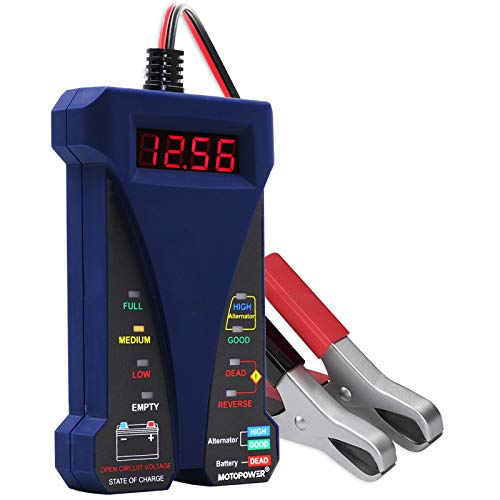
Motopower MP0514A Digital Battery Tester
Narrow clamps fit the tight posts on motorcycles, ATVs and ride on mowers where full size jaws will not sit square. Battery voltage, cranking voltage and charging voltage appear on a backlit LCD. Measurement is voltage based rather than conductance, so it shows how a battery behaves under load without reporting measured CCA.
Pros
- Small jaws clear crowded motorcycle terminals
- Backlight reads in a dim shed
- Three numbers, no chemistry menu to set
Cons
- No measured CCA or state of health value
- Short leads limit reach across a car bay
Side by side
| # | Model | Battery types | Best for | Score | Price |
|---|---|---|---|---|---|
| 1 | TOPDON BT200 Battery Tester | 12V flooded, AGM, gel, EFB | Best overall | 9.4 | Check price |
| 2 | KONNWEI KW208 Battery Load Tester | 12V flooded, AGM, gel | Best value | 9.2 | Check price |
| 3 | ANCEL BA101 Battery Tester | 12V flooded, AGM, gel | Best budget | 9.0 | Check price |
| 4 | FOXWELL BT705 Battery Analyzer | 12V batteries, 12V and 24V charging systems | Best for charging system faults | 8.7 | Check price |
| 5 | TOPDON BT100 Bluetooth Battery Tester | Bluetooth to phone app | Best for long term monitoring | 8.5 | Check price |
| 6 | Autel MaxiBAT BT506 Battery and Electrical System Analyzer | 6V and 12V | Best for mixed garages | 8.2 | Check price |
| 7 | Motopower MP0514A Digital Battery Tester | 12V systems | Best for motorcycles and small batteries | 8.0 | Check price |
What matters most
What a digital battery tester measures Conductance has replaced the carbon pile in almost every home unit. A small signal passes through the plates, and the tool measures how they respond. That response gets compared against the CCA rating you type in, which is why a wrong entry ruins the result. Resting voltage is a weak signal by itself. A worn battery can sit at 12.6 volts and still collapse the instant a starter pulls. Cranking and charging tests are what turn a single number into a diagnosis.
Matching CCA range and chemistry to your battery Start with the sticker on the battery you own. Most passenger cars land between 400 and 800 CCA, well inside the 100 to 2000 CCA window shared by every unit here. Chemistry is the specification that really splits this group. AGM and EFB packs in stop start cars respond differently to a test signal than flooded lead acid. Run an AGM battery in flooded mode and a healthy pack can read as failed. Gel batteries in mobility scooters and some marine setups deserve the same care. Only the Motopower MP0514A skips chemistry selection, because it reads voltage instead of conductance.
How to read state of health, cranking and charging numbers Three figures carry most of the meaning. State of health under roughly 60 percent points to replacement rather than another charge. Cranking voltage comes next, and a dip below about 9.6 volts during start says the battery cannot hold up under draw. Charging voltage should settle in the mid 13s to mid 14s with the engine running. Below that range, suspect the alternator. Above it, look at the regulator. Charge a flat battery fully before any of this, since a discharged pack fails a test whether or not it is actually worn. FOXWELL BT705 adds a ripple figure, which flags diode failure while output still looks normal.
Testers for motorcycles, mowers and 6V batteries Small batteries create two separate problems. Jaw size is the first, because full width clamps will not straddle the narrow posts on a motorcycle or an ATV. Motopower MP0514A exists for exactly that. Voltage is the second problem. Older lawn tractors, golf carts and some classic cars run 6V systems that a 12V tester refuses outright. Autel MaxiBAT BT506 is the only pick here that reads 6V, and that alone decides it for a garage holding more than cars. Deep cycle marine batteries add a third wrinkle: conductance rates cranking ability, not reserve capacity, so a trolling battery needs a capacity test instead.
Common questions
How does a digital battery tester work?
A conductance tester sends a small signal through the battery and measures the response. That result is weighed against the CCA rating you enter, then reported as a state of health percentage. Carbon pile load testers get their answer by heating up and draining the battery, which is slower and warmer than most people want in a garage.
What does state of health mean on a battery tester?
State of health compares measured CCA against the rating printed on the case. Under roughly 60 percent, most units call for replacement. State of charge is a separate figure and describes how full the battery is right now, which is why a flat but healthy battery can show a low charge and a fine health score.
Can a battery tester check the alternator?
Yes, through the charging test. TOPDON BT200, KONNWEI KW208 and FOXWELL BT705 all read charging voltage with the engine running. FOXWELL adds ripple, which is how failing diodes announce themselves before total output drops off.
Do you have to disconnect the battery before testing?
No. Every tester here clamps onto the posts in place. Clean the terminals first, since corrosion under a clamp produces readings that mimic a dying battery. A wire brush and thirty seconds saves a wrong replacement.
Load tester vs conductance tester: which is better for a home garage?
Conductance wins on practicality, being quick, cool and safe to use in a driveway. A carbon pile load tester shows behaviour under real draw, which is why some shops keep one on the bench. For home use, the cranking test on a digital unit covers the same question with less heat.
Which battery testers support AGM and EFB batteries?
TOPDON BT200 covers flooded, AGM, gel and EFB. KONNWEI KW208, ANCEL BA101, FOXWELL BT705 and Autel MaxiBAT BT506 include AGM modes. Selecting the right chemistry matters, because an AGM battery tested as flooded can return a false failure.
Is there a battery tester that reads 6V lawn tractor batteries?
Autel MaxiBAT BT506 handles 6V and 12V batteries, which is unusual here. Everything else starts at 12V. Garages with classic vehicles, golf carts or older equipment should treat that 6V support as the deciding specification.
How often should you test a car battery?
Twice a year works for most drivers, ideally before winter and after a long hot summer. Heat damages plates while cold exposes the damage. Vehicles that sit for weeks deserve more frequent checks, since a slow parasitic drain shortens life fast.
Are Bluetooth battery testers worth leaving connected?
They earn their place on a car that sits, such as a weekend convertible or an RV. TOPDON BT100 logs voltage continuously and graphs the trend, catching a decline that a single test would miss. Daily drivers gain less, and the monitor does pull a small current of its own.
Final word
Buy the TOPDON BT200 for a home garage. One hookup tells you whether the battery, the starter or the alternator deserves the blame, and that answer is what stops parts guessing. Garages with a mower, a motorcycle or a 6V classic in the corner should move up to the Autel MaxiBAT BT506 for its voltage coverage. Drivers who only want a twice yearly verdict on one car get the same practical outcome from the ANCEL BA101 with far less setup.
Tony Russo
Tony trained as an automotive technician and spent years in service and parts retail before moving into writing. He focuses on garage tools, car care products and accessories from a hands-on maintenance perspective.

