Desk Fans for Home Offices, Dorms and Warehouses
Honeywell’s TurboForce HT-908 wins on raw airflow for most desks. Rowenta’s Turbo Silence Extreme VU2531 runs quietest for bedrooms and shared offices. Lasko’s 3-Speed Wind Machine covers wider tables with a tilting head. Each targets a different priority: power, silence, or reach across a bigger surface.
Honeywell’s TurboForce HT-908 leads this list for anyone who wants strong airflow from a compact base. Its turbine-style head pivots for direction but skips oscillation entirely. Buyers who need quiet operation near a bed or shared desk should look at the Rowenta Turbo Silence Extreme instead.
Desk fans differ more in noise output and power source than headline wattage suggests. We compared manufacturer speed and motor specs against owner feedback on noise, stability and battery life to rank these seven models.
Before you buy
What to look for in a desk fan Blade size and desk space set the first limit. A 5 inch clip fan suits a laptop cart, while a 9 to 11 inch fan suits a wide desk. Speed count matters more than headline wattage, since three real steps beat five overlapping ones. Oscillation spreads air across a room; a fixed head aims it at one spot instead. Power source splits fans into corded models for constant desk use and battery models for patios or travel.
Which desk fan runs quietest for an office or bedroom? Shared offices and bedrooms punish loud fans fastest. DC motors, like the one in the Dreo, run quieter at low speed than older AC motors. Rowenta markets its Turbo Silence line around reduced motor noise, and owner reviews back that reputation. Testing the lowest speed setting first reveals real-world noise, since volume usually jumps most between the bottom two steps.
Best picks for airflow and wider desks Wide desks and drafting tables need more than a gentle breeze. Lasko’s Wind Machine design forces more air through a small housing than typical box-style blades. Honeywell’s TurboForce line takes a similar approach with a pivoting turbine-shaped head. Neither model oscillates, so correct positioning matters more than with a sweeping fan.
Compact and USB-powered options for small spaces Dorm rooms, RVs and cramped desks favor small footprints over raw power. Clip fans, like the Genesis 5 inch model, mount to an edge and free up surface space entirely. Battery-powered fans, such as the OPOLAR model, skip the outlet and recharge over USB instead. Smaller blades move less air than a full-size desk fan, so expect reduced airflow from either category.
The shortlist, ranked
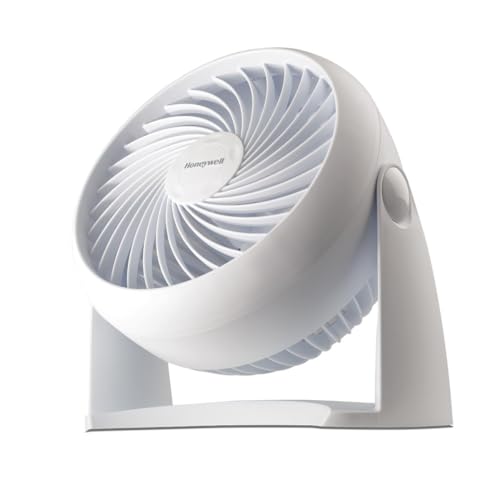
Honeywell TurboForce Power Fan HT-908
A turbine-style head pivots up to 90 degrees, aiming air at a desk, floor or shelf. Three speeds range from a light breeze to a post-workout cooldown. Garage and workshop owners often run it as a portable spot cooler, not just at a desk.
Pros
- Strong airflow relative to its compact size
- Pivoting head directs air precisely
- Sturdy build owners say lasts for years
Cons
- Top speed gets loud for shared offices
- No oscillation limits coverage to one direction

Rowenta Turbo Silence Extreme VU2531
Rowenta tuned this table fan’s motor for bedrooms and shared workspaces. Four speeds plus 90 degree auto oscillation spread air across a room instead of one spot. Owners report holding a phone call next to it on low speed without disruption.
Pros
- Quieter operation than typical desk fans
- Oscillation spreads air around a desk or room
- Stable base resists tipping on hard floors
Cons
- Larger footprint than a compact desk fan
- Higher price than basic single-speed models

Lasko 3-Speed Desktop Wind Machine Fan U12104
Lasko’s Wind Machine blade pulls more air through a compact housing than most desk fans its size. A tilting head redirects airflow across a wide desk or drafting table. Three speeds range from a gentle circulate setting to a strong direct blast.
Pros
- Moves more air than similarly sized fans
- Tilting head reaches across a wide desk
- Light enough to move between rooms
Cons
- No oscillation keeps coverage fixed once positioned
- Motor hum grows audible on the highest speed

Amazon Basics 3-Speed Small Room Air Circulator Fan
Amazon Basics skips extra features to keep this circulator affordable. A 9 inch blade and adjustable tilt head handle a desk, nightstand or small room. Three speeds give enough range for everyday cooling.
Pros
- No learning curve with simple controls
- Compact footprint fits a crowded desk
- Handles daily use without extra bulk
Cons
- Skips remote control and oscillation features
- Plastic housing feels less sturdy than metal-frame fans
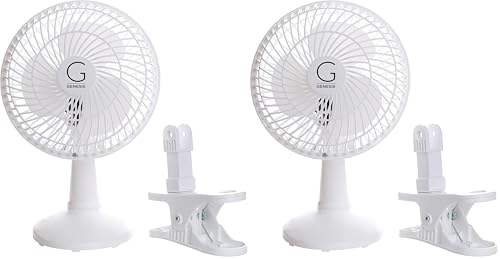
Genesis 5-Inch Clip Convertible Fan
A clip mount lets this fan attach to a desk edge, shelf or headboard instead of taking up surface space. Its 5 inch blade keeps total weight low enough to move between rooms in seconds. Two speeds cover a light breeze or stronger airflow at close range.
Pros
- Clip mount frees up desk space entirely
- Small size fits dorms, cribs or workbenches
- Few parts keep the design simple and durable
Cons
- Airflow trails full-size desk fans
- Clip grip loosens on thicker edges over time

OPOLAR Rechargeable Battery Operated Desk Fan
OPOLAR built this fan around a rechargeable battery for patios, campsites or a laptop bag away from an outlet. USB charging works from a power bank, laptop or wall adapter. Three speeds balance runtime against airflow strength.
Pros
- Runs cordless for hours away from an outlet
- Recharges from any USB power source
- Packs small enough to travel in a bag
Cons
- Airflow trails corded desk fans
- Battery capacity fades with age like any rechargeable

Dreo Desk Fan with Remote
Dreo pairs a DC motor with a remote and touch panel, adjusting speed and oscillation from a desk chair. Auto oscillation sweeps air across a wider area than fixed-head fans. Multiple speed steps allow finer adjustment than typical 3-speed models.
Pros
- Remote adjusts speed without reaching the unit
- Auto oscillation covers more of a room than fixed fans
- DC motor runs quieter than AC fans at low speeds
Cons
- Costs more than basic 3-speed desk fans
- Small remote is easy to misplace
How they stack up
| # | Model | Speed settings | Best for | Score | Price |
|---|---|---|---|---|---|
| 1 | Honeywell TurboForce Power Fan HT-908 | 3 | Best overall | 9.4 | Check price |
| 2 | Rowenta Turbo Silence Extreme VU2531 | 4 | Best quiet | 9.1 | Check price |
| 3 | Lasko 3-Speed Desktop Wind Machine Fan U12104 | 3 | Best for airflow and larger desks | 8.9 | Check price |
| 4 | Amazon Basics 3-Speed Small Room Air Circulator Fan | 3 | Best value | 8.6 | Check price |
| 5 | Genesis 5-Inch Clip Convertible Fan | 2 | Best budget | 8.4 | Check price |
| 6 | OPOLAR Rechargeable Battery Operated Desk Fan | 3 | Best compact and USB-powered | 8.2 | Check price |
| 7 | Dreo Desk Fan with Remote | Multiple speed steps via touch panel or remote | Best with remote and oscillation | 8.0 | Check price |
Good to know
How many watts does a desk fan use?
Most desk fans draw between 15 and 45 watts on their highest speed, well under a box fan or air conditioner. Running one overnight costs very little on a standard electricity rate. Battery-powered models draw even less, since a small rechargeable cell caps total output.
What size desk fan works best for a small desk?
A 5 to 7 inch blade suits a laptop cart or small desk without crowding the workspace. Clip-mounted fans free up surface area entirely by attaching to an edge or shelf. Larger 9 to 11 inch fans work better on wide desks where air needs to reach farther.
Can a desk fan cool down a whole room?
A desk fan moves air rather than lowering room temperature, unlike an air conditioner. It creates a wind-chill effect that makes skin feel cooler as sweat evaporates faster. For an entire room, a larger circulator or tower fan covers more area than a desk model.
Is a USB or battery desk fan as powerful as a corded one?
Battery and USB-powered fans generally move less air than corded models, since their motors run on lower voltage. They trade some strength for portability, which suits travel, patios or spots without a nearby outlet. A corded fan performs better for maximum airflow on a fixed desk.
Which desk fan is quietest for sleeping or office use?
Fans built around DC motors, or marketed specifically for quiet operation like the Rowenta Turbo Silence Extreme, run with less audible hum at low speeds. Oscillating models can add slight mechanical noise from the sweep motor. Testing the lowest speed setting gives the clearest sense of real-world noise.
Do desk fans use a lot of electricity?
Desk fans use far less electricity than heating or cooling appliances, typically under 50 watts even on high speed. Leaving one running for eight hours costs a small fraction of what a space heater or air conditioner would use. Battery models add no direct electricity cost between charges.
What is the difference between a desk fan and a tower fan?
A desk fan sits on a flat surface and blows air from a compact head, aimed at one person or a small area. A tower fan stands upright, oscillates over a wider angle, and typically covers more of a room. Desk fans suit personal cooling; tower fans suit whole-room airflow.
Can you leave a desk fan on overnight?
Most corded desk fans carry a continuous-use rating, including overnight operation, according to their listings. Keeping the fan clear of bedding, curtains and clutter reduces any fire risk from a blocked motor. Battery-powered models run until the charge depletes, then shut off on their own.
Desk fan vs clip fan: which fits a small desk better?
A clip fan mounts to an edge or shelf and frees up the entire desk surface. A standalone desk fan needs footprint space but usually moves more air per speed setting. Dorms, cribs and workbenches favor clip mounts, while a wider desk favors a standalone model.
Final word
Honeywell’s TurboForce HT-908 remains the strongest all-around pick for real airflow without paying for extra features. Shared offices and bedrooms call for the Rowenta Turbo Silence Extreme instead, since its low-noise motor outweighs raw power in those settings. Anyone working away from an outlet, on a patio or in a dorm, should skip corded options entirely and grab the OPOLAR rechargeable model.
Dana Whitfield
Dana spent eight years buying and merchandising for a regional kitchenware retailer before moving into editorial work. She has handled thousands of SKUs across cookware, small appliances and kitchen organization, and focuses on the practical differences that matter once a product is actually in daily use.

