9 Crossbows Worth Comparing for Draw Weight and Accuracy
TenPoint’s Turbo M1 leads for accuracy, pairing a narrow cocked width with a crisp trigger and reliable ACUdraw cocking. The Barnett Whitetail Hunter STR delivers the most complete package for treestand hunters on a budget, while the CenterPoint Sniper 370 remains a sensible, affordable start for first time shooters.
TenPoint’s Turbo M1 stands out as the strongest all round pick, thanks to a trigger and cocked width built for accuracy rather than a headline speed number. The Barnett Whitetail Hunter STR wins on value, and the CenterPoint Sniper 370 covers hunters buying their first bow.
Marketing leans hard on feet per second, yet trigger quality, cocked width and cocking consistency decide most clean shots. We compared published speed and draw weight figures, cocked axle widths, cocking mechanisms and package contents, then weighed those specifications against what owners report about noise, string life and scope quality.
Before you buy
Does crossbow speed matter more than kinetic energy? Feet per second dominates the marketing copy, yet it tells only part of the story. Kinetic energy comes from both arrow speed and arrow weight, so a heavier bolt from a moderate speed bow can penetrate as well as a light bolt from a faster one. Local game laws sometimes set a minimum draw weight, so check regulations before comparing models. Group size and shot placement still matter more than a headline speed figure.
How much does cocked width matter for blind hunting? Reverse cam and HeliCoil designs cock down to single digit widths, which opens up tight ground blinds and cramped treestands. Older forward draw bows can measure twice that width once cocked, and a limb catching a blind window ruins a shot at the worst moment. Hunters who work confined spaces should treat cocked axle to axle width as an early filter, not an afterthought. Wider bows still perform fine from open stands or fields.
Which crossbow cocking system fits your strength and joints? Rope cocking a 200 pound draw weight gets harder every cold morning, and inconsistent technique produces unexplained flyers downrange. Integrated crank and sled systems remove that variability, which explains their presence on most premium models. Shoulder or back limitations make the cocking mechanism a higher priority than trigger feel or speed. Testing the motion in a store, when possible, beats guessing from a spec sheet.
What extra costs come with a ready to hunt crossbow package? Bundled scopes and starter arrow sets get hunters shooting quickly, but the included optic is usually the weakest part of the package. Budget for a better scope, a broadhead set and a padded case within the first season of ownership. Strings and cables count as consumables, and manufacturers typically recommend replacement every few hundred shots. Regular waxing remains the cheapest maintenance step and extends string life considerably.
Our top picks

TenPoint Turbo M1
TenPoint’s reverse cam design keeps the Turbo M1 narrow once cocked, and that geometry also smooths the draw cycle. Trigger pull stays crisp for the category, which shows up directly in group size. ACUdraw cocking comes standard, and owners report it lets shooters who cannot rope cock heavy draw weights fire consistent shots.
Pros
- Crisp trigger supports tight, repeatable groups
- Narrow cocked width fits tight blinds and stands
- Quiet report for a bow at this speed
Cons
- Costs more than package style crossbows
- Parts and service stay brand specific

Barnett Whitetail Hunter STR
Barnett bundles the Whitetail Hunter STR with a scope, quiver, arrows and rope cocker, so new hunters skip the extra shopping trip. A step through riser lowers the cocking effort for smaller framed shooters. Owners report solid groups at typical whitetail ranges once the included scope gets a proper sight in.
Pros
- Full hunting package included in one box
- TriggerTech release performs above its price
- Step through riser eases the cocking motion
Cons
- Included scope calls for an eventual upgrade
- Report is louder than reverse cam competitors

CenterPoint Sniper 370
CenterPoint built the Sniper 370 as a first crossbow, pairing usable speed with a complete accessory set at a low outlay. Its adjustable stock and forearm let one bow fit several household shooters. Stock strings need regular waxing and eventual replacement, and owners report that upkeep is normal at this price point.
Pros
- Lowest entry cost with a full accessory set
- Adjustable length of pull suits multiple shooters
- Respectable speed relative to the price
Cons
- Heavier and wider than compact modern bows
- Factory strings are the first upgrade most buyers make

Ravin R10X
Ravin’s HeliCoil cam pulls the R10X down to a single digit cocked width while keeping the string path straight, which underpins its accuracy reputation. A built in cocking mechanism replaces a separate rope or crank tool. Arrows and nocks stay proprietary to the brand, and that raises long term running costs.
Pros
- Cocked width fits the tightest blinds and stands
- Straight string path supports long range accuracy
- Built in cocking stays smooth and repeatable
Cons
- Requires Ravin specific arrows and nocks
- Service typically routes back through the brand
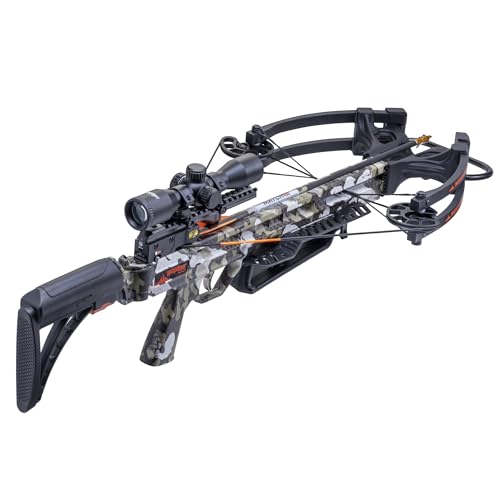
Wicked Ridge Invader 400
Wicked Ridge operates as TenPoint’s value line, and the Invader 400 carries over the same emphasis on low effort cocking. It reaches 400 feet per second while staying manageable in overall weight. Hunters with shoulder limitations often choose it, and owners report current generation speed without a difficult draw.
Pros
- Cocking effort stays low for its draw weight
- 400 feet per second speed at a mid tier price
- TenPoint parts and service network backs it
Cons
- Wider cocked profile than flagship compact models
- Finish quality trails the premium TenPoint line

Killer Instinct Boss 405
Killer Instinct pushes the Boss 405 toward high arrow speed while including a lighted scope, quiver and rope cocker in the package. Extra mass over premium bows helps steady the shot from a rest. Owners report noticeably more delivered energy than entry level bows, which matters when hunting larger game.
Pros
- High speed for a mid range price bracket
- Lighted scope included at no extra cost
- Adjustable comb and stock improve fit
Cons
- Adds weight on long carries into the field
- Louder report than reverse draw designs

Excalibur Micro 340 TD
Excalibur relies on recurve limbs, so the Micro 340 TD has no cams or cables to fail. A take down frame splits the bow in half, which fits it into a pack or a small aircraft hold. Owners report it shoots slower and louder than comparable compounds, and most accept that trade off for easier field repairs.
Pros
- Simple mechanism leaves little to break down
- Take down frame suits backcountry transport
- String swaps work in the field without a press
Cons
- Higher draw weight makes cocking more demanding
- Strung limbs sit wider than compound designs
Compared at a glance
| # | Model | Arrow speed | Best for | Score | Price |
|---|---|---|---|---|---|
| 1 | TenPoint Turbo M1 | About 380 feet per second | Best overall | 9.4 | Check price |
| 2 | Barnett Whitetail Hunter STR | About 375 feet per second | Best value | 9.2 | Check price |
| 3 | CenterPoint Sniper 370 | About 370 feet per second | Best budget | 9.0 | Check price |
| 4 | Ravin R10X | About 400 feet per second | Best for compact width | 8.8 | Check price |
| 5 | Wicked Ridge Invader 400 | About 400 feet per second | Best for easy cocking | 8.6 | Check price |
| 6 | Killer Instinct Boss 405 | About 405 feet per second | Best for speed per dollar | 8.3 | Check price |
| 7 | Excalibur Micro 340 TD | Recurve, take down frame | Best for simplicity and travel | 8.0 | Check price |
Questions worth asking
How far can a crossbow shoot accurately?
Most hunters keep shots inside forty yards despite what range testing suggests is possible. Wind drift, arrow drop and animal movement all reduce reliability at longer field distances, even from bows capable of tight groups on paper.
Is a crank cocking device worth buying?
Not for every shooter, but it delivers consistent cocking tension, which improves accuracy and reduces fatigue. Anyone shooting a heavy draw weight regularly, or hunting cold mornings in gloves, tends to notice the difference fastest.
How often should crossbow strings get replaced?
Manufacturers commonly suggest replacement every few hundred shots or every couple of seasons, whichever arrives first. Waxing the string regularly and checking the serving for fraying can extend that interval well beyond the minimum.
Are recurve crossbows better than compound crossbows?
Recurve designs stay simpler and easier to service, since many strings swap out without a bow press. Compound models shoot faster and cock narrower at the same draw weight, so most hunters pick compound unless field repair is the priority.
Can you dry fire a crossbow without damage?
No. Firing without an arrow loaded risks serious damage to the limbs and rail, plus injury to the shooter. Use a discharge bolt or a target whenever a cocked crossbow needs to be unloaded.
What arrows work with a specific crossbow model?
Match the arrow weight, length and nock type the manufacturer specifies for that model. Ravin bows, for example, require proprietary nocks, and mismatched nocks cause a large share of reported damage.
Does an illuminated scope actually help while hunting?
In low light around dawn and dusk, an illuminated reticle makes the aiming point easier to see against a dark colored animal. That benefit only holds if the glass itself resolves detail well, since a bright reticle cannot fix a dim, low contrast image.
How should a crossbow be stored between hunting seasons?
Uncock the bow, wax the string and store it in a case away from temperature swings and humidity. Check limb bolts and the rail before the next season starts, and never leave a crossbow stored while cocked.
What is the difference between cocked and uncocked axle to axle width?
Uncocked width describes the limbs at rest, while cocked width, the smaller figure, matters for blinds and tight stands. Compact reverse cam bows can measure roughly six to nine inches cocked, versus wider forward draw models.
Our take
TenPoint’s Turbo M1 earns the top spot because its trigger, cocked width and cocking system all serve accuracy rather than a headline speed figure. Budget conscious hunters get a more complete outfit from the Barnett Whitetail Hunter STR, while first time buyers are well covered by the CenterPoint Sniper 370. Decide how you hunt and how you will cock the bow first, then let speed figures settle any remaining tie.
Sierra Daniels
Sierra's background is in landscape design and nursery retail. She focuses on lawn and garden equipment, outdoor furniture and gear durability, weighing published specs against how materials actually hold up outside.