Jump starters that crank diesels in a busy shop
NOCO Boost Pro GB150 leads at 4250 peak amps, with a stated rating for 10 litre gas and 10 litre diesel engines. Clore Automotive Jump-N-Carry JNC660 suits shops that jump cars daily. HULKMAN Alpha 85 packs the most capability into a tool cart drawer.
NOCO Boost Pro GB150 answers most working mechanics. One pack covers a 1.0 litre city car and a 10 litre diesel, and a 2250 lumen light replaces a torch under the bonnet. Roughly 7 pounds of weight rules out glovebox storage.
Peak amp figures get quoted loudly, yet clamp contact and cable gauge decide how much current reaches the post. We compared manufacturer engine-size ratings, cable length and gauge, clamp jaw construction, battery chemistry and recharge input. Owner reports on cold cranking, self-discharge during storage and clamp wear shaped the order.
What we recommend
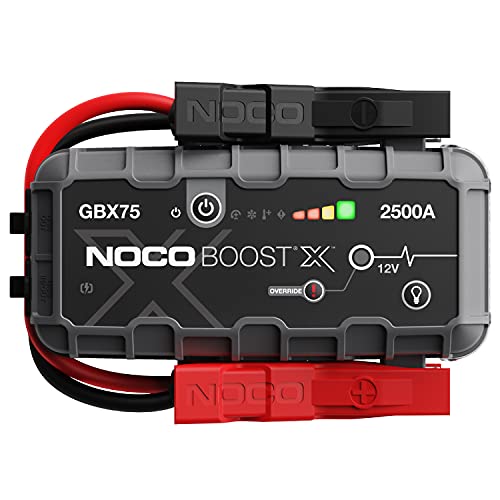
NOCO Boost Pro GB150
NOCO rates this pack for gas and diesel engines up to 10 litres, which covers nearly everything rolling into a general repair bay. Spark-proof clamps and reverse polarity protection let an apprentice connect it without frying a fuse box. Seven light modes, topping out at 2250 lumens, cover night roadside work.
Pros
- Starts large diesels without a second pack
- Spark-proof clamps tolerate a wrong-way connection
- Doubles as a power bank and shop light
Cons
- Around 7 pounds, too bulky for a glovebox
- Full recharge takes several hours
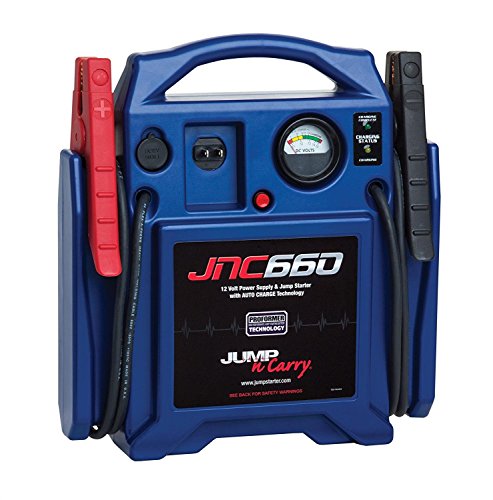
Clore Automotive Jump-N-Carry JNC660
Sealed AGM chemistry sits behind this one instead of lithium, so it can live on a float charger in a cold bay for months. Cables run 46 inches, long enough to reach a boot-mounted battery without pushing the car. Clore quotes 425 cranking amps, a sustained figure rather than a surge number.
Pros
- Long cables reach boot and under-seat batteries
- AGM chemistry shrugs off cold storage
- Industrial clamp teeth bite through terminal corrosion
Cons
- Around 18 pounds, awkward to carry far
- No USB ports or power bank function

HULKMAN Alpha 85
A 20000 mAh lithium pack drives 2000 peak amps, covering gas engines to 8.5 litres and diesels to 6 litres. An LCD reports charge level and clamp status, so you know the connection is good before turning the key. USB-C Power Delivery at 60 watts refills it between jobs and tops up a laptop on the way.
Pros
- LCD shows state of charge and connection status
- Refills fast over 60 watt USB-C
- Fits a tool cart drawer or door bin
Cons
- Diesel rating stops at 6 litres
- Cables are shorter than a wheeled shop unit
NOCO Boost X GBX155
Same 4250 peak amp class as the GB150, with 65 watt USB-C input and output added. Refilling takes roughly an hour, which matters when a van does five calls a day. Diesel coverage stops at 8 litres, one step behind the GB150.
Pros
- Recharges in about an hour from a van inverter
- IP65 sealing suits wet roadside call-outs
- Runs laptops and phones at 65 watts
Cons
- Diesel rating trails the GB150
- Lithium output falls in deep cold

DEWALT DXAEJ14 Jump Starter
Two roadside problems get one case here: 1400 peak amps for a flat battery and a 120 PSI compressor for a soft tyre. Instant amps sit at 700, enough for four and six cylinder petrol engines. Sealed lead acid cells need a top-up every month or two whether the unit gets used or not.
Pros
- Compressor inflates tyres, balls and air mattresses
- Thick cables and heavy clamp jaws
- Switch operation with no app pairing
Cons
- Lead acid pack self-discharges in storage
- 1400 peak amps falls short on big diesels

GOOLOO GT4000S Jump Starter
GOOLOO quotes 4000 peak amps and rates the unit to 10 litre gas and 8 litre diesel engines. Its 26800 mAh cell also feeds two USB outputs and a 12V socket, so it works as a site power bank. Clamp jaws are lighter than the NOCO and Clore units, and owners report slipping on corroded posts.
Pros
- High amp rating for a low outlay
- 26800 mAh runs phones and lights all day
- Carry case and cables come in the box
Cons
- Clamp jaws grip poorly on corroded terminals
- Case and cable insulation feel light next to pro units
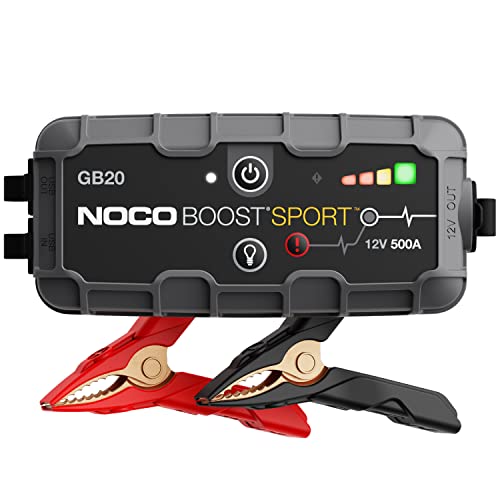
NOCO Boost Plus GB40
At 1000 peak amps, coverage runs to 6 litre gas engines and 3 litre diesels. IP65 sealing and a rubberised shell let it sit in a door pocket through summer heat and winter damp. Treat it as a personal backup, not the pack that lives on the shop wall.
Pros
- Slips into a glovebox or door pocket
- Carries the same spark-proof clamp safety as bigger NOCO packs
- Holds charge for months between uses
Cons
- Too small for most diesel work
- Short cables force the bonnet fully open
The lineup, side by side
| # | Model | Peak amps | Best for | Score | Price |
|---|---|---|---|---|---|
| 1 | NOCO Boost Pro GB150 | 4250 | Best overall | 9.4 | Check price |
| 2 | Clore Automotive Jump-N-Carry JNC660 | 1700 | Best for daily shop use | 9.2 | Check price |
| 3 | HULKMAN Alpha 85 | 2000 | Best value | 9.0 | Check price |
| 4 | NOCO Boost X GBX155 | 4250 | Best for fast recharge | 8.8 | Check price |
| 5 | DEWALT DXAEJ14 Jump Starter | 1400 | Best with a built-in compressor | 8.6 | Check price |
| 6 | GOOLOO GT4000S Jump Starter | 4000 | Best budget high-amp pack | 8.3 | Check price |
| 7 | NOCO Boost Plus GB40 | 1000 | Best glovebox backup | 8.0 | Check price |
What to look for
What to look for in a jump starter for shop work Start with the engine-size rating, not the headline amp figure. Manufacturers state litres for gas and diesel separately because compression ratios differ. Cable gauge comes next, since thin leads drop voltage before current reaches the terminal. Clamp jaws decide the rest: corroded posts need teeth that cut through oxide rather than rest on it. Reverse polarity and spark protection belong on any pack several people will share.
Peak amps vs cranking amps Peak amps describe a momentary surge measured under lab conditions, and no two brands measure it identically. Cranking amps describe sustained current at a stated temperature, which is closer to what a starter motor actually draws. Clore quotes 425 cranking amps on the JNC660 for that reason, while lithium packs usually publish only a peak number. Treat a 4000 peak amp claim from a budget brand as a ceiling, not a working figure.
Lithium packs vs AGM shop units Weight and USB features favour lithium; tolerance favours AGM. Sealed lead acid handles float charging and near-freezing bays predictably, which is why the JNC660 still cranks after a winter on the wall. Lithium cells lose output below freezing and need a top-up every few months in storage. Many shops run both: an AGM unit parked by the lift, and a lithium pack such as the Alpha 85 in the service truck.
Best for mobile mechanics and roadside calls Recharge speed decides how many calls a pack covers. Boost X GBX155 refills in roughly an hour over 65 watt USB-C, so a van inverter can revive it between jobs. DEWALT takes the other route, bundling a 120 PSI compressor so one case handles flat batteries and soft tyres. Anyone who only needs cover for their own car should stop at the GB40 and skip the weight. Avoid the GOOLOO if your work involves older vehicles with crusty battery posts.
Common questions
How many amps do I need to jump start a diesel?
Rated engine size answers this better than a peak figure. Diesels above 6 litres want a pack that states a matching diesel litre rating, such as the 10 litre figure on the NOCO Boost Pro GB150.
Which jump starter is best for a busy repair shop?
Clore Automotive Jump-N-Carry JNC660 fits shop life. AGM chemistry tolerates constant float charging, and 46 inch cables reach batteries mounted in boots or under seats.
Do lithium jump starters work in cold weather?
They work, but output drops as temperature falls. Owners report weaker cranking below freezing. Storing the pack indoors overnight, or keeping an AGM unit for winter, avoids the problem.
Can a jump starter damage my car’s electronics?
Not with reverse polarity and spark protection, which NOCO builds into the GB150, GBX155 and GB40. Unprotected clamps connected backwards can take out fuses or an ECU.
What is the difference between peak amps and cranking amps?
Peak amps measure a brief surge. Cranking amps measure sustained current at a set temperature, closer to real starter draw. Clore publishes 425 cranking amps on the JNC660 alongside its 1700 peak figure.
Is a jump starter with an air compressor worth it?
For roadside and fleet work, yes. DEWALT DXAEJ14 runs a 120 PSI compressor from the same battery, saving a second tool in the boot. Inside a shop with a wall air line, it adds only weight.
How often should a jump starter be recharged in storage?
Lithium packs such as the HULKMAN Alpha 85 hold charge well, so a top-up every three months is enough. Sealed lead acid units like the DEWALT DXAEJ14 want charging more often than that.
Can a small jump starter start a truck?
Rarely. A 1000 peak amp unit like the GB40 tops out near a 6 litre gas engine. Light trucks running large diesels need a 4000 amp class lithium pack or an AGM shop unit.
Do jump starter cables need to be long?
Length decides whether you move the car. Batteries under a seat, in a boot or behind a wheel arch need the 46 inch reach of the JNC660. Compact lithium packs usually offer about half that, which works fine on engine-bay terminals.
NOCO GB150 vs GBX155: which should a mechanic buy?
Both sit in the 4250 peak amp class. GB150 covers diesels to 10 litres and adds a 2250 lumen light, so it suits a fixed bay. GBX155 recharges in roughly an hour over USB-C, which matters more in a service van.
Our take
Buy the NOCO Boost Pro GB150 if one pack has to cover small petrol cars and 10 litre diesels, and if several technicians will share it. Shops jumping cars all day are better off with the Clore Automotive Jump-N-Carry JNC660, because AGM chemistry and 46 inch cables outlast lithium in that duty. Mobile techs should take the NOCO Boost X GBX155 and its hour-long recharge instead.
Tony Russo
Tony trained as an automotive technician and spent years in service and parts retail before moving into writing. He focuses on garage tools, car care products and accessories from a hands-on maintenance perspective.

