Which digital jump starters suit a working mechanic
NOCO Boost X GBX155 wins the bench slot with 4250 peak amps, a backlit charge readout and 60W USB-C recharging. HULKMAN Alpha85 offers a sharper LCD at 2000 amps. Van based techs should take the DEWALT DXAEPS14, which folds in a 120 PSI compressor and an alternator check.
NOCO Boost X GBX155 belongs on the bench in a general repair bay. Its 4250 amp peak covers gas engines to 10 litres and diesels to 8 litres. A backlit panel names the fault instead of blinking an LED code at you. Bulk is the cost, since this pack no longer hides in a glovebox.
Peak amp figures sell packs and explain almost nothing about cranking a cold diesel. We compared published engine limits, screen contents, clamp jaw construction, cable length and recharge routes. Owner reports filled the remaining gaps on freezing weather behaviour and charge retention after months in a toolbox.
The shortlist, ranked
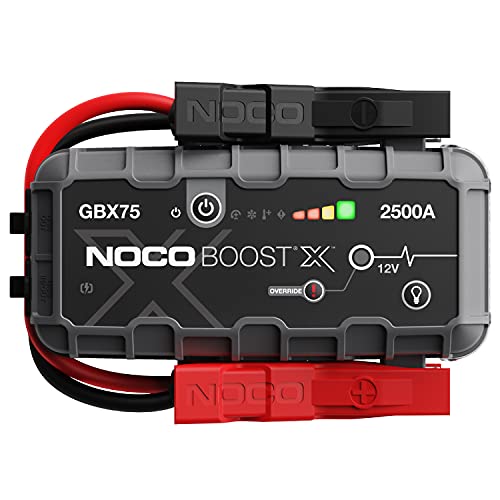
NOCO Boost X GBX155
Gas engines to 10 litres and diesels to 8 litres sit inside the rated range, which covers nearly every vehicle a general bay sees. USB-C Power Delivery at 60 watts runs both directions, refilling the pack quickly and charging a laptop between jobs. Backlit status text replaces guesswork, reporting internal charge and whether the clamps have a live connection.
Pros
- Rated for large gas and diesel engines
- Refills through USB-C rather than a proprietary brick
- Screen names charge state and clamp connection faults
Cons
- Case is far too thick for a glovebox
- Carries more weight than the 2000 amp class

HULKMAN Alpha85
A full LCD sits on the top face, reading out charge percentage, pack temperature and boost status together. Output of 2000 amps covers gas to 8.5 litres and diesel to 6 litres, spanning most cars, vans and half ton pickups. Charge retention holds up across weeks of toolbox storage, so it stays usable as an occasional backup.
Pros
- Reads out an exact percentage instead of four bars
- Strong output relative to its size and mass
- Holds charge through long storage gaps
Cons
- Diesel ceiling stops short of one ton trucks
- Recharging runs slower than USB-C PD rivals

DEWALT DXAEPS14
Think rolling power station rather than pocket pack. A 120 PSI compressor with a digital gauge handles low tyres on site, while the onboard readout checks battery voltage and alternator output. Sealed AGM chemistry brings real weight, so this one lives in the van and stays there.
Pros
- Compressor and jump pack share one chassis
- Voltage and alternator checks run from the panel
- AGM cells tolerate cold overnight storage in a van
Cons
- Far heavier than every lithium pack listed here
- Needs periodic top up charging to protect the AGM

GOOLOO GT4000S
Four thousand peak amps covers gas to 10 litres and diesel to 8 litres. Cell capacity is the real story, since several starts come from a single charge. That matters on a used car lot where a whole row sits flat on a Monday. Reverse polarity appears on the LCD before the clamps ever draw current.
Pros
- Several starts between recharges
- Reverse polarity flagged on screen, not just by a buzzer
- Doubles as a high capacity power bank on site
Cons
- Clamp jaws feel lighter than shop grade units
- Case footprint eats a full toolbox drawer
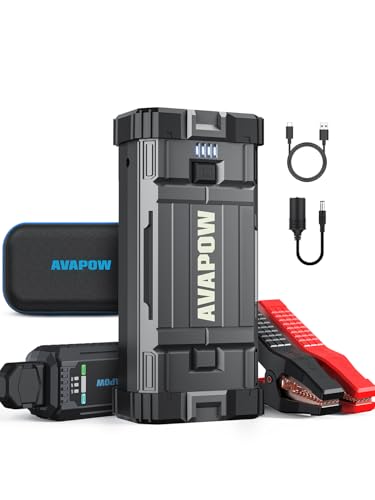
AVAPOW A58
AVAPOW publishes 6000 peak amps, the biggest figure in this group, aimed at heavy diesel pickups and yard equipment. Fault codes and charge state appear on its LCD, which shortens roadside diagnosis. Read that headline number as a momentary surge, then judge the unit on its published engine limits instead.
Pros
- Output headroom for heavy diesel cranking
- Fault codes speed up roadside diagnosis
- Work light covers night call outs
Cons
- Peak rating is not a cranking amp figure
- Heavier than mid size lithium packs
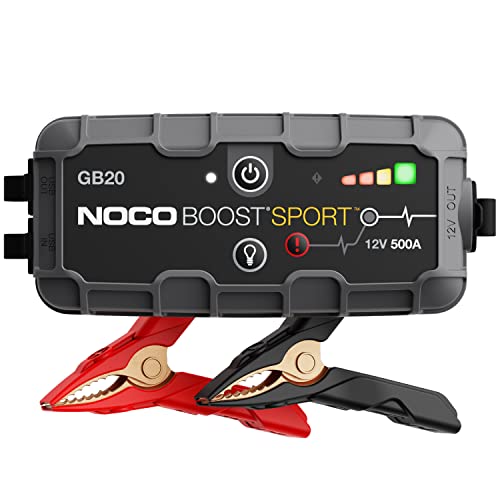
NOCO Boost Plus GB40
Roughly 2.4 pounds means this pack actually stays in the car. Gas engines to 6 litres and diesels to 3 litres fall inside its range, which covers commuters and small vans but not pickups. Charge shows through LED segments, so no number appears before a start attempt.
Pros
- Small enough for a glovebox or door pocket
- Spark proof clamps with reverse polarity protection
- 400 lumen light handles night roadside work
Cons
- LED segments only, with no numeric charge readout
- 3 litre diesel limit rules out most pickups
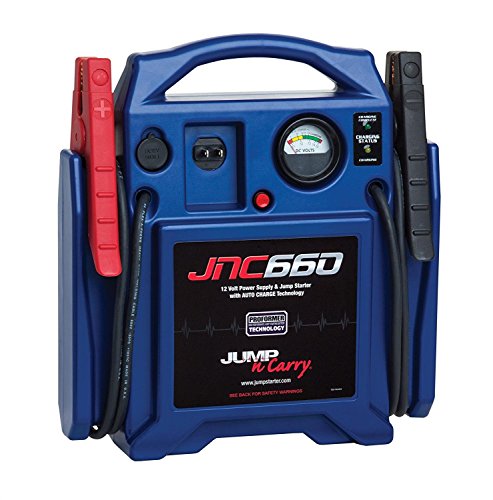
Clore Automotive Jump-N-Carry JNC660
Shops keep buying the JNC660 because its format survives constant cycling: heavy clamps, 46 inch cables and a Clore PROFORMER lead acid battery. Cranking amps are published at 425, with 1700 peak, so the useful number sits right on the label. No screen exists beyond a charge indicator, which means voltage checks need a separate meter.
Pros
- Cables reach across a wide engine bay
- Publishes cranking amps, not only a peak surge
- Built for repeated daily deep cycling
Cons
- No digital voltage or percentage display
- Lead acid pack needs maintenance charging
How they compare
| # | Model | Peak amps | Best for | Score | Price |
|---|---|---|---|---|---|
| 1 | NOCO Boost X GBX155 | 4250 | Best overall | 9.4 | Check price |
| 2 | HULKMAN Alpha85 | 2000 | Best value | 9.2 | Check price |
| 3 | DEWALT DXAEPS14 | 1400 | Best for mobile mechanics | 9.0 | Check price |
| 4 | GOOLOO GT4000S | 4000 | Best for repeated starts | 8.8 | Check price |
| 5 | AVAPOW A58 | 6000 | Best for large diesels | 8.6 | Check price |
| 6 | NOCO Boost Plus GB40 | 1000 | Best compact backup | 8.3 | Check price |
| 7 | Clore Automotive Jump-N-Carry JNC660 | 1700 | Best for daily shop use | 8.0 | Check price |
Before you buy
What peak amps and cranking amps actually mean Peak amps describe a surge lasting milliseconds. Cranking amps describe sustained current, and that is what spins a starter motor. Most lithium packs publish only the peak, so the manufacturer’s engine size limit becomes the honest comparison. Two packs advertising 4000 amps can list very different diesel ceilings. Read those ceilings first and treat the box number as marketing.
What a useful display should show Charge percentage is the floor, and bar style LEDs are the weakest version of it. Better panels add pack temperature, a reverse polarity warning and a boost prompt for batteries sitting below detection voltage. DEWALT goes furthest on the DXAEPS14, reporting battery voltage and alternator output. That saves a walk back to the van for a multimeter on a driveway call.
Matching output to the engines in your bay Commuter cars and hybrids are served by the 1000 amp class, where the GB40 sits. Mixed bays seeing V8s and light diesels want 2000 amps or more. Heavy diesel pickups justify the 4000 amp class, since a cold 6.7 litre pulls far more current than displacement suggests. Buying well above your real workload just adds weight you carry every day for nothing.
Cold weather, clamp bite and storage habits Lithium output sags below freezing, exactly when flat batteries multiply. Store packs indoors overnight through winter. Jaw design matters as much as amperage, because a weak bite on a corroded post wastes current before it reaches the battery. Recharge lithium units every three months even when unused. Lead acid workhorses like the JNC660 belong on a maintenance charger between jobs.
Questions worth asking
What size jump starter does a mechanic need?
Mixed car and light truck work is covered by 2000 peak amps. Bays that regularly start large diesels should move up to the 4000 amp class instead.
Is a digital display on a jump starter worth it?
Yes, mainly because it prevents failed attempts. Knowing the pack reads 40 percent changes your plan, and fault warnings catch reversed clamps before sparks appear.
Lithium vs lead acid jump starters: which lasts longer in a shop?
Lead acid units such as the JNC660 handle constant daily cycling better and publish a cranking amp rating. Lithium wins on weight, recharge speed and storage life.
Can a jump starter damage a car battery or ECU?
Normal use is safe, since modern packs include reverse polarity and overcurrent protection. Boost and override modes bypass some of that, so save them for batteries too flat to detect.
How often should a jump starter be recharged?
Lithium packs sitting in storage want a top up every three months. Lead acid units should stay on a maintenance charger whenever they are not in use.
Which jump starters can start a diesel engine?
Check the published diesel limit rather than the peak figure. NOCO GBX155 and GOOLOO GT4000S both list diesels up to 8 litres, while the GB40 stops at 3 litres.
Do jump starters work in freezing weather?
They work, though usable capacity drops as temperature falls. Warming the pack before use and starting from a full charge both make a measurable difference.
What does a built in air compressor add?
It handles a soft tyre on the same call out, which suits roadside and mobile work. Weight is the trade, because compressor units are built around a heavier battery.
How many starts should one charge deliver?
Large capacity packs such as the GT4000S manage a run of starts before needing power. Compact 1000 amp units are better treated as a one or two start backup.
Our pick
NOCO Boost X GBX155 earns the bench slot, because its engine ceiling covers nearly everything a general bay sees and USB-C keeps it topped up between jobs. Mobile technicians get more from the DEWALT DXAEPS14, since a compressor and an alternator check solve two extra roadside problems on one visit. Shops doing twenty starts a week should still keep a JNC660 on the cart for that constant cycling.
Tony Russo
Tony trained as an automotive technician and spent years in service and parts retail before moving into writing. He focuses on garage tools, car care products and accessories from a hands-on maintenance perspective.

