Which Compost Bin Fits Your Kitchen or Backyard Setup?
FCMP’s Outdoor IM4000 dual chamber tumbler wins overall, since one side finishes while the other fills. Bulk garden waste goes cheapest into the expandable Geobin. Indoors, the OXO Good Grips Easy-Clean Compost Bin collects kitchen scraps without smell or scrubbing.
For most households the FCMP Outdoor IM4000 is the right composter. Its two chambers let a finished batch cure while fresh scraps fill the other side. Gardeners drowning in leaves and clippings should buy the expandable Geobin instead, and every setup needs an indoor caddy like the OXO Good Grips.
Composters resist comparison because tumblers, static bins, and insulated towers are judged on different terms, and listed capacities rarely match usable volume. We compared published specifications and materials, then weighed owner reports on turning effort, drainage, rodent problems, and how quickly each design stalls once temperatures drop.
The shortlist, ranked

FCMP Outdoor IM4000 Tumbling Composter
Two chambers set the IM4000 apart. One batch finishes undisturbed while daily scraps fill the other side, so compost flows continuously instead of in stop start cycles. Deep internal fins break clumps apart with each rotation, a job single drums often fail at. Owners report finished compost in weeks when greens and browns stay balanced.
Pros
- Continuous output from alternating chambers
- Sealed drum locks rodents out
- Rotating replaces fork turning entirely
Cons
- Assembly involves dozens of small screws
- Full chambers take real effort to rotate
Miracle-Gro Dual Chamber Compost Tumbler
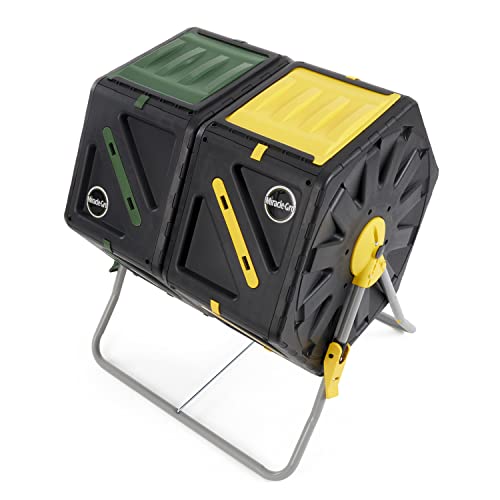
Patio composting is this tumbler’s niche. Dual chambers survive the shrink to a 27.7 gallon footprint that fits a side return or balcony corner. Sliding doors open with one hand, easier than the clip lids on several rivals. Batch sizes run smaller than full size drums, the trade for the compact frame.
Pros
- Footprint small enough for a patio
- One handed sliding door access
- Powder coated steel frame resists rust
Cons
- Batches run smaller than full size drums
- Overfilling can jam the sliding doors
Geobin Compost Bin
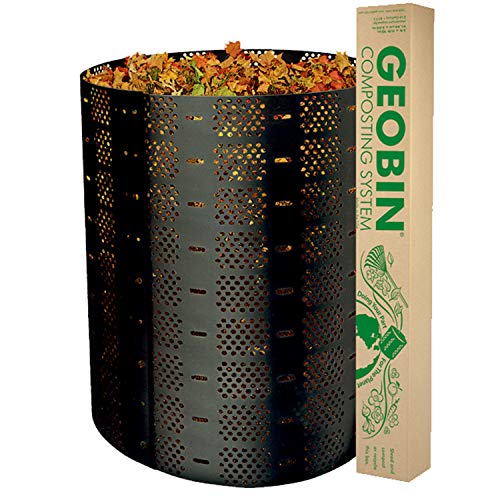
Simplicity makes the Geobin work. Unroll the perforated plastic sheet, clip it into a cylinder, and a bin holding up to 216 gallons stands ready in minutes. Diameter adjusts to match the pile, which makes autumn leaf fall manageable at almost no outlay. Turning still takes a fork, as with any open heap.
Pros
- Holds up to 216 gallons when expanded
- Adjustable diameter matches the pile
- Tool free setup in minutes
Cons
- Open base lets rodents reach food waste
- Fork turning takes real effort

VIVOSUN Outdoor Tumbling Composter
Growing season output drives this design. At 43 gallons across two chambers, it cycles more volume than most tumblers, and adjustable vents let airflow increase for a heating batch or close down when material dries too fast. Sliding doors seal well enough to keep summer flies down, owners report.
Pros
- 43 gallons across two chambers
- Adjustable vents control moisture and heat
- Doors seal tightly against flies
Cons
- Rotation gets heavy near capacity
- Assembly instructions lack detail

Envirocycle The Composter
Runoff becomes a feature here. Its drum rolls on a hollow base that captures the liquid draining from decomposing scraps, giving you compost tea for feeding container plants. Looks matter too; this is the tidiest composter in the group for a spot near a patio. Modest capacity suits kitchen waste over garden bulk.
Pros
- Collects liquid runoff as plant feed
- Clean design suits a visible spot
- Rolls on its base instead of a crank
Cons
- One chamber forces batch composting
- 35 gallons fills quickly with garden waste

Exaco Aerobin 400 Insulated Composter
Insulated double walls keep the Aerobin 400 decomposing after open bins go dormant for winter. An internal aeration lung feeds air through the pile, so turning is rarely needed. Finished material draws out through a lower hatch without disturbing fresh layers above, and a tap drains liquid tea. Moving its 113 gallon bulk is a two person job.
Pros
- Stays active through freezing weather
- Aeration core nearly eliminates turning
- Bottom hatch harvests without disturbing the pile
Cons
- Too large to relocate easily
- Small households fill it slowly

OXO Good Grips Easy-Clean Compost Bin
Indoor collection kills more composting habits than any outdoor gear, and this caddy fixes the two usual causes. Its lid flips up and stays open while you scrape a cutting board, and smooth internal walls rinse clean instead of trapping residue. Holding 0.75 gallons, it stores a couple of days of scraps for a small household.
Pros
- Smooth walls rinse clean in seconds
- Lid stays open hands free while scraping
- Fits a counter or under sink shelf
Cons
- Standard version lacks a carbon filter
- Requires emptying every few days
Compared at a glance
| # | Model | Capacity | Best for | Score | Price |
|---|---|---|---|---|---|
| 1 | FCMP Outdoor IM4000 Tumbling Composter | 37 gal total across two chambers | Best overall | 9.4 | Check price |
| 2 | Miracle-Gro Dual Chamber Compost Tumbler | 27.7 gal total | Best for small gardens | 9.2 | Check price |
| 3 | Geobin Compost Bin | Up to 216 gal expanded | Best value | 9.0 | Check price |
| 4 | VIVOSUN Outdoor Tumbling Composter | 43 gal total | Best for fast batches | 8.7 | Check price |
| 5 | Envirocycle The Composter | 35 gal drum | Best for compost tea | 8.5 | Check price |
| 6 | Exaco Aerobin 400 Insulated Composter | 113 gal | Best for cold climates | 8.2 | Check price |
| 7 | OXO Good Grips Easy-Clean Compost Bin | 0.75 gal | Best for kitchen scraps | 8.0 | Check price |
Before you buy
Should you buy a tumbler or a static compost bin? Tumblers finish faster, stay tidy, and lock out rodents, since the sealed drum turns in seconds. Static bins win on sheer volume, which decides the question if you generate lawn clippings, hedge trimmings, and autumn leaves. Many gardeners run both: a tumbler near the back door for food scraps, and an open bin down the garden for bulk material.
What is the right ratio of greens to browns? Aim for roughly two to three parts browns to one part greens by volume. Browns are carbon rich materials such as dry leaves, cardboard, and shredded paper. Greens are nitrogen rich scraps like vegetable peelings and grass clippings. A slimy, smelly pile is short of browns almost every time. A dry pile that never heats needs more greens and water.
How do you keep rodents out of a compost bin? Open based bins give rodents a way in, so keep cooked food, meat, and dairy out of static piles entirely. Sealed tumblers such as the FCMP IM4000 tolerate a wider range of scraps. Site any bin on level ground with some sun, since warmth drives decomposition. Leave room to open doors fully and park a wheelbarrow alongside.
Why is my compost pile not breaking down? Three causes explain most stalled piles: pieces too large, material too dry, or a pile too small to hold heat. Chopping inputs before they go in speeds things more than any activator. Cold weather slows everything regardless. Either insulate, accept a winter pause, or keep filling and let the pile restart in spring.
Questions worth asking
How long does compost take to be ready?
Six to eight weeks in a well balanced, regularly turned tumbler during warm weather. Static open bins usually need several months to a year, depending on turning and how finely material was chopped.
Can you compost meat and cooked food?
Not in an open bin, where they draw rodents and smell. Sealed tumblers cope with small amounts, but most guidance still excludes meat, dairy, and oily food. Bokashi fermentation handles them if needed.
Why does my compost smell bad?
Sour or ammonia smells mean too much wet green material and too little air. Mix in shredded cardboard or dry leaves and turn the pile. Odour usually clears within days.
Do compost bins work in winter?
Activity slows sharply below about 40 degrees Fahrenheit and can stop entirely. Insulated designs like the Exaco Aerobin 400 keep working longer. Keep adding through winter; the pile restarts in spring.
What size compost bin do I need?
A 30 to 40 gallon tumbler covers kitchen scraps for a small household. Lawn clippings and leaves demand hundreds of gallons, which is where an expandable bin like the Geobin fits.
Do I need a compost starter or activator?
Rarely. A handful of finished compost or garden soil supplies the same microbes. Fixing moisture and the green to brown balance revives a stalled pile more reliably.
Can a compost bin sit on concrete or paving?
Tumblers are built for it, since they stand on frames. Open bottomed bins prefer soil so worms can enter, but a seeding layer of garden soil lets them work on paving too.
How do you know when compost is finished?
Finished compost turns dark, crumbly, and earthy smelling. Original ingredients should be unrecognisable, apart from the odd twig or eggshell fragment.
Is a compost tumbler worth it?
For households composting mainly food scraps, yes. Sealed drums resist rodents, turning takes seconds, and batches can finish in under two months. Bulk garden waste still favours a high volume static bin.
Our pick
Most households should buy the FCMP Outdoor IM4000 and stop deliberating; it turns scraps into compost quickly while keeping rodents locked out. Heavy garden waste changes the answer to the Geobin, which swallows an entire autumn of leaves for minimal outlay. Whichever wins, add the OXO caddy indoors, because the kitchen stage decides whether the habit sticks.
Sierra Daniels
Sierra's background is in landscape design and nursery retail. She focuses on lawn and garden equipment, outdoor furniture and gear durability, weighing published specs against how materials actually hold up outside.