Compact wire connectors ranked by gauge and box fill
Wago 221-415 Lever-Nuts lead here. One body clamps solid, stranded and fine-strand copper from 24 to 12 AWG, and levers reopen for later fixture swaps. Wago 2273-205 push-wire connectors displace the least box volume. Ideal In-Sure suits plain solid-copper rough-in at two to eight ports.
Wago 221-415 Lever-Nuts fit almost any household junction box, which is why they lead this list. Five independent levers clamp solid, stranded and fine-strand copper without ferrules, so a ceiling fan lead and 14 AWG cable share one connector. Bulk is the trade, since five lever bodies swallow more box volume than a flat push-in part.
These parts look interchangeable at a glance. Nearly every housing prints 600 V, yet the listings diverge sharply on stranded copper, port count and reuse. We compared UL 486C listings, printed gauge ranges, strip lengths and body dimensions, then read owner reports about connectors backing out of shallow ceiling boxes.
What matters most
What to look for in a compact wire connector Read the listing before the packaging claims. A UL 486C mark plus printed voltage and current means the part was evaluated for building wiring. Gauge range comes next: 14 and 12 AWG cover most branch circuits, while 10 AWG feeders need a larger series. Clear shells earn their place by showing whether copper actually reached the contact.
Lever vs push-in vs twist-on Levers take mixed conductor types, reopen cleanly and cost the most space. Push-in bodies sit flattest and install fastest, though most are listed for solid copper alone. Spring nuts handle varying conductor counts, since one coil swallows three to six wires of matched gauge. Match the part to the wire in your hand rather than to habit.
Fitting connectors in shallow and crowded boxes Box fill is a code limit, not only a nuisance. Every connector displaces cubic inches, and five-port lever bodies displace plenty. Wago 2273 push-wire parts are the usual rescue in a pancake box already carrying two cables and a ground pigtail. Fold conductors flat and toward the back before seating the fixture.
Stranded, fine-strand and low-voltage wiring Ceiling fans and pendant lights ship with fine-strand leads. Push those into a solid-only clamp and individual strands can escape the contact. Wago 221, TICONN and Wirefy lever bodies grip fine strand directly, with no ferrule required. For 12 V tape and speaker wire down to 28 AWG, Wirefy goes thinner than the rest of this list.
The shortlist, ranked

Wago 221-415 Lever-Nuts 5-Conductor
Each of the five ports gets its own lever, so conductor types can differ inside a single connector. Copper from 24 to 12 AWG seats without a ferrule, including the fine-strand leads that arrive on light fixtures. Transparent housing shows how far each wire travelled, and side slots take a meter probe.
Pros
- Mixes solid, stranded and fine-strand in one body
- Lever reopens for a later fixture swap
- Test slots allow probing without unwiring
Cons
- Five-port body eats box volume
- Range stops at 12 AWG, so 10 AWG needs the 221-6 series

Wago 2273-205 Push Wire Connectors
Losing the levers leaves a flat body that tucks behind a fixture where a 221 will not go. Stripped solid copper pushes into a cage clamp and locks on contact. Stranded fixture leads sit outside the listing, so carry a few lever bodies alongside these.
Pros
- Flat profile helps in shallow pancake boxes
- One push per conductor, no tool needed
- Side ports accept a meter probe
Cons
- Listed for solid copper only
- Wire must be twisted back out to release
Ideal In-Sure Push-In Wire Connectors
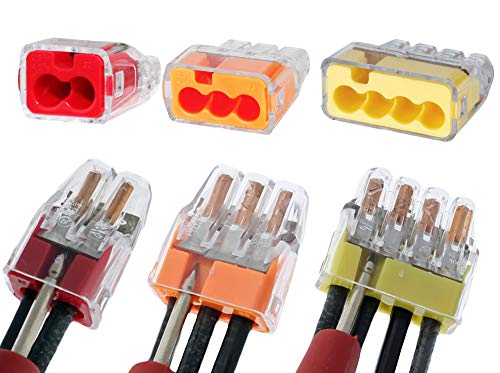
Residential rough-in runs on solid 14 and 12 AWG, which is exactly the conductor In-Sure is listed for. Port counts reach eight, so a three-gang switch box lands its neutrals in one connector instead of three. Strip length is moulded into the shell, cutting down on short-strip failures.
Pros
- Eight-port version clears a crowded switch box
- Colour by port count speeds sorting on site
- Strip gauge moulded into the shell
Cons
- Stranded conductors fall outside the listing
- Releasing a wire takes more effort than a lever

TICONN Lever Wire Nut Connectors
Counts run high and mixed, covering 2, 3 and 5 port bodies in a single order. Gauge coverage reaches 28 AWG at the thin end, so doorbell and LED leads clamp as readily as 12 AWG cable. Owners describe stiffer lever action, so confirm each conductor is fully home before folding wires back.
Pros
- Enough bodies to rewire a whole basement
- Clamps stranded and solid without ferrules
- Clear shell confirms insertion depth
Cons
- Lever feel varies between bodies
- Some inspectors prefer a named-brand part
AIRIC Lever Wire Connectors Assortment
Four port counts arrive sorted in a compartment case, which is the reason to pick this over a single-size bag. Coverage spans 28 to 12 AWG, enough for mains junctions and low-voltage runs from one kit. Electrical behaviour tracks other lever bodies closely, so buy it for the organisation.
Pros
- Case keeps four port counts separated
- Latched lid survives a tool bag
- Spread suits mixed repair calls
Cons
- Case bulk is wasted when one size covers the job
- Lever plastic feels thinner than Wago

Ideal Twister Wire Connectors
Spring nuts still answer the junction where six 12 AWG conductors must land together, because the coil stretches and a fixed port count cannot. Moulded wings give torque through gloves in an unheated attic. Reuse means inspecting the spring first, and re-stripping nicked copper is common.
Pros
- One size covers a range of conductor counts
- Reaches 10 AWG, unlike the lever bodies here
- Wings turn easily in gloved hands
Cons
- No way to confirm copper engagement visually
- Slower than push-in across many splices

Wirefy Lever Wire Connectors
Fine-strand LED tape leads splay inside a push-in clamp, while a lever bar presses them flat instead. Coverage reaches 28 AWG, a gauge most mains-focused connectors skip. Headroom suits 12 V lighting and signal runs, so treat these as a fixture and bench connector rather than a branch-circuit workhorse.
Pros
- Grips thin speaker and LED conductors
- Reopens through repeated prototype changes
- Small enough for a fixture canopy
Cons
- Overkill on plain solid-copper branch runs
- Tops out at 5 ports, below the 8-way In-Sure
How they stack up
| # | Model | Conductors | Best for | Score | Price |
|---|---|---|---|---|---|
| 1 | Wago 221-415 Lever-Nuts 5-Conductor | 5 ports, independent levers | Best overall | 9.4 | Check price |
| 2 | Wago 2273-205 Push Wire Connectors | 5 ports, push-in only | Best for crowded junction boxes | 9.2 | Check price |
| 3 | Ideal In-Sure Push-In Wire Connectors | 2, 3, 4, 5 and 8 conductor | Best for solid-copper branch circuits | 9.0 | Check price |
| 4 | TICONN Lever Wire Nut Connectors | Mixed 2, 3 and 5 port bodies | Best value multipack | 8.8 | Check price |
| 5 | AIRIC Lever Wire Connectors Assortment | 2, 3, 4 and 5 port in a case | Best assortment kit | 8.6 | Check price |
| 6 | Ideal Twister Wire Connectors | Spring twist-on with wings | Best for large conductor bundles | 8.3 | Check price |
| 7 | Wirefy Lever Wire Connectors | 2, 3 and 5 port bodies | Best for low voltage and LED wiring | 8.0 | Check price |
Frequently asked questions
Are lever wire connectors approved by code?
Wago 221 and Ideal In-Sure carry UL 486C listings, which is the mark inspectors look for. Approval holds only while you stay inside the printed gauge, conductor type and temperature limits, and keep the splice in an accessible enclosure.
Wago 221 vs wire nuts: which is better?
Lever connectors win on mixed conductor types, visible insertion depth and reuse. Spring nuts win when five or six conductors of one gauge must land together, because the coil expands and a five-port body cannot.
Can compact wire connectors take stranded wire?
Only the lever types here. Wago 221, TICONN, AIRIC and Wirefy accept stranded and fine-strand copper. Wago 2273 and Ideal In-Sure are listed for solid conductors.
What wire gauge do compact connectors accept?
Common bodies span 24 to 12 AWG, and the lever multipacks reach 28 AWG for thin leads. Above 12 AWG you need the Wago 221-6 series or a spring nut rated to 10 AWG.
How many times can a lever connector be reused?
Manufacturers do not publish a cycle count. Practically, lift the lever, withdraw the wire and inspect the copper for nicks; re-strip if the strands look deformed.
Do compact connectors have to stay inside a junction box?
Yes. Every connector listed here is for use in an accessible enclosure. None may be buried in insulation, sealed behind drywall or left loose above a ceiling.
How much insulation do you strip for a push-in connector?
Follow the strip gauge printed on the housing, around 11 mm on the Wago 2273. Too short leaves insulation inside the clamp, and too long leaves bare copper exposed outside it.
Is a compact connector safe on aluminium wiring?
Not unless the part is specifically marked for aluminium. Everything here is rated for copper, and aluminium branch circuits need a connector listed for that conductor plus the correct compound.
Which compact connectors suit light fixture installs?
Pick a lever body. Fixture leads are usually fine-strand, and Wago 221-415 grips them without a ferrule while letting you reopen the splice at the next bulb or fitting change.
Do lever connectors loosen over time?
Owner reports point to installation error more often than spring fatigue: a partly inserted conductor, or insulation caught in the clamp. Seat the wire until it stops, then tug it gently to check.
Final word
Buy Wago 221-415 Lever-Nuts as the default for household work, because one body handles solid, stranded and fine-strand copper and reopens at the next fixture swap. Anyone fighting box fill in a shallow ceiling box should order Wago 2273-205 instead, accepting solid copper only. Keep a few Ideal Twister nuts in the bag for the junction where six same-gauge conductors have to meet.
Jake Monroe
Jake worked as a residential contractor for over a decade before shifting to full-time writing. He evaluates power tools, hand tools and workshop gear through the lens of someone who has actually used them on job sites, not just read the box.