Which Compact Tape Measure Fits a Front Pocket
Milwaukee 48-22-6616 wins for daily carry, pairing a nylon coated blade with a case that clears a jeans pocket. For measuring alone across wide rooms, Stanley FatMax 33-716 stands out furthest. Stanley PowerLock 33-312 stays the light 12 foot choice for interior work.
Milwaukee 48-22-6616 suits tradespeople and DIYers who carry a tape all day and hate a bulging pocket. Nylon coating over the steel keeps the first two feet readable long after bare blades go blank. Sixteen feet is the ceiling, so framers measuring long walls still want a 25 foot tape alongside it.
Pocket tapes photograph identically, then split apart on standout, lock feel and how long the printing lasts. We compared published blade lengths and widths, hook designs, lock mechanisms and owner reports of blade curl and spring failure. Novelty tapes without real scale markings were left out.
The shortlist, ranked

Milwaukee 48-22-6616 Compact Tape Measure (16 ft)
Nylon bonds over the steel blade, so printed numbers survive being dragged across brick and concrete. One inch of width holds standout well without widening the case past pocket depth. Owners report the thumb lock still bites hard after a full season of site work.
Pros
- Genuinely pocket sized for a 16 foot blade
- Coating keeps the first two feet legible
- Lock holds a reading without creeping
Cons
- Sixteen feet falls short on long framing runs
- Belt clip grips hard on thick leather belts

Stanley FatMax 33-716 Tape Measure (16 ft)
Blade width of 1.25 inches buys the longest unsupported reach in this lineup. Bi-material housing wraps the shell in rubber, which helps on drops onto a concrete slab. Pocket carry suffers, because the wider case sits proud of a jeans seam.
Pros
- Reaches furthest before the blade folds
- Rubber armour absorbs ladder height drops
- High contrast printing reads at arm’s length
Cons
- Wider case fills a front pocket
- Weight tells on a belt across a full day

Stanley PowerLock 33-312 Tape Measure (12 ft)
Chrome plated steel and a half inch blade keep this lighter than everything else here. Twelve feet covers shelving, appliance gaps, curtain drops and most interior walls. Standout runs out early, so one handed overhead measuring turns fiddly past roughly four feet.
Pros
- Disappears into a shirt pocket
- Metal case shrugs off workbench knocks
- Simple enough to keep one in every toolbox
Cons
- Narrow blade collapses within a few feet
- Bare steel printing wears off with use
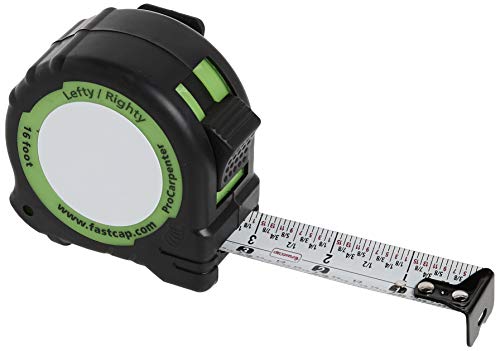
FastCap PSSR16 ProCarpenter Lefty/Righty (16 ft)
Numbers run in both directions along the blade, which suits left handed marking and tight inside measurements. An erasable pad on the case holds a cut list, and a built in sharpener keeps a carpenter pencil working. Plastic housing points this at bench work rather than nail bag abuse.
Pros
- Printed fractions cut mental arithmetic
- Cut list stays written on the tool
- Reads correctly approached from either side
Cons
- Plastic case takes drops worse than metal
- Notepad surface dulls under heavy marking

Komelon SL2816 Self-Lock Tape Measure (16 ft)
Blade holds position the moment you stop pulling, with no thumb pressure involved. Press the release and it retracts, which frees a hand on a ladder or above a door head. Grit reaches the mechanism over time, so self locking tapes wear faster than a plain lever.
Pros
- Holds a reading with no thumb on the lock
- Suits overhead and ladder measuring
- Rubber grip stays usable in work gloves
Cons
- Sawdust builds up in the locking mechanism
- Retract button wants a deliberate press

eTape16 Digital Tape Measure
An LCD shows the measurement outright, removing the fraction misreads behind most bad cuts. Memory stores figures so a cut list can be transferred back at the bench. Once the AAA cell dies, the printed blade still works, just without the screen.
Pros
- Digits remove fraction confusion under pressure
- Stores readings for later transfer
- Switches between imperial and metric
Cons
- Screen and memory stop when the cell dies
- Case sits chunkier than a plain tape

Crescent Lufkin Shockforce Nite Eye Tape Measure (16 ft)
High contrast printing stays legible in crawl spaces, attics and unlit basements. Shock absorbing housing targets repeat drops from ladder height onto joists. Blade stiffness spans a standard doorway with nobody holding the far end.
Pros
- Numbers read clearly in poor light
- Housing designed around repeated drops
- Stiff blade for a 16 foot compact
Cons
- Bright finish shows scuffs quickly
- Heavier to carry than a 12 foot tape
What matters most
What to look for in a compact tape measure Compact describes the case, not just the blade length. Most pocket models run 12 or 16 feet, and case width tracks blade width almost exactly. Wider blades reach further unsupported, then fill a front pocket. Check the hook next, since a loose rivet there is the usual reason readings drift by a sixteenth. Some hook movement is deliberate and matches the hook thickness, so inside and outside measurements both read true.
How far should the blade stand out? Standout is the distance a blade extends before it folds under its own weight. Half inch blades like the PowerLock buckle within a few feet, which is fine at a bench and awkward across a bedroom. FatMax and the Milwaukee compact hold much further because their blades are wider and more deeply curved. Anyone who measures alone should treat standout as the deciding spec. For a tape that lives in a kitchen drawer, it barely registers.
Best for woodworking and cut lists Shop work rewards clear fractions more than raw reach. FastCap PSSR16 prints to a sixteenth in both directions, which speeds marking from the far side of a board. eTape16 removes the arithmetic entirely by displaying the number, useful on repeat cuts where one misread fraction wastes stock. Neither housing is built for concrete drops, so keep both on the bench. Where the same tape also goes to site, the Milwaukee coated blade is the safer buy.
Job site durability: hooks, coatings and springs Blades die at the first two inches, where printing rubs off against brick and slab edges. Nylon coatings on the Milwaukee and Stanley models delay that wear. Hooks bend when dragged over corners, and a bent hook skews every measurement in the same direction. Verify yours against a known dimension now and then. Return springs are the other failure point, and letting a blade snap home at full speed shortens their life faster than anything else.
Compared at a glance
| # | Model | Blade length | Best for | Score | Price |
|---|---|---|---|---|---|
| 1 | Milwaukee 48-22-6616 Compact Tape Measure (16 ft) | 16 ft | Best overall | 9.4 | Check price |
| 2 | Stanley FatMax 33-716 Tape Measure (16 ft) | 16 ft | Best value | 9.2 | Check price |
| 3 | Stanley PowerLock 33-312 Tape Measure (12 ft) | 12 ft | Best budget | 9.0 | Check price |
| 4 | FastCap PSSR16 ProCarpenter Lefty/Righty (16 ft) | 16 ft | Best for woodworking | 8.8 | Check price |
| 5 | Komelon SL2816 Self-Lock Tape Measure (16 ft) | 16 ft | Best for one handed work | 8.6 | Check price |
| 6 | eTape16 Digital Tape Measure | 16 ft | Best for digital readout | 8.4 | Check price |
| 7 | Crescent Lufkin Shockforce Nite Eye Tape Measure (16 ft) | 16 ft | Best for dim work areas | 8.0 | Check price |
Questions worth asking
What size tape measure is best for everyday carry?
Sixteen feet handles nearly all household and finish work while still fitting a pocket. Drop to 12 feet when weight matters most. Step up to 25 feet only for long framing runs and room diagonals.
Why does the hook on a tape measure move?
That play is engineered in. It shifts by exactly the hook thickness so inside and outside readings both come out true. A hook that flops loosely or sits visibly bent is a different fault and will skew every measurement.
Is a wider blade always better?
No. Width buys standout and costs pocket space and weight. For shelving, furniture and interior work, a narrow 12 foot tape carries easier and measures just as accurately.
Can a compact tape measure replace a 25 foot tape?
For cabinetry, finish carpentry and most home projects, yes. Framing, roof runs and long diagonals still need the longer blade, which is why many tradespeople carry one of each.
Which compact tape measure is best for woodworking?
FastCap PSSR16 fits the shop, thanks to dual direction printing, fractions to a sixteenth and a notepad for cut lists. eTape16 helps anyone who misreads fractions when working quickly.
Do digital tape measures still work without a battery?
Yes, as an ordinary tape. Blade, hook and printed scale behave normally. Only the LCD and the stored measurements go dark when the AAA cell runs flat.
How do you stop a tape measure blade from breaking?
Guide the blade back with a thumb rather than letting it snap home. Cracks usually start at the hook rivets after repeated high speed returns. Grit pulled into the case accelerates the same damage.
What does a self locking tape measure do?
It grips the blade at whatever length you pull, then releases only when you press the retract button. Komelon SL2816 works this way, which frees a hand for overhead and ladder measurements.
Milwaukee 48-22-6616 vs Stanley FatMax 33-716: which should you buy?
Both run 16 feet, so the split is width against bulk. Milwaukee keeps a one inch blade and a slimmer case for all day carry. FatMax uses 1.25 inches for more standout, at the cost of pocket room and weight.
Are compact tape measures accurate enough for cabinetry?
Yes, provided the hook is straight and the blade is not kinked. Most error comes from a damaged hook or reading the wrong fraction mark, not from the shorter blade length.
The verdict
Milwaukee 48-22-6616 takes the recommendation for daily carry, balancing usable standout against a case that still drops into a pocket. Choose Stanley FatMax 33-716 instead if you measure alone across wide spans and accept the extra bulk on a belt. A drawer tape for household jobs needs nothing more than the 12 foot PowerLock, while anyone marking fractions all day gets more from the FastCap.
Jake Monroe
Jake worked as a residential contractor for over a decade before shifting to full-time writing. He evaluates power tools, hand tools and workshop gear through the lens of someone who has actually used them on job sites, not just read the box.


