Compact Pipe Fittings That Fit in Tight Stud Bays
SharkBite U008LFA Push-to-Connect Coupling suits most repairs, joining copper, PEX and CPVC with no tool. SharkBite U248LFA Elbow turns a line where a straight run cannot fit. Uponor ProPEX EP Coupling keeps a full bore on PEX-a systems.
SharkBite U008LFA Push-to-Connect Coupling is the fitting most home repairs want, because copper, PEX, CPVC and PE-RT all seat in one brass body with no torch. Clearance is its limit. Roughly an inch of clean straight pipe has to be free before the fitting will seat fully.
Listings rarely publish installed length, so a fitting that looks compact on a bench can still jam between studs. Material rules add another trap, since some jurisdictions restrict concealed push fittings. We compared published pressure and temperature ratings, body materials, supported pipe types, required insertion depth and tool dependencies, then weighed plumber and owner feedback on leaks and reuse.
How to pick the right one
What to look for in a compact pipe fitting Start with pipe material, because copper, PEX-a, PEX-b and CPVC each accept different joints. Printed pressure and temperature ratings come next. Hot supply lines sit near 140 F for years, while a cold line never does. On potable water, look for lead free brass or an NSF listed polymer. Measure the clear pipe around the joint before ordering, since insertion depth often approaches an inch. Decide last whether the joint should stay removable or go permanent.
Push-to-connect vs crimp, press and expansion Speed is where push fittings win, and no tool is needed at two in the morning. Crimp rings cost least per joint but demand calibrated jaws. Commercial copper leans on press, since nothing burns and nothing has to dry. Cold expansion is the long horizon option for PEX-a, with no rubber in the joint at all. One leak means buy push fittings. Fifty joints means buy a tool and let it pay for itself.
Best fittings for tight spaces under sinks and behind panels Under a vanity, body length hurts more than diameter. Short couplings and elbows hold the run near the wall and leave room for a P-trap. Acetal fittings in 1/4 in handle icemaker and filter tubing where a brass body will not turn. Behind drywall, plan an access panel so the next owner can reach the joint. Pencil the insertion depth onto the pipe, then check that mark after pushing to confirm full seating.
Code limits, removal and the mistakes that cause leaks Concealment rules vary by county, so ask the building department before closing up a wall. Burrs cause most failures, because a sharp edge shreds the O-ring during insertion. Deburr and gauge every cut, copper especially. Removal takes a disconnect clip or tongs pressed against the release collar while the pipe pulls straight out. Skip reuse on anything pulled from a sediment heavy line, since grit scores the sealing face.
The shortlist, ranked

SharkBite U008LFA Push-to-Connect Coupling
One body accepts copper, PEX, CPVC and PE-RT in any combination, so a single coupling handles mixed-material repairs. Installation runs cut, deburr, mark depth, push. Lead free DZR brass resists dezincification where water runs aggressive.
Pros
- Seats without a torch, solder or crimp jaw
- Joins copper to PEX at a single joint
- Comes back off with a disconnect clip
Cons
- Wants about an inch of clean straight pipe
- Per joint cost sits above crimp or solder

SharkBite U248LFA Push-to-Connect 90 Degree Elbow
Corners inside a cabinet defeat straight couplings. A short 90 degree body turns the line close to the wall, leaving clearance for a stop valve and a trap. Brass construction and pipe compatibility match the U008LFA coupling.
Pros
- Tight turn radius suits shallow vanity bays
- Rotates for alignment until the line is pressurised
- Keeps open flame away from cabinet wood
Cons
- Every turn adds flow resistance to the branch
- Outside diameter runs wider than a sweat elbow

SUNGATOR Push-to-Connect Fittings Assortment
Repiping a bathroom burns through couplings, elbows and tees in roughly equal numbers, and a mixed box covers all three shapes. Lead free brass bodies pair stainless grip rings with EPDM O-rings. Both 1/2 in and 3/4 in fittings ship together, which saves a trip when one line steps up.
Pros
- Per fitting cost drops against buying singles
- Three joint shapes arrive in one box
- Standard disconnect tongs release them
Cons
- Odd sizes often sit unused afterwards
- Inspectors recognise the SharkBite name more readily

EFIELD Push-Fit Brass Tee
Branching a line for an icemaker or bidet calls for one tee, not a bulk pack. EFIELD keeps its lead free brass tees short, and every port takes copper, PEX or CPVC. Grip rings bite on insertion, so the pipe holds itself while you work the next joint.
Pros
- Cheap enough for a single branch tap
- Short body clears studs on 16 in centres
- Each port accepts a different pipe type
Cons
- Owners report finish quality varying by batch
- Size range stops well short of major brands

John Guest Speedfit Push-Fit Coupling
Fridge lines, reverse osmosis units and espresso plumbing run on 1/4 in and 3/8 in tubing, where a brass body is overkill. Acetal copolymer weighs almost nothing and tucks into the gap behind an appliance. A collet lock clip blocks accidental release when someone knocks the tube.
Pros
- Footprint small enough to hide behind a fridge
- Collet releases under finger pressure alone
- Carries NSF certification for potable water
Cons
- Rated for cold supply only, never hot lines
- Acetal body can crack if forced into a valve
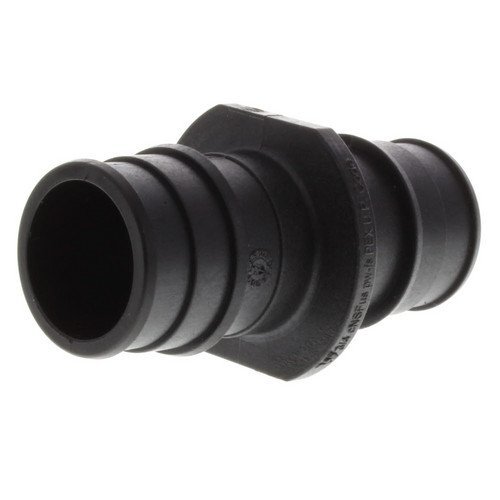
Uponor ProPEX EP Coupling
Cold expansion works backwards from a push fitting: pipe and ring stretch over the body, then shrink onto it. Nothing rubber sits inside the joint, so no seal hardens over thirty years. A ProPEX expander is mandatory, which rules the method out for a one off repair.
Pros
- No elastomer seal ageing inside the connection
- Polymer body tolerates aggressive water chemistry
- Grip tightens as the pipe rebounds
Cons
- Expander tool is a real upfront purchase
- PEX-a only, so PEX-b and copper are out

NIBCO PC600 Press Coupling
Where flame is banned, occupied buildings and shallow crawl spaces included, press is the copper trade standard. Jaws compress the wrought copper fitting onto the tube and an EPDM O-ring seals it permanently. Each joint finishes in seconds once the tool is charged.
Pros
- Works with no open flame near framing
- Joint times measured in seconds, not minutes
- Needs less clearance than a torch and solder
Cons
- Press tool pays back only at trade volume
- Finished joint cannot be reopened
How they stack up
| # | Model | Size | Best for | Score | Price |
|---|---|---|---|---|---|
| 1 | SharkBite U008LFA Push-to-Connect Coupling | 1/2 in | Best overall | 9.4 | Check price |
| 2 | SharkBite U248LFA Push-to-Connect 90 Degree Elbow | 1/2 in | Best for tight corners | 9.1 | Check price |
| 3 | SUNGATOR Push-to-Connect Fittings Assortment | 1/2 in and 3/4 in | Best value multipack | 8.8 | Check price |
| 4 | EFIELD Push-Fit Brass Tee | 1/2 in | Best budget branch fitting | 8.6 | Check price |
| 5 | John Guest Speedfit Push-Fit Coupling | 1/4 in and 3/8 in | Best for small tubing lines | 8.4 | Check price |
| 6 | Uponor ProPEX EP Coupling | PEX-a only | Best for PEX-a systems | 8.2 | Check price |
| 7 | NIBCO PC600 Press Coupling | Copper tube | Best for professional press installs | 8.0 | Check price |
Good to know
Can you put push-to-connect fittings inside a wall?
Manufacturers rate them for concealed use, though local code has the final say. Many inspectors still want an access panel at the joint. Ask your building department before drywall goes back up.
How long do SharkBite fittings last?
SharkBite publishes a 25 year warranty for fittings installed to instructions on approved pipe. Failures owners describe usually trace to burrs or partial insertion. Sediment heavy water shortens O-ring life.
Are push-to-connect fittings reusable?
Yes, once a disconnect clip frees them, provided the new pipe is clean and deburred. Check the O-ring for cuts or trapped grit first. Discard the fitting if the old pipe was scored or corroded.
What size pipe fitting do I need for a bathroom sink?
Bathroom supply stubs are usually 1/2 in copper or PEX. Kitchen branches and main runs often step up to 3/4 in. Measure the outside diameter of the pipe rather than working back from the faucet connection.
Do push fittings join PEX and copper at the same joint?
They do, and that is their main advantage during a repair. Crimp, press and expansion fittings stay material specific. One coupling can therefore patch a failed copper section with PEX.
Push fitting vs press fitting: which is better in tight spaces?
Push fittings need no tool clearance, so cramped bays favour them. Press jaws require room to open and close around the body. Given an open joist bay and a press tool on site, press finishes faster and costs less per joint.
Is a special tool needed to remove a push fit coupling?
A plastic disconnect clip or metal tongs sized to the pipe handles it. Both press the release collar so the pipe slides free. Speedfit style collets need only finger pressure.
Do compact fittings reduce water flow or pressure?
Inside diameter narrows slightly at each body, so many joints on a long run can shave pressure. One or two fittings on a branch make no noticeable difference. Expansion fittings hold a fuller bore where flow really matters.
Which compact fittings are best for a fridge water line?
Acetal push fittings in 1/4 in suit icemaker and filter tubing. Brass bodies are heavy and hard to turn in that gap. Keep those plastic fittings on cold lines only.
Our take
Buy the SharkBite U008LFA for a leak that has to stop tonight, since it bridges almost any pipe material without a tool and pulls back off if the alignment is wrong. Add the U248LFA elbow when the run turns inside a cabinet. Anyone repiping a whole house should skip push fittings and put the money into a ProPEX expander or a press tool, because per joint savings compound across fifty connections.
Jake Monroe
Jake worked as a residential contractor for over a decade before shifting to full-time writing. He evaluates power tools, hand tools and workshop gear through the lens of someone who has actually used them on job sites, not just read the box.